• There has been a recent cluster of spammers accessing BARFer accounts and posting spam. To safeguard your account, please consider changing your password. It would be even better to take the additional step of enabling 2 Factor Authentication (2FA) on your BARF account. Read more here.

Tube frames - WHY?

Starshooter10

Bane of your Existence!
Joined
Apr 7, 2008
Location
Vallejo
Moto(s)
current ride: 2002 ZX-7R
Name
~Vince
okay lets keep this a FACTUAL no bull shit thread (on barf.... I MUST be high!)

so, back in the ages of carbs and oil injection we had steel frames, okay easy/cheap to work with and strong.

then in the late 80s AL frames came along I assume out technology finally allowed a lighter/more ridgid frame

yet duc aprillia and a few other still use tube frames (even buells where all tubers untill recently)

and now im hearing that he tube frames are lighter by almsot 20 lbs?!?

somebody please explain this to me :|

pros and cons of both...

ready...
set...
GO!
 
Trellis frames look cooler and the weight difference doesn't mean much to street riders.

The SV650 frame was reported to be just 7-8 lbs. so I'm not sure they are lighter.
 
while most people are ignorent about how things really work I dont think they would move to AL trellis frames just because the looked cooler :p

and holy shit balls! sub 10 lbs?! that cant be right!
 
Tube frames make more sense for small-volume production; tooling up for stamped or cast sections is very expensive, and won't pay off unless you're building a lot of units. Sometimes the look of a tube frame is thought to be marketable, even in a frame that actually has a ot of castings...the Honda Superhawk, for instance.

--Scot
 
Even the ultra-expensive Ducati Desmo had a trellis tube frame.

146_0704_10_z+art_science+ducati_desmosedici_frame.jpg
 
One difference is that a cast frame simply supports the engine. The trellis frame uses the engine itself as a structural member.

But truthfully, effective as they are, I do think the trellis frame is getting too expensive to produce, and is basically old school technology. For Ducati, the trellis frame is such a big part of their image, they are afraid to drop it completely. That is why the new Monsters have a hybred frame, with a cast rear and a trellis front.

So it is also there for marketing reasons. But I did read that the next generation Ducati superbikes that will replace the 1198 will not have a trellis frame.
 
Last edited:
metal frames are soooooooo last century. all the cool kids are gonna have carbon fiber frames
 
One difference is that a cast frame simply supports the engine. The trellis frame uses the engine itself as a structural member.

I'd be a little careful about that generalization. Certainly there have been tube frames were the engine was not a stressed member (Norton Commandos come immediately to mind, but I'm sure there are others), and there are cast/formed frames where it is a stressed member (e.g. oilhead BMWs). I know of no reason why your claim would have to be true.
 
That's exactly right Flyin Hun. Another example like the Norton Commando...Buell.

Mine had the frame made of straight tubes (like a Ducati frame) and the engine sat in rubber mounts and in the movement directions confines of Heim Joints. That was Erik Buells contribution to Harley back before he set out on his own (the first time) when he designed the FXR frame.

I stood right next to a Harley salesman, as he was trying to sell a Buell to a customer. A salesman that had limited Sponsorship road racing his Gixxr.

He told the prospective customer, the Buell had a stress member mounting to the engine with the frame.

I had to turn and walk away.

As far as the question on this thread...I won't touch it. It involves too much.
 
OKay.. which motorcycles came with a hinge in the frame? :laughing

The Honda GL500... the BMW R100GSPD?
 
OKay.. which motorcycles came with a hinge in the frame? :laughing

The Honda GL500... the BMW R100GSPD?

GT750, H1, H2, and so on..... :laughing
 
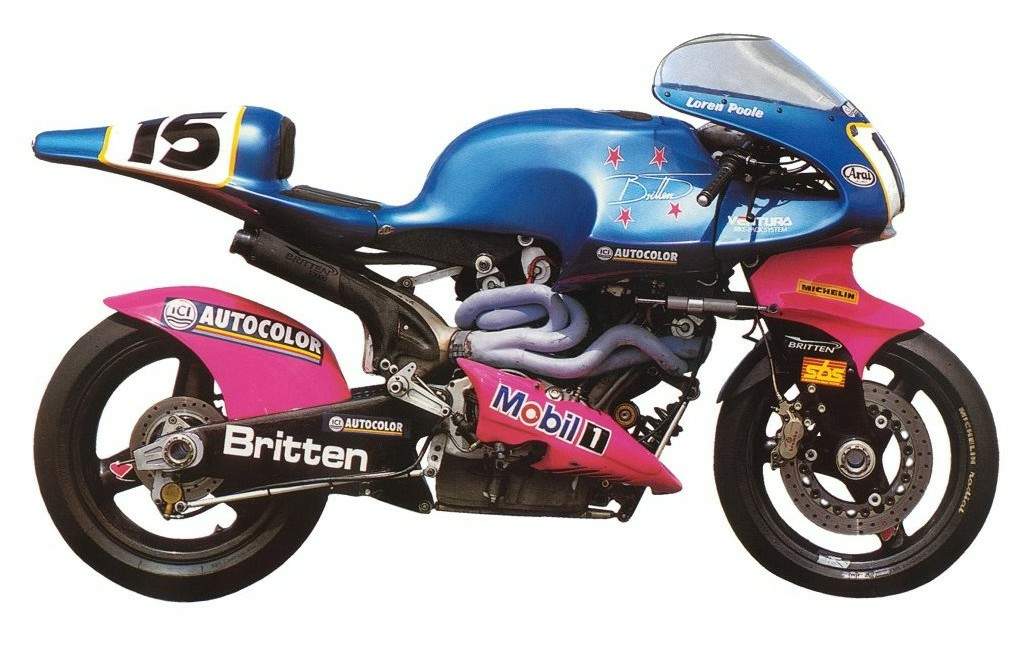
we're all still waiting for the technology to come out and catch up to a frameless bike, made in someone's shed, back in 1991

Britten%20V1000-1995.jpg
 
The Britten isn't frameless. It's a beautiful example of engine as a stressed member, and sub frames and swing arm, attached to the engine/transmission casting.
 
Last edited:
I think a good part of the explanation for the frame differences are in the design of the motor itself. When both Japan and Italy moved away from the single backbone frame in search of more rigidity, Japan was in a position to make completely new motors and hang them however they wanted. Ducati wasn't in a position to make a whole new motor and went with a design that gave similar structural rigidity, but allowed the use of the old motor design. And Bimota was already there, with a proven birdcage frame design...
 
One difference is that a cast frame simply supports the engine. The trellis frame uses the engine itself as a structural member.

...

to further agree with flyinghun, this is almost NEVER true. every motorcycle frame/engine package ive seen has solid motor mounts. because the two are rigidly connected, the engine will always add some stiffness to the package, limiting its displacement under all conditions. if a engine has rubber motor mounts, then yes... itd only support the engine.

as for any justification for trellis frames... id say that they are def easier to engineer. the software used for analyzing the stiffness of tubes welded together is a bit simpler than for castings. though, if u can use one... the other isnt out of reach by any means.
 
Last edited:
That's exactly right Flyin Hun. Another example like the Norton Commando...Buell.

Mine had the frame made of straight tubes (like a Ducati frame) and the engine sat in rubber mounts and in the movement directions confines of Heim Joints. That was Erik Buells contribution to Harley back before he set out on his own (the first time) when he designed the FXR frame.

I stood right next to a Harley salesman, as he was trying to sell a Buell to a customer. A salesman that had limited Sponsorship road racing his Gixxr.

He told the prospective customer, the Buell had a stress member mounting to the engine with the frame.

I had to turn and walk away.

wait
i've read some shocking things on barf... but you used to ride harley?

As far as the question on this thread...I won't touch it. It involves too much.

troof

but i will say this: OP it's a dance between engineering/manufacturing, accounting, product design, and marketing. the last three usually gang up on the first one....

6990.strip.gif
 
At equal weight a high tensile steel and an aluminum frame have the same strength but the aluminum frame would be stiffer. Remember that's at equal weight. The higher stiffness with less deflection would still only amount to a few thousands of an inch. The bottom line is that they can be very comparable and the design details would be more important than what the basic structure is made out of.
Both designs have merit. Aluminum is more expensive but easier to machine. So basically, it's a push. A marketing decision may override the engineering requirements in this case.
 
Cast aluminum or chromoly tubing, which is better ?

Neither, and both.

Same answer for most questions about "which technology is better".

The question is; "What is the application and what resources do you have ?"


To elaborate....

"why do we still use pistons, when turbine engines have so many benefits ? "
 
Simply put: You can cast an alu frame a lot cheaper than weld a chro moly one.
 
Back
Top