• There has been a recent cluster of spammers accessing BARFer accounts and posting spam. To safeguard your account, please consider changing your password. It would be even better to take the additional step of enabling 2 Factor Authentication (2FA) on your BARF account. Read more here.

Help with leak down test - can't stop leak

Mario

Active member
Joined
Dec 20, 2015
Location
San Jose, CA
Moto(s)
Track and dirty ones
Hi all, first time rebuilding a two stroke engine, 2009 KTM 200 XCW, 70hrs on engine. Got new gaskets, put everything together following the manual instructions, perform leak down test and found 3 leaks:

1) slave clutch cylinder gasket,
2) clutch cover gasket (the big one, not the small clutch cover),
3) cylinder base gasket

I disassembled everything (but the cylinder head) to fix #1 and #2, cleaned the surfaces, lightly sanded with 1500 grit on a wooden block to remove any imperfections (did not change surface finish), greased gasket and reassembled. Testing again, I get the exact same leaks in the same places.

Any suggestions on what I an do? I can think of testing with oil in the engine, hoping that oil might seal those leaks (??). Next I can think of is gasket sealant but don't see why I would need to use this if I do a good job with the surface preparation.

Regarding cylinder head, the leak is minimal, very tiny bubbles. I am using a double gasket as instructed per manual. I expect seal might not be tight and will get sealed once exposed to two stroke oil? I torqued the cylinder nuts per manual torque.

Thanks!

PS: leak is around 5psi drop in 10 seconds

PPXtL5k.png
 
Last edited:
If it is coming out of the gasket seam... and everything is clean like you say, I would be looking at warpage someplace or a small crack.

But look at where the leak is in regards to the airflow into the engine.

Does the intake charge run through the gearbox and clutch to lube that part of the engine? Usually there is a separate chamber for the crankshaft where the inlet air charge comes through an another chamber for the gearbox that has oil in it for lubing the gearbox and clutch. Admittedly, I do not know that engine but on all the Yamaha and Honda 2-strokes I have worked on, that is how they are built.

That said, if air injected into the sparkplug was leaking out through the gearbox... that means the main crank seals are leaking which is very bad from an operating 2-stroke perspective because the gearbox oil will be sucked into the crankshaft area and cause mixture issues.
 
How much pressure are you inducing into the motor to do your the leak down test? Shouldn't be more than 8 psi max. Can you take a picture of the leak down tester you made and how you are using it?

If its losing 5 psi in 10 seconds, that's a major fail. Do not run this motor until you can diagnose where the leak is.

I ask these questions as I don't think you understand how the two stroke leak down test works and where it's supposed to hold air, vs just oil, based on what you have done thus far.

If the test is being done correctly, the only way air would leak from any of the external side cover gaskets be it the clutch cover or slave, is if the wet side main seal is leaking or potentially the center case gasket.

Take your side covers off, dry side which is the stator cover and the entire right side cover off. Retest and I will bet your leak is on the right side main seal.

For the leak down test you are testing/looking for leaks from either main seal, the center case mating seam around the crank case, the cylinder to case mating surface, head, and intake boot. Anywhere air/fuel are mixed and combusted.

Its not to check mating surfaces that only hold oil. If air is present there, then you need to be looking at the main seals.

Re your cylinder base and head gaskets, they should be holding air pressure. No, they won't improve by running them and exposing them to premix.
 
Last edited:
Thanks for the clarification. I did not know if the clutch chamber should be under pressure or not. I changed all of the seals in this engine, so surprised to see it leak still. I'll remove both covers and check all the inner seals. To your other question, using a hand pump to go to 5-6psi. I cannot hear any hissing. All pressure is lost in about 10 seconds.
 
Hard to see here, but I see the fuel charge enters the intake via reed into crank chamber and don't see any seal other than the crank seals. I'll look through pictures to get a better understanding before I take it apart again

MjYZ6oP.png
 
Well... there you go. Leak on right crank seal, not through the shaft/rubber seal but through the seal metal body and seal housing. I am guessing I damaged it when pressing it in. I will have to take the entire thing apart again. There goes stonyford on the two stroke...

2EzOgms.png
 
:thumbup boom, as suspected. Your wet side (right) crank seal.

BTW, nice MP two stroke tester, its a really good tool.

No need to tear your motor down again to replace the wet side seal. They can be removed and replaced without tearing the motor down. Very few two stroke dirtbikes do other than the KDX and a few other older model Kawasakis that I am aware of. Search/read some threads over on thumpertalk.

You can use some sheet metal screws and or small picks on the inner lip to get the old one out. I usually have better luck with the latter. Just take your time and be careful to not scratch or gouge the case when doing so. Install your seal with a film of oil on the outer and inner lips. OEM is my preference for seals.

Then retest and report back if there are still other leaks.

I'm not a pro mechanic, but I have rebuilt a lot of two strokes over the years. Just a word of caution. I would almost never use a sanding block, even with ultra fine 1500 grit paper on a case mating cover. Its easier to add an imperfection than take out using that method for most of us amateurs.

To remove old gasket material, use only a plastic putty knife and some solvent of your choice. For anything really stubborn, some green scotch brite at most. Never a metal putty knife or screw drivers. Cases are very soft and easy to damage.

Just my opinion and experience. You will have this back together before Stonybard. :ride
 
Thank you again! I will try to replace it without splitting the engine. I will also test the other side too, don't want to find out I messed that one too.

I wish my tester was a Motion Pro... I am using the hose from a MP 4S leak down tester, the rest is home depot stuff: pipe plugs, gas pipe pressure gauge for leak testing, bunch of adapters and lots of pipe dope. Amazingly this contraption does not leak :teeth

Ordering parts now, hopefully I can make it before the Stonyford date :ride
 
One more update, I didn't pay attention to the order and the installed seal that is leaking is the old model and shows as superseded. I wonder if this is what went wrong. Or I just need to learn to press the damn thing straight... :afm199

GsELmVn.png
 
Thank you again! I will try to replace it without splitting the engine. I will also test the other side too, don't want to find out I messed that one too.

I wish my tester was a Motion Pro... I am using the hose from a MP 4S leak down tester, the rest is home depot stuff: pipe plugs, gas pipe pressure gauge for leak testing, bunch of adapters and lots of pipe dope. Amazingly this contraption does not leak :teeth

Ordering parts now, hopefully I can make it before the Stonyford date :ride

I have to admit I didnt look very closely to your pictures, just saw the Motion Pro and assumed a MP two stroke leak down tester. Looking back at this today, you need to introduce the air pressure via the intake boot. I don't know the science behind the two stroke method, but that is how all two strokes testers are set up and procedures written. Wish I could explain why, but I can't.

My tester, the MP 2 stroke tester, every DIY one I have seen, and all instructions online introduce the pressure for 2 stroke tester through the intake boot.

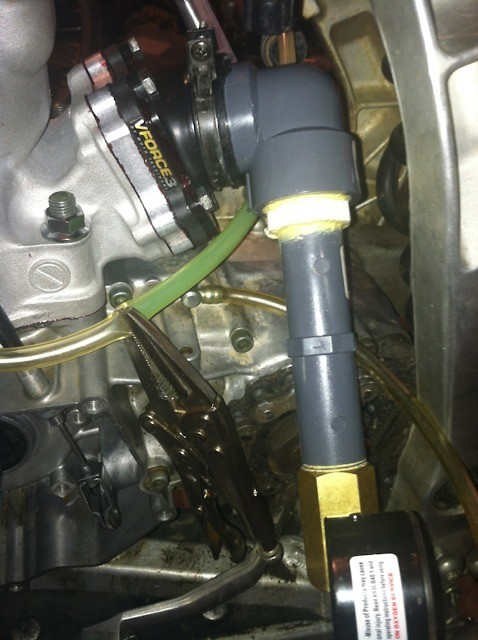
Like my home made one here. The white PVC fiiting is inserted into the intake boot has a flexible tube to my gauge with a shraeder valve.

attachment.php


Others just used fixed pvc piping no hose like this

Leakdown2.jpg


or this

s1200_9B8DD7D3_3664_4DC4_818D_879DF1D7B7A1.jpg


s1200_1D5BCD07_FCD5_45C0_AB82_97D5753192ED.jpg
 
If the piston is at bdc as it should be, no difference between spark plug and intake for pressure.
 
That's what I figured too and why I did it through the spark plug. Maybe the only reason why to test through intake is that reeds block back pressure, so you are not testing the entire intake (boot, one of the reed assembly gaskets, etc.)
 
Hmmmm...... maybe. I wonder if reeds are truly airtight when they are closed. Designed to stop air/gas mixture from flowing back towards carb. :dunno

Your solution is certainly more elegant looking than my steam punk tool. :laughing
 
Last edited:
So I was able to make a hook tool and pull the seal easily. Examining the area that had the leak, I found these marks. I am pretty certain I made them myself prying the old seal out with a screwdriver. I don't know how else these marks can be done. How effed am I? Is there a solution that doesn't involve getting a new engine?

vYQBPdT.png
 
What an idiot I am... I cannot believe I made such a stupid mistake. I remember making a seal puller tool but I guess I wasn't paying attention and decided to pry it out with a screwdriver.... what a dumbass!!!

Something positive, I bought the seal that supersedes the seal that I installed and it is about 0.1mm larger in diameter (45.02 vs 45.12). The old seal came out with no effort. All I can think of is lightly polish with very fine grit sandpaper, install the seal and test. If it still leaks, I can order new engine cases for just $800....

Edit: found in KTM-Talk suggestion of fine grit sanding plus application of loctite 515. Any other wisdom appreciated.

KkGsvIc.png
 
Last edited:
Ah shiet.... that sucks. I'd certainly try to clean up the cases to seal before resorting to replacing, but no idea how. Never done that.

Hopefully someone has a good suggestion that has been tried and proven to work (also check KTM talk and Thumpertalk.)

I'm just guessing, but maybe yamabond would be enough to seal it and hold. I use it between my case halves to seal up any potential imperfections on two stroke motors (KTM uses a gasket I believe.) :dunno

I remember there being a material folks use to repair a case where the bearing has spun. Again, just guessing. (edit I think thats the locktite 515 you read about.)

Please update what you find and how you repair. Surely others have done the same and found a repair.
 
Last edited:
I'd go with yamabond or toyotaseal, loctite is kinda committed.
 
I don't think those scratches are deep enough to worry about. Just put a little sealer {not silicone} on the seal edges. Easy to check for leaks again before reassembly since the seal is already exposed. If it leaks, your only out a seal.
 
Back
Top