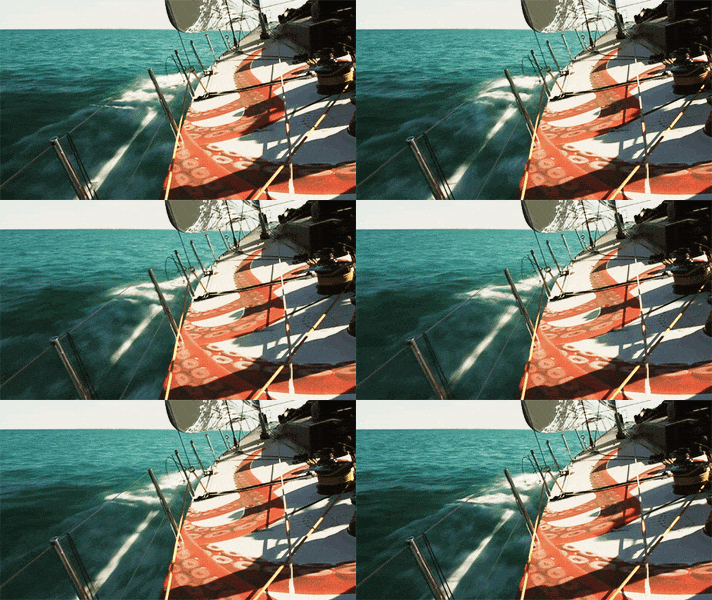
Breaking masts - not so much, snapping BOOMS - yeah - you have to put a mechanical "fuse" or weak link into the system* or when you or the autopilot fucks up due to a sudden windshift or freak wave and you wander beyond dead downwind onto the other gybe ( what happened here) or you just stuff the end of the boom into a big ol' wave then you can easily snap the boom ( the spar at the bottom of mainsail that the guy is sitting against)
Is it okay to sit/stand against the boom ?
Sure, we often put a crew man there (hand holding out the boom on small boats, body on it on larger ones) in SOME conditions (moderate to lighter wind and some lumpy swell that has the main pumping unproductively) - the person on boom duty just has to know that if the helmsman wanders off course ( in relation to the boat angle to the wind ) then it's GONNA gybe the boom and you have to get clear, quick.
The remedy here is to 'heat it up' a little bit - or, to sail an angle a bit closer to the wind. For instance: If sailing directly before the wind is referred to as sailing 180 degrees from true wind ( a point of sail called a dead run, or DDW for dead-downwind) then you would actually be very well advised to sail at 165-170 degrees to keep this from happening.
Problem with THAT is the angle-to-the-wind thing gets rather subtle as you sail those deep angles because your own speed away from the wind makes feeling the direction harder and the skipper can easily get 'caught out' by a even a minute shift in wind direction if he gets a bit off course...and...BLAMMO !
See - when you TACK ( bow passes through the eye of the wind ) the sails all shake ( luff ) and make noise but they hinge on the attached LEADING edges (at the mast and forestay) and when you GYBE ( inadvertently or otherwise ) the STERN of the boat crosses the wind's axis - and the trailing edge now has to also pass through the direction of the wind and it ISN'T the pivot-point so you can get a big door-slamming effect ( high yield of potential energy) - than can injure or flick a man overboard.
In the 'olden days' of conscripting crews out of bars and Shangai'ing them into service this was referred to as "paying them off with the boom" - a well-timed gybe can really cut down of crew salary expenses.
* the System I'm referring to here is a Preventer system - essentially a line running from the boom led forward, pulling the boom forward against the pull of the main-sheet ( line that trims or pulls the mainsail in to control its angle to the boat ) - these are used most commonly on boats sailing for long periods (hours or days or even weeks sometimes) downwind in steady winds on passages - useful for maintaining speed and keeping the boom and mainsail from bouncing around in swells, but a bit of lighter line should be put into the thing somewhere to allow it to break before something more expensive and harder to fix does in case of an unplanned gybe - which CAN happen, even to very good sailors in some conditions.
Sorry. Yeah, I sail a bit...