

seavoyage
grunt n00b
What's in your wallet? Drivers License, CapitalOne Credit Card, Triple-A and AMA membership cards + GPS enabled Smartphone?
I'm a minimalist but you need to be able to do the following tasks in the middle of nowhere:
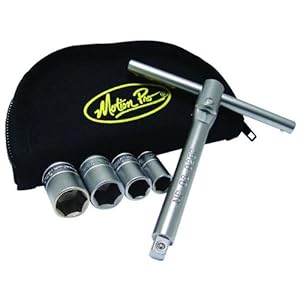
1. Fix a flat tire: (3 tire irons, a small MotionPro T-6 trail bead buddy, valve core removal tool (caps on each valve + spare valve core), hand bicycle pump (I use a Mini Versair) , a few Co2 cartridges, small tire pressure gauge, talcum powder (optional), 21" tire tube which can also be used on the rear. Small patch kit ($2 at bicycle shop). Combination wrench to remove both axle nuts and spark plug. Tusk has this wrench for $11.
 Small T-handle socket set for the front axle retaining bolts, and the brake caliper mounting bolts. A 12mm or 13mm spanner to loosen the rear axle adjustment block nuts.
2. Clear a drowned engine: Spark plug wrench (14mm), spare sparkplug(s) pre-gapped. The abilit to flip the bike over so the spark plug holes and exhaust can drain while your kicking over or turning the the crankshaft (E-start).
3. Get a tow: Tow strap (a single ratchet strap is more useful for me)

4. Siphon fuel: 6' Plastic tubing with I.D. that matches the fuel petcock bung. You plug into the other bikes' petcock, then blow into his gas cap vent hose into gas tank to start the flow into your tank, vacuum and gravity does the rest.
5. Seal a cracked side case or punctured radiator: JB weld, Quicksteel, or Metal putty.
6. Repair a broken chain: 520 chain links with master links, and small chain breaker tool.
7. Replace a broken clutch or throttle cable: Spare clutch cable. You can also use a bicycle brake cable which can be used for the throttle or clutch. (Taped parallel to the existing cables.)
8. Repair a punctured hose: Ductape (wrapped around wrenches), electric tape (wrapped around wrenches), , hose clamp (around hose).
9. Secure anything that may fall off. Loctite (blue/red) everything, carry cable ties (duct taped to front forks or swing arm), safety wire (wound around seat subframe tube). Safety wire your drain plug, steering nut, caliper retaining bolts, handgrips, and throttle housing adjustment nut.
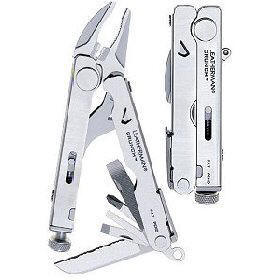
A basic multi-tool: Leatherman Crunch (with a vice grip which can be used as a shift lever)
and a MotionPro Tool Metric The 8mm, 10mm and 12mm sockets (or whatever sizes) to get the sidepanels, fuel tank, and seats off to access everything .
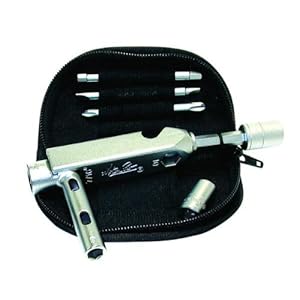
Everything fits in a Moose Racing Fender bag which stays on the bike at all times. The moment you remove it from the bike, you'll forget it!
Survival kit: (Stays on your body at all times) The moment it isn't in your riding jacket/pants pockets, or fanny pack; you'll forget it!
3L Water (Camelback "Hydrate or Die!")) + purification tablets or waterpurifier.
Leave a route map in your vehicle and with friends/family before each trip. USCG call this a 'float plan'. On that topic hope your 'estate' is in order: Will, Power of Attorney and 'Blood Chit'.
+1 on shoes! you may have to walk out
+1 on no hard objects on your body.
The little bandaid/neosporin/aspirin First Aid kits won't save you. You won't die from a splinter, paper cut or blister but, if you go into shock, bleed out, or have a major fracture...The only 'first aid' items that are critical are:
Display your blood type and any allergies in a location on your clothing where it can be clearly seen: Strip of ductape on chest/right upper arm; dogtags; helmet; tatoo (we call these meat tags).
I don't recommend traveling alone... use the buddy system, just like evey other professional organization (SCUBA, Military, Outward Bound). Since you got a buddy, cross load... you only need one of the heavy stuff between the two or more of you.
From ADVrider: http://advrider.com/forums/showthread.php?t=776989
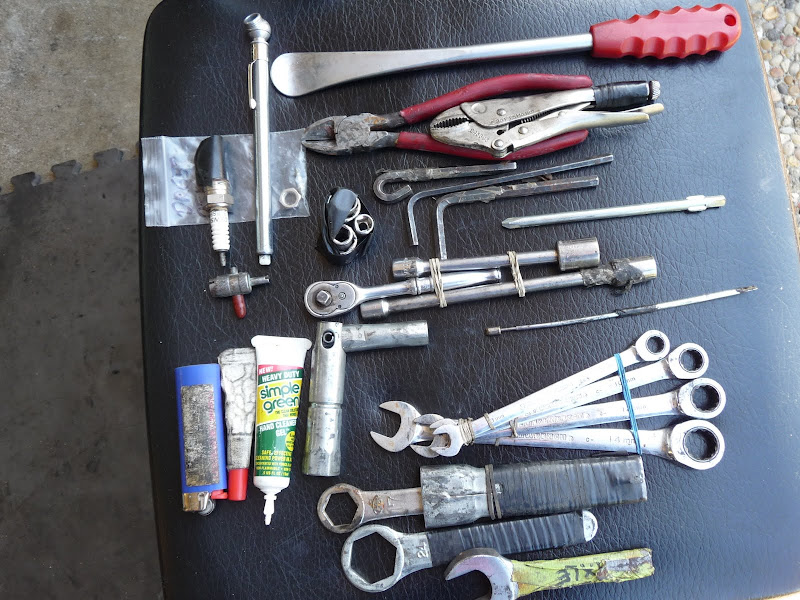
Short range 2 to 4 day kit. Most ALL fits in stock tool tube.[/QUOTE]
I'm a minimalist but you need to be able to do the following tasks in the middle of nowhere:
1. Fix a flat tire: (3 tire irons, a small MotionPro T-6 trail bead buddy, valve core removal tool (caps on each valve + spare valve core), hand bicycle pump (I use a Mini Versair) , a few Co2 cartridges, small tire pressure gauge, talcum powder (optional), 21" tire tube which can also be used on the rear. Small patch kit ($2 at bicycle shop). Combination wrench to remove both axle nuts and spark plug. Tusk has this wrench for $11.
2. Clear a drowned engine: Spark plug wrench (14mm), spare sparkplug(s) pre-gapped. The abilit to flip the bike over so the spark plug holes and exhaust can drain while your kicking over or turning the the crankshaft (E-start).
3. Get a tow: Tow strap (a single ratchet strap is more useful for me)
4. Siphon fuel: 6' Plastic tubing with I.D. that matches the fuel petcock bung. You plug into the other bikes' petcock, then blow into his gas cap vent hose into gas tank to start the flow into your tank, vacuum and gravity does the rest.
5. Seal a cracked side case or punctured radiator: JB weld, Quicksteel, or Metal putty.
6. Repair a broken chain: 520 chain links with master links, and small chain breaker tool.
7. Replace a broken clutch or throttle cable: Spare clutch cable. You can also use a bicycle brake cable which can be used for the throttle or clutch. (Taped parallel to the existing cables.)
8. Repair a punctured hose: Ductape (wrapped around wrenches), electric tape (wrapped around wrenches), , hose clamp (around hose).
9. Secure anything that may fall off. Loctite (blue/red) everything, carry cable ties (duct taped to front forks or swing arm), safety wire (wound around seat subframe tube). Safety wire your drain plug, steering nut, caliper retaining bolts, handgrips, and throttle housing adjustment nut.
A basic multi-tool: Leatherman Crunch (with a vice grip which can be used as a shift lever)
and a MotionPro Tool Metric The 8mm, 10mm and 12mm sockets (or whatever sizes) to get the sidepanels, fuel tank, and seats off to access everything .
Everything fits in a Moose Racing Fender bag which stays on the bike at all times. The moment you remove it from the bike, you'll forget it!
Survival kit: (Stays on your body at all times) The moment it isn't in your riding jacket/pants pockets, or fanny pack; you'll forget it!
- SPOT or EPIRB Personal Locator Beacon (PLB)
- Emergency blanket
- Plastic (bright colored) poncho/emergency bivvy (SOL?)
- Magnesium fire starter
- Compass (on your watch) or handheld GPS.
- Whistle and signal mirror (Coghlan's 5-in-1 survival tool : $3)
- Condom (no lube, no flavor) - to carry or store water...
3L Water (Camelback "Hydrate or Die!")) + purification tablets or waterpurifier.
Leave a route map in your vehicle and with friends/family before each trip. USCG call this a 'float plan'. On that topic hope your 'estate' is in order: Will, Power of Attorney and 'Blood Chit'.
+1 on shoes! you may have to walk out
+1 on no hard objects on your body.
The little bandaid/neosporin/aspirin First Aid kits won't save you. You won't die from a splinter, paper cut or blister but, if you go into shock, bleed out, or have a major fracture...The only 'first aid' items that are critical are:
- A nasopharangeal airway to keep airway open (No.. it's for the other guy. Good luck keeping your own airway open)
- 2 windlass tourniquets and Quickclot to keep from bleeding out (read compound fracture, impaled object, or large laceration)
- Sam Splint to stabilize a fracture (can also use your tire irons and duct tape) or a C-collar. I place the Sam Splint for support in a fanny pack to make it a kidney belt.
- Emergency blanket (for shock, hypothermia, exposure)
- Bandanna/Cravat (bandage, sponge)
Display your blood type and any allergies in a location on your clothing where it can be clearly seen: Strip of ductape on chest/right upper arm; dogtags; helmet; tatoo (we call these meat tags).
I don't recommend traveling alone... use the buddy system, just like evey other professional organization (SCUBA, Military, Outward Bound). Since you got a buddy, cross load... you only need one of the heavy stuff between the two or more of you.
From ADVrider: http://advrider.com/forums/showthread.php?t=776989
I never carry anything hard on my body, so never a fanny pack or back pack with tools. A camel back with water is good, for hydration and offers a little back protection too.
This is my ADV touring kit, but if on a short ride, just the stuff in the tool roll, and in a fender bag-tubes, levers, patch kit.

1) gloves,2) tire levers and axle nut tool,3) tire pump, 4) rope, 5) front wheel bearings, 6) oil filter and o-rings, 7) nuts/bolts/fuses, 8) two chain links, 9) spoke wrench & front axle nut tool, 10) patch kit, 11) wire ties, 12) electrical tape,
13) tool roll, misc, allen wrenches, combination wrenches, sockets, pliers, air gauge, test light, crescent wrench, screw driver bits, carb jets
14) Sven 15" saw and sheath, 15) wire, 16) 1/4" T wrench w/ bailing wire wraped, 17) chain tool, 18) hammer and epoxy, 19) jumper cables, 20) throttle and clutch cable, 21) coil, 22) front brake pads, 23) spark plug, 14T counter shaft sprocket, 24) 30mm counter shaft socket, and extension/adapters, 25) foot levers
Not pictured are the front and rear inner tubes, small cans of chain lube and air filter oil, and 1st aid kit
Tools are bike and even ride specific for me. The best way to figure out what you need is to do your maintenance at home with your trail tool kit. You figure out pretty fast what to keep, what needs to be upgraded and what can be tossed.
I have my LC4 down to just the tools that will fit in the stock tool kit. I add a fender or enduro bag as needed. If it is going to be a long ride in tough conditions I carry a Wolfman enduro bag for extra tools and spares on the rack plus a fender bag of tire stuff on the front.
On my MXC all the tools I need will fit in the fender bag along my with my tire stuff and spare tubes. One of the joys of riding orange, especially two stroke orange, is that most of the fasteners are the same size so a couple of KTM tools are almost all you need.
But I agree with One Less Harley about how to carry them. I never strap anything to my body that I don't want smashed into it. That is why I have the enduro and fender bags. I don't want my tools on my body when I crash.
My tool kits are too KTM specific to bother posting. But this is my tool kit tire stuff minus the spare tubes, pump and two more levers in my fender bag. It is enough to get me home but still packs very small with everything in the pouch except the lever and axle wrench. I have learned to not travel without flat repair capapbility.

The reason I posted here despite the other billion or so tool kit threads is that the OP said "basic". To me, that says what goes in the bike kit rather than what can I carry in my enduro bag. Since I was fooling around in the garage this morning gathering up tools from my MXC toolkit following a motor R&R, I took a couple of pics. BTW, I really do practice what I preach and did as much as practical on my MXC with my KTM tool kit. It helps that KTM tools are actually pretty nice compared to the crap that came with my Yamahas and Honda.
Anyway, this is my everyday LC4E kit that is always on the bike. I get off easy here because nearly every fastener on a KTM is an 8mm hex head with a couple of 10's and 13's. An LC4E also has a little subframe hung toolkit just like most Japanese dual sports making this at least somewhat relevant. And almost everything you see fits in that stock tool kit. The second picture shows it really fits in the tool kit. The KTM combo axle wrench/preload spanner and tire lever are too long for the kit so they go under the saet along with the inflation/patch kit.
What might not be instantly recognizable are the black pouch and spare plug taped inside the socket. The black pouch holds the little bit driver you see with flat and phillips head bits plus a hex bit that fits my spark arrestor. Those wads of tape are a few feet of rolled duct and vinyl tape plus some safety wire, a few zip ties and a spare master link. That is all I carry for basic everyday riding and it can handle pretty much anything I am likely to attempt. I add a fender pack with front and rear tubes, irons, pump and spare shifter for extended rides or rock fests.
Having my tool kit well sorted plus only carrying a shifter and master link for spares frees up my rack with Wolfman enduro bag for carrying anything else I might want to have along.


My MXC is a street legal race bike that adds a tool carrying wrinkle in that it has very little subframe and no tool kit plus I refuse to carry tools on my body. But it also reduces complexity because it is a two stroke race bike without a whole lot of crap you are likely to break. So for it I just carry my fender pack with a tool kit I put together just for it. The fender pack you see mounted also has a front tube since it will work at either end and the inflation kit. It all fits nicely in the fender pack and doesn't get in my way.


A few of my thoughts....
The repair/tool kit and the survival kit are two very separate concepts for me. First Aid and a map and compass falls in with the survival kit, and both of these go everywhere with me when I'm in the backcountry. My dad drilled it into my head that you never know when you're going to wander off watching a deer, or be sucked away from camp by the good fishing, or just get caught out by mother nature.
These days I rely on my GPS, I've gotten into the habit of always keeping good tracks, marking camp, the truck, and major intersections (which is mostly useful for future rides). But I still have a map which I use all the time, and a compass, which doesn't get used but is always there.
I often ride solo, and many times have been over 50 miles from my truck, and my truck is much further than that from outside help. In this situation I'm prepared for a serious mechanical breakdown and the forced walk out (although no spare footware, I've always figured I could make it out in my moto boots, although I know this would be extremely uncomfortable). I have lots of hours on my WR426, I feel comfortable that it's reliable, I meticulously maintain it (for a trail bike), and I take it easy and minimize my risk taking when my exposure to a serious incident (most incidents could be serious in this situation) is high.
THe moto toolkit is very bike specific for me, while the repair and rescue items are the same I'd carry with most trail bikes. Here it is with the toolkit on the right and my survival kit on the left:

This picture is missing a number of CO2 cartidges, I usually carry around 6 (and use them all the time, either on mine or on others' bikes, you always use them... as many as you've got). Also I usually carry a sm roll of 1" gorilla tape as well.
This is the combo packed away. I run my tools in a moose front fender bag, and I carry the survival kit in a small backpack with a camelbak, map, rain shell, first aid kit, and an insulation layer (usually a down vest stuffed very small). The GPS and map stay where I can get to them easily.

The bag and tools take a beating after the mile wear on. I use the cutoff of jean leg to wrap the tools in order to protect the bag. And lots of duct tape.


What are your thoughts on a spare tube versus a patch kit?
Nice tool kits and comments!
Patch kits vs. Tubes:
IMHO ... carry BOTH! I learned years ago on long Baja rides with 12 or 15 other maniacs to carry extra tubes and never take the time to do a patch on the trail unless you are out of tubes ... and enjoy riding through the Desert in the dark.
Fix the flat using new tube ... making certain all the cactus, nails or whatever ... are cleaned out of the tire. Hang onto the old tube if repairable (MC Tubes are Gold in Baja). Fix the tube later at the Motel over a beer. Some tubes are non natural rubber ... Buytl ... and will not easily accept a patch. The good news is that in Mexico the Llantero shops can patch ... anything! I never carry CO-2 Cartridges ... Bicycle pump never runs out, mounts on bike out of way, about 8 oz.
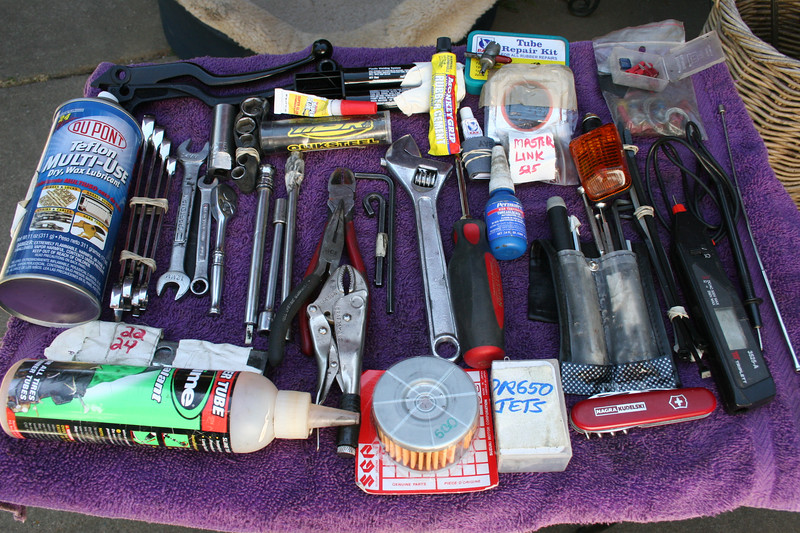
Long Range tool kit from 4 years ago. It's changed a bit since ... This is the "out of country" kit. Not shown are tire irons. Most tools fit in stock DR650
plastic tool holder.
Full report here:
http://bikerdave.blogspot.ca/2007/04/chance-favours-well-prepared.html
Basically, it's whatever I can fit in the standard tool-pouch, tire levers strapped to the down-tube, a patch kit, air pump strapped to the handlebars, and a survival kit to keep me alive overnight if it comes down to it.
One other tip is to carry lengths of tape/wire wrapped around your tools instead of full rolls. Replace as they get ratty or used.
I'm actually trying to figure out a bead-breaker that I can carry as well. Something that incorporates the tire levers has handles. The MT-21s I like to run are really hard to get off the bead and last time I had a flat, there was no one around to lean their kickstand on the tire to help. I ended up just riding it home, pumping it up about a dozen times in the process. Not entirely fun and I was very surprised to learn just how many gas stations have out-of-order air compressors. Just my luck,
David...
I have used mine in south Idaho to have the bike towed after a serious tire blowout on the freeway about midnight. Worked great as it was only a 25 mile tow. Now I carry Good Sams with unlimited miles.
Don't make them any lighter but it does make them smaller. I put them in a plastic bag with talc, shake to get them coated, and then vacuum seal. I vacuum seal a number of things that may not be used at all or if they are it is a one time use, freeze dried food (becomes much smaller), my water pump kit (lube the shaft and seals, along with the gasket and ring it goes into one nice little packet with nothing lost).


Maybe haven't read every post above very carefully but an item I consider essential is a multimeter and I make copies of the electrical diagrams and put them in the meter pouch. This is an old photo with stuff I carry for my VTX, you can see the meter and diagram. I think legal bikes have just as many electrical problems as mechanical. I've certainly used it on mine and others bikes. Also carry little alligator jumper leads that can be used for things like bypassing switches and connecting meter leads.

Short range 2 to 4 day kit. Most ALL fits in stock tool tube.[/QUOTE]
Last edited:


