• There has been a recent cluster of spammers accessing BARFer accounts and posting spam. To safeguard your account, please consider changing your password. It would be even better to take the additional step of enabling 2 Factor Authentication (2FA) on your BARF account. Read more here.

Fish tailing/Tank slapping?

Juubi

New member
Joined
May 6, 2009
Location
San Francisco
Moto(s)
gsxr
Today I was riding home and there was a car accident. i was a few cars back of a 1 lane that merges into a 2 lane street. It was around a bank so I didnt notice the accident in till the last minute. When I noticed it I hit the front and rear brakes hard (and held the clutch down even tho I know I shouldnt have) and my bike's rear tire start swing back and forth. My handle bar also was swinging back and forth (possibility with the rear). Since it was 1 lane where I was at all the cars stopped so I did the same. I looked at the trail of tire marks I made so thats how I know my rear was swinging too. I might of ran over some oil from the accident but I dont know forsure its a bit foggy. I didnt crash and I know its "crash analysis" but I want to know what ur suppose to do when ur front and rear are whipping around. What I did was hit the front and rear hard and held down the clutch while trying to hold the handle bars straight. Im sure what I did wasnt 100% correct but luckily I wasnt going that fast.
 
Also I had to stop no matter what since there were cars infront of me so I couldnt ride it out. Braking is a must in my situation but I want to know how to brake correctly and how to keep the handle bars/rear tires from swinging like that.
 
You probably locked up the rear tire, which would cause both fish tailing and tank slapping. I suggest you practice braking using the rear brake LIGHTLY if at all. Practice emergency stops and particularly practice NOT slamming the brakes on but increasing the pressure gradually. Even if it is an emergency, take a second to brake. It can save your life.
 
So obviously you got sideways with the rear... but why?

When you get on the brakes, the entire weight of the bike and rider is shifted forward onto the front tire. This actually gives the front tire more traction. While that's happening, weight is being taken off of the rear tire... this reduces the amount of traction for the rear tire.

So, the harder you brake with the front, the less you can brake with the rear. In situations where you REALLY need to stop, the rear brake only accounts for like 1% of your actual stopping power. During these so called "panic" stops, it is very likely that you will lock up the rear wheel as you discovered. This is bad, because it diverts attention away from using the front brake effectively. The best thing to do is to practice stopping with the front brake only. The front brake is the one that will get you stopped, and being extremely effective with the front brake is MUCH better than being semi-effective with both brakes.

The back brake is still useful, though, and I would never tell anyone to forget about it. It's really useful when you want to control the speed and attitude of the bike while making tight maneuvers at slow speeds, and it's also great when you have to stop or start while traveling up hill. But when it comes to getting the bike stopped, it's all about the front brake. Each has its purpose.
 
Oh BTW just a general tip, try to keep your body weight off the handlebars at all times. You can put pressure on the bars to steer, but don't rest your body weight on them. Use your legs, abs, and lower back muscles to brace yourself and keep your arms totally loose and relaxed. The handlebars are controls, and they react to every input you give them, so you should only use them for steering, not for supporting your body. You wouldn't rest your foot on the rear brake would you? (rhetorical question... the answer is NO! :))

But I'm not just saying that because I'm a technique Nazi. It's especially important to keep your weight off the bars when you're braking hard, because one of the dangers is when the front tire loses traction. If you have weight on one side of the bars when the front lets go, the handlebars will turn freely and you will fall right over. But if you have your weight OFF the bars when the front tire lets go, you might have more time to save it. Another problem is when the front starts to wobble. If you're holding on too tight, the wobble will transfer up your arms, down your back, through your butt and straight to the rest of the bike, causing a minor oscillation in the front forks to turn into a massive tank slapper. If you stay loose on the bars, the forks will wobble for a second and then usually the wobble will fade away. In general, most bikes tend to handle much better when you don't rest your body weight on the bars.
 
Last edited:
Why it happened: rear slide (I've been experimenting w/ inducing these at speed w/ a quick hard jab to the rear brake, and that's exactly what happens)

How to counter it: Go loose, don't do anything. If just the tail is sliding, gently back off gas. If just the front is wobbling, gently roll on the gas.

How to not do it in the first place: it was caused either by too much rear brake, jerky/un-smooth braking, or too much braking while leaning (if you was leaning)
 
Last edited:
How to counter it: Go loose, don't do anything. If just the tail is sliding, gently back off gas. If just the front is wobbling, gently roll on the gas.

Or maybe just let off the rear brake so the rear wheel can spin again. And given he said he was hard on both brakes and the clutch was disengaged, rolling off the gas isn't going to do much, assuming he was even still on the throttle.

This was a simple rear lock up. Simple solution is learn not to lock the rear brake.
 
Or maybe just let off the rear brake so the rear wheel can spin again. And given he said he was hard on both brakes and the clutch was disengaged, rolling off the gas isn't going to do much, assuming he was even still on the throttle.

This was a simple rear lock up. Simple solution is learn not to lock the rear brake.

It's funny to read these threads.. Nowadays If my rear tire isn't swinging back and forth I'm not enjoying myself. I'm working on consistency. You just have to roll with it; square off the corner slightly, get in the groove of the sway... wait wait wait.. TURN!

:laughing The faster the bike the more fun it is..
 
You probably locked up the rear tire, which would cause both fish tailing and tank slapping. I suggest you practice braking using the rear brake LIGHTLY if at all. Practice emergency stops and particularly practice NOT slamming the brakes on but increasing the pressure gradually. Even if it is an emergency, take a second to brake. It can save your life.

:thumbup This :thumbup. The DMV (or whoever hands out the Motorcycle license) can't insure that you are trained for the real world, they don't have the time., and can't weed out riders that won't be able to prove they can perform the skills that are required when things go bad, in every way and shape that they will go bad.

You don't know how to determine just what your braking needs are, and how to tell your bike what to do.
Take what that "crisis" showed you, and get real...Get professional instruction and coaching (so the instructor knows your getting it).

Without the skills...it's a total crap shoot on how the next crisis goes, because you don't know what it is ahead of time, and if it more than you can get through...Your the Fatal case, making the news.
 
Only bad things happen when you use the rear brake for panic stopping. Except on a Harley, if you don't use both brakes, you never going to stop. At least that what it seemed like to me. Anywho, the front brake is the only one I use, other than a few exceptions, like stopped on a hill. And don't ever give up on the brakes. Feel the innitial bite, squeeze them down, and try to steer away from the obstacle. As long as you don't lock up your front, you should have some ability to control your direction. And pay attention to what is in front of you, and around you, at all times, and you'll lessen the amount of times you have to panic stop. AND, when you come to a stop immediately check your six and make sure someone isn't about to asspack you.
 
When I noticed it I hit the front and rear brakes hard (and held the clutch down even tho I know I shouldnt have) and my bike's rear tire start swing back and forth.
There's nothing wrong with pulling in the clutch when you brake. You want the throttle out of the equation anyway. Some people have this erroneous idea that engine braking will contribute magical braking power to emergency braking-- it does NOT. Engine braking slows down your rear tire, which your rear brake is already-- obviously-- very capable of doing on its own.

The rear brake is much easier to lock than the front, and will cause the bike to fishtail. It's good that you kept the bike upright, and were able to come to a stop when you needed to-- letting off of the rear brake too quickly when the rear locks can cause a highside, and braking with the front too hard while the bike is fishtailing can cause it to flop over, and you avoided both of those options successfully. (last time I locked the rear I achieved option B: The Flopping, and still have the bruises to show for it) You also didn't nail the front too hard and pull a superman. That's awesome.

Practice braking in empty parking lots. Until you really have good control of both brakes you're not going to be able to use both at once for truly optimal braking, so start out concentrating on the front for heavy braking, and be really gentle with the rear if you use it at all.

What do you do in the event of fish slapping
You know, that was my first thought when I saw the thread title, too!
 
Last edited:
So you should apply maximum braking force to the front tire for an effective stop, enough to unload the back wheel and place 99 percent of the bike's weight on a dime-sized contact patch? And that gives you the best stopping distance?

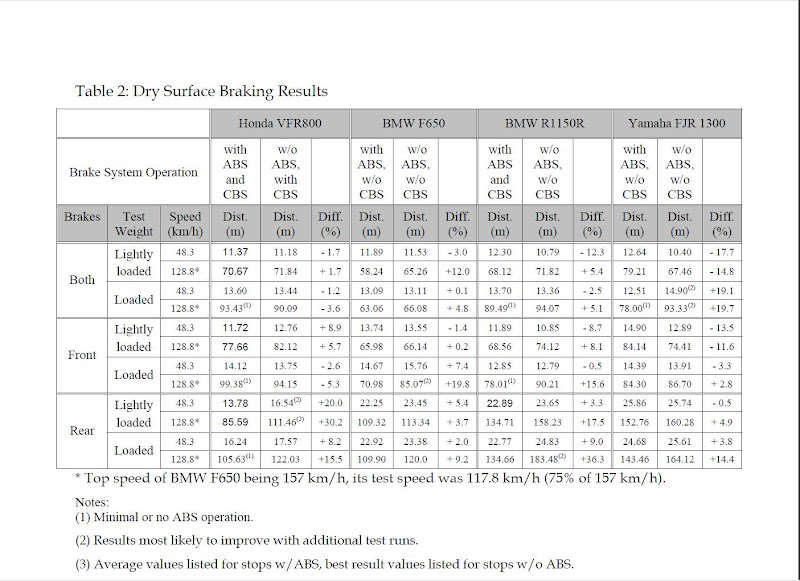
Can a front-braking-only advocate explain to me why having just one tire available for braking traction is better than two? If this is true, why have manufacturers like Honda spent so much time and money developing linked brakes? Systems that stop better than non-linked systems? And why, when professional riders practice maximum braking, do they use both brakes? Do you have data to back up your claims? If you don't, why are you telling a novice rider something that may be opinion or conjecture like it's gospel?

I found at least two tests of motorcycle braking that indicated the best stops, to varying degrees, used both front and rear brakes. I can't find any information that shows a rider will achieve a shorter stopping distance or generate more Gs using front alone.

But I could be wrong. You could be, too.


From an MSF study:

braking%20results.jpg


http://mfes.com/motorcyclebraking.html
http://www.msf-usa.org/imsc/proceedings/a-Green-ComparisonofStoppingDistance.pdf
 
So you should apply maximum braking force to the front tire for an effective stop, enough to unload the back wheel and place 99 percent of the bike's weight on a dime-sized contact patch? And that gives you the best stopping distance?

Can a front-braking-only advocate explain to me why having just one tire available for braking traction is better than two?

Sure. It's because when you are hard on the front brakes on a sportbike the rear is so unweighted that the envelope within which you can effectively use that limited rear traction is so small that the risk of locking up outweighs the benefit of any additional traction. And the survey you quote was one study done years ago, presenting the best times achieved using very experienced testers doing a controlled condition drill over and over and over. IMO, it has no relevance to the real world once in a year, out of nowhere, panic braking situation the average rider finds them in. I believe one of our resident track school instructors commented previously how these findings were exactly counter to what they saw running braking drills at their school, i.e., that the average rider stopped quicker using the front alone.

The other comment I'd make is the idea that use the rear first to settle the chassis then the front, is a joke. In that second where you've eschewed the front brake you've travelled so far that any distance you saved by rear braking is gone. The best spend of the average rider's attention is getting on the front brake immediately, progressively and firmly.

I totally agree that an uber skilled rider that's practiced using both brakes on their bike for a long period of time could probably eke out a few extra feet of braking distance. But the average rider doesn't, isn't and can't. And the average rider sucks on their front brakes as well. IMO the right approach is to suggest they focus on improving their front braking to a very high level first, where they're going to get the most bang for their buck and have a bigger margin for error, and then work on the rear brake.

And even more importantly, learn to control speed with the throttle so you rarely even have to touch your brakes to stop. Anyone who's ridden a B or C group at a track day knows that the average rider uses their brakes way too much and often incorrectly.
 
So you think the physics of a wheel spinning at very high speed regaining traction is the same as a locked wheel regaining traction?

It's similar enough to possibly result in a highside in both situations! I'll let you do the actual testing. Let me know what you find out.

Sure. It's because when you are hard on the front brakes on a sportbike the rear is so unweighted that the envelope within which you can effectively use that limited rear traction is so small that the risk of locking up outweighs the benefit of any additional traction. And the survey you quote was one study done years ago, presenting the best times achieved using very experienced testers doing a controlled condition drill over and over and over. IMO, it has no relevance to the real world once in a year, out of nowhere, panic braking situation the average rider finds them in. I believe one of our resident track school instructors commented previously how these findings were exactly counter to what they saw running braking drills at their school, i.e., that the average rider stopped quicker using the front alone.

The other comment I'd make is the idea that use the rear first to settle the chassis then the front, is a joke. In that second where you've eschewed the front brake you've travelled so far that any distance you saved by rear braking is gone. The best spend of the average rider's attention is getting on the front brake immediately, progressively and firmly.

I totally agree that an uber skilled rider that's practiced using both brakes on their bike for a long period of time could probably eke out a few extra feet of braking distance. But the average rider doesn't, isn't and can't. And the average rider sucks on their front brakes as well. IMO the right approach is to suggest they focus on improving their front braking to a very high level first, where they're going to get the most bang for their buck and have a bigger margin for error, and then work on the rear brake.

And even more importantly, learn to control speed with the throttle so you rarely even have to touch your brakes to stop. Anyone who's ridden a B or C group at a track day knows that the average rider uses their brakes way too much and often incorrectly.

Yay! More anecdotal evidence. I'll go with the evidence from actual controlled testing. And we're not talking about using brakes on the racetrack: we're talking about how to get new riders to stop as quickly and safely as possible.

The only way to settle this would be to measure stopping distances on a sportbike from a certain speed, and compare front brake only to front and rear. You'd probably have to rig a switch on the rear brake to turn it on and off so the rider wouldn't know if it was working or not. My hypothesis is that using both brakes will deliver better stopping distances. Yours is that it will result in worse stopping distances.

Remember that even if the rear tire is locked, it will still slow the bike. It shouldn't HURT, so long as the rider keeps the brake applied. And I don't know what all the applying the rear brake first stuff is all about. I don't know who advocated that. It doesn't sound like a good idea.

Also, attacking that study--and are you saying there are no other studies that show using both brakes is more effective than just one?--proves nothing, because the testers consistently got better results with both brakes under the same conditions.

And I don't know who you've been learning racetrack riding from, but not using your brakes is a sure way to be a slow-ass rider, forever.
 
Back
Top