• There has been a recent cluster of spammers accessing BARFer accounts and posting spam. To safeguard your account, please consider changing your password. It would be even better to take the additional step of enabling 2 Factor Authentication (2FA) on your BARF account. Read more here.

Front wheel axle spacers: tolerance

auntiebling

megalomaniacal troglodyte
Super Moderator
Joined
Apr 27, 2004
Location
atop the parapet
Moto(s)
.
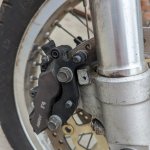
I'm working on a long term project that involves mating a set of forks from a cbr900rr with a wheel from a gl1000, rotors of Honda origin and some nissin calipers... Anyway. The spacers of course are custom and I'm wondering what kind of precision I really need. At what point does pinching the wheel end of the forks together start to noticeably impact function?

Will a .050" gap be sufficiently small? Zero gap is obviously the goal
 

Attachments

  • Resize_20230402_172029_9968.jpg
    Resize_20230402_172029_9968.jpg
    78.7 KB · Views: 61
  • Resize_20230402_172030_0117.jpg
    Resize_20230402_172030_0117.jpg
    226.7 KB · Views: 58
Last edited:
I would like to know a bit more about the forks and how they clamp onto the axle. The last quite a few bikes that I've owned had one of the fork legs clamping to the axle such that you could move it back and forth a bit to line everything up perfect before tightening things. Then you would only have to get the spacer right on the other side so that the brake pads line up reasonably well and neither side of the rim or tire hits the fork legs.

Does your setup work differently than that?
 
I would say 0.050” is too large. 0.003” would be what I’d shoot for. But there are many other things you need to check. Many.
 
you could jack up the front end, remove the springs and lift up the wheel, first without tightening the axle to see if the wheel falls free when released from the top. Then tighten the axle and see if it still drops free. You can add washers or shims to fill the .050 gap and try again. You should be able to lift and drop the wheel without binding. Worth a look.
 
I would like to know a bit more about the forks and how they clamp onto the axle. The last quite a few bikes that I've owned had one of the fork legs clamping to the axle such that you could move it back and forth a bit to line everything up perfect before tightening things. Then you would only have to get the spacer right on the other side so that the brake pads line up reasonably well and neither side of the rim or tire hits the fork legs.

Does your setup work differently than that?

This. Looking at google'd photos of 900RR forks, the pinch bolt & axle setup keeps the forks aligned when assembled correctly. It's common on top-spec bikes. The spacer tolerance of the fixed side is necessary to center the wheel on the bike and the rotors in the calipers.
 
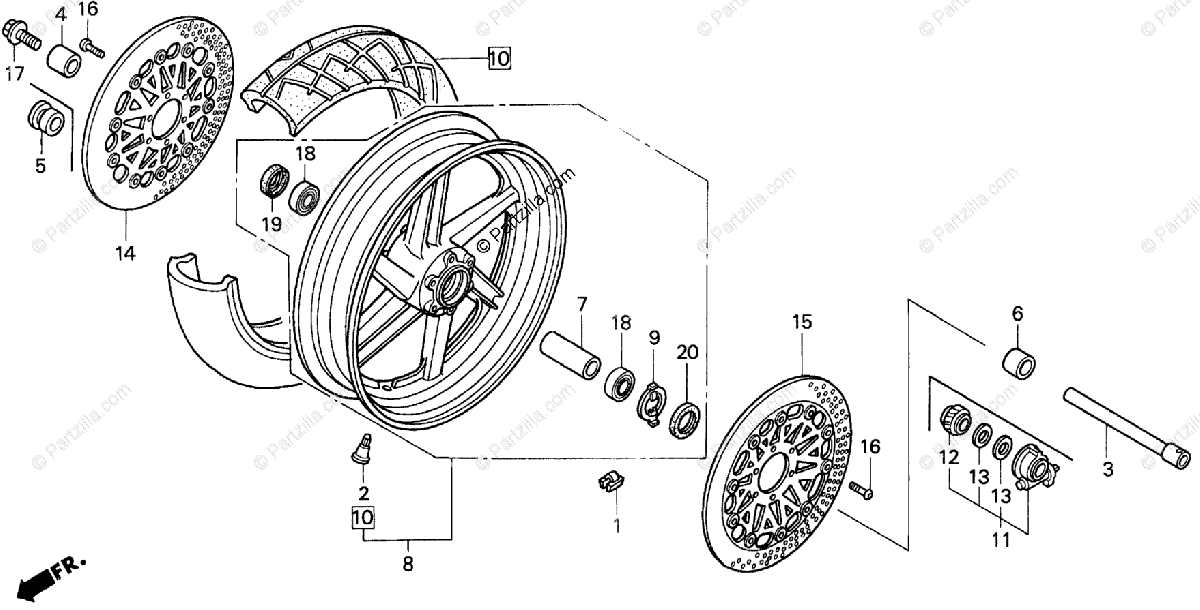
so here's the stock setup for a 1993 CBR900RR per partzilla. there is an axle (3), and a spacer (4, 6) on each side of the wheel. the axle is captured on both sides by a fork leg, left side of bike gets the large diameter, right side clamps on the smaller diameter. stangmx and scott seem to be saying this is an obsolete system and spacer 6 is inegrated into the axle leaving spacer 4 to do all the centering?

the problem here is that i've replaced everything inside of the wheel sub assembly (8) with something completely different and i've also deleted the speedometer drive assy (11)

if i had dimensions for the spacers, this would be a simple arithmetic issue but i don't have a complete 900rr front end... or if i do i don't' have the slightest clue where those spacers scampered off to :laughing

MjAzOTYxMQ-dd65c03a.png
.
 
Last edited:
stangmx and scott seem to be saying this is an obsolete system and spacer 6 is inegrated into the axle leaving spacer 4 to do all the centering?
What we want to see is how the fork legs attach to all of that. On my bikes one of the fork legs tightens up around the axle. We would like to know if that's how your fork leg attaches. Could you include a photo of the bottom of each fork leg?
 
the axle passes through both axles with pinch bolts. the larger diameter of the axle (3) on one side is captured within the end of the fork, same as the smaller diameter on the other side. i don't have pics handy, will look on the googles....
 
Last edited:
help? ebay is way better than google images for this stuff
 

Attachments

  • 900rr-forkends.jpg
    900rr-forkends.jpg
    61 KB · Views: 12
Okay, with a setup like that, usually one side has a bolt, or a flange, or something that slides in and provides a firm stop against the fork leg and the other side is sort of floating.

Is that how it seems to work for your setup?
 
it does not. The right fork leg (smaller diameter hole on the end) sets the spacing of the wheel between the legs when you tighten up the bolt (17) on the end drawing all the slop out of the spacer/wheel stackup... so i just definitively answered my own question. Zero is allowable or the assembly won't be assembled correctly

thanks for helping me think this through, i have some quality time ahead of me with some metrology equipment!
 
Last edited:
When you get it all sorted out and lined up correctly, please share a photo of the result. :cool
 
I just looked at the exact same photos on eBay where you can zoom in close. You can see these are a modern configuration where one fork leg "floats". So, the accuracy of the spacer will depend on which side it is on. On one side everything is sinched against the fork leg. The accuracy of the spacer on this side will control how close to center the wheel is held. On the other side it doesn't have any effect other than holding the floating side of the axle in position. The fork leg on that side is free to float along the axle and is tightened after everything is sinched to side with the axle bolt. So the spacer won't effect fork performance if you tighten the axle first, then the floating fork.
 
It's interesting to see that the spacers are not identical. Im glad Honda did away with that on the newer CBRs.
 
At what point does pinching the wheel end of the forks together start to noticeably impact function?

You will not know that until you remove the fork springs and FEEL the degree
of friction as the forks travel full stroke as you add more pinch... the goal with
custom spacers is less stock slop and more %100 dead nuts accurate...

My custom spacers and axle interfaced the list of parts from other
manufactures... the pay off is lower weight and butter smooth travel...

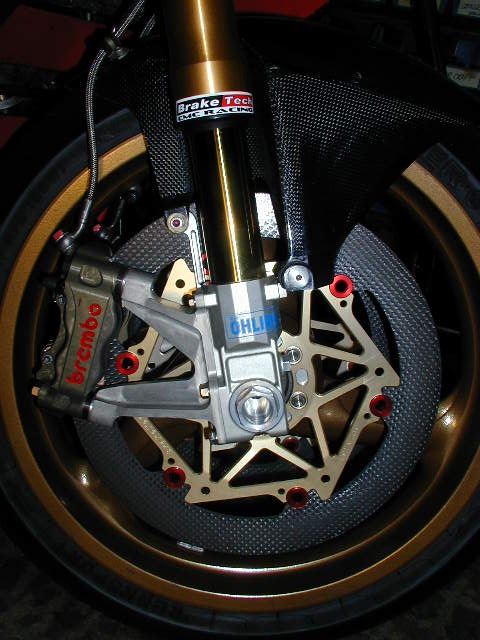
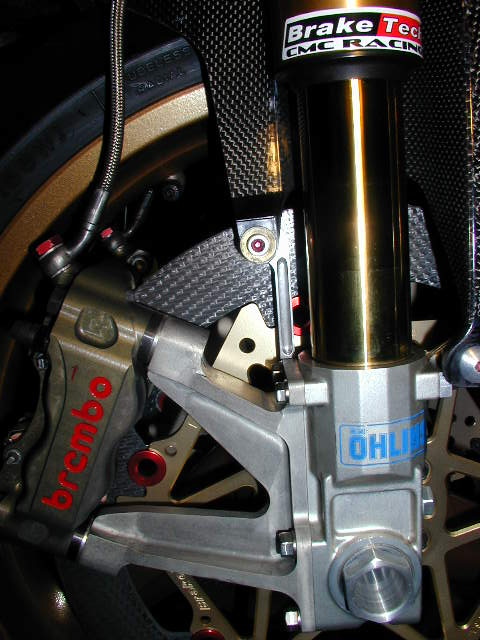
Yamaha R1 Ohlins FG310 Superbike Forks...
Suzuki GSXR1000 Brembo billet radial Front Calipers...
Ducati 1098 Ferodo Ceramic Matrix Composite Front Disc...
Ducati 1198 Panigale Simcon Ceramic Matrix Composite Rear Disc...
Yamaha TZ250 3.50x17 3 spoke magnesium Marchesini...
Custom magnesium caliper mounts...

3193188896_9d34585b46_o.jpg


3193188902_d61cb52189_o.jpg
 
Last edited:
You will not know that until you remove the fork springs and FEEL the degree
of friction as the forks travel full stroke as you add more pinch... the goal with
custom spacers is less stock slop and more %100 dead nuts accurate...

Nope. The spacer dimensional tolerance has no impact on fork alignment with the OP's forks. It's already well-explained in this thread.
 
Back
Top