• There has been a recent cluster of spammers accessing BARFer accounts and posting spam. To safeguard your account, please consider changing your password. It would be even better to take the additional step of enabling 2 Factor Authentication (2FA) on your BARF account. Read more here.

Let's talk about "smart" homes

that's super cool!:thumbup


for smart garage door sensor (any of them), if you do it I would recommend installing a camera facing the garage door for the scenario that the sensor glitches and says the door is open and the camera shows that it's closed. Avoids the corner case of you being hundreds of miles away with the garage door sensor lying to you. Or you could ask your neighbor to check...a bit pointless if you're automating so many things though lol.

I get what you're saying, but a reed switch is FAR simpler than a camera and less prone to failure. one side is a magnet, and the other side is a contact that's open when the magnet is absent, and closed when the magnet is present.

I haven't tried it, but the garage door I originally installed this on in SF can still be controlled from my phone here in NY. I don't, because I don't want to fuck with my subletters.

But I could. :devil

I get it though. We are visual creatures, and seeing that feedback of the door opening or closing fills our primal brains with confidence.
 
Tried to wire up a light switch in the garage with a motion sensor + "on" override for when I work in there.

Switch I bought has 4 wires - black/hot, white/neutral, green/ground, red/load.

Outgoing switch had only 2 wires connected - black/hot, white/neutral. Copper ground was just hanging in the box not connected.

I hooked the new one up black/black, white/white, green/copper, left red floating as it's not going to any other switches. Light came on briefly when I flipped it to "auto", then turned off after a few seconds and I can't get it to come back on. Not sure if I hooked something up wrong, burned the fuse out in the switch, or just need to adjust motion settings and sensitivity on it.
 
Tried to wire up a light switch in the garage with a motion sensor + "on" override for when I work in there.

Switch I bought has 4 wires - black/hot, white/neutral, green/ground, red/load.

Outgoing switch had only 2 wires connected - black/hot, white/neutral. Copper ground was just hanging in the box not connected.

I hooked the new one up black/black, white/white, green/copper, left red floating as it's not going to any other switches. Light came on briefly when I flipped it to "auto", then turned off after a few seconds and I can't get it to come back on. Not sure if I hooked something up wrong, burned the fuse out in the switch, or just need to adjust motion settings and sensitivity on it.

The white wire on the switch is not a neutral, it's a load carrying conductor ( bet a buck it's a romex cable.) The white should have been taped or identified with a colored mark. And your switch is almost certainly toast, instead of supplying it with a neutral and hot, you just made it into a short circuit.
 
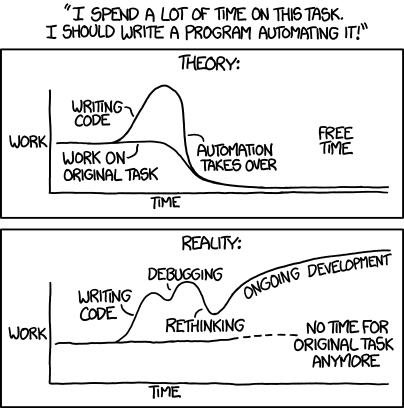
Hour 3 of automating something that takes ~1 second to do manually? :teeth
 
The white wire on the switch is not a neutral, it's a load carrying conductor ( bet a buck it's a romex cable.) The white should have been taped or identified with a colored mark. And your switch is almost certainly toast, instead of supplying it with a neutral and hot, you just made it into a short circuit.

Knew I should have DMed you first...:laughing

Hopefully it's got a fuse and didn't fry the whole thing, but at least it was cheap. White was not marked in any way - even on the outgoing switch there were no markings for + / - or anything.

Edit : for the next one (gonna rebuy the same switch if it's toast), how SHOULD it be hooked up?
 
Last edited:
I'll just leave this here....

automation.png
 
Knew I should have DMed you first...:laughing

Hopefully it's got a fuse and didn't fry the whole thing, but at least it was cheap. White was not marked in any way - even on the outgoing switch there were no markings for + / - or anything.

Edit : for the next one (gonna rebuy the same switch if it's toast), how SHOULD it be hooked up?

Wiring diagram
 
The white wire on the switch is not a neutral, it's a load carrying conductor ( bet a buck it's a romex cable.) The white should have been taped or identified with a colored mark. And your switch is almost certainly toast, instead of supplying it with a neutral and hot, you just made it into a short circuit.
Yeah, well how come? I have had neutral whites and load carrying whites. What is the difference? I recently got a slight buzz from a white wire on GFI socket I was installing because I didn't turn off the power. Surprised the heck out of me.
 
The white wire on the switch is not a neutral, it's a load carrying conductor ( bet a buck it's a romex cable.) The white should have been taped or identified with a colored mark. And your switch is almost certainly toast, instead of supplying it with a neutral and hot, you just made it into a short circuit.

Curious. According to the wiring diagram the white wire should have been connected to the white AND red. Not following how this would have destroyed the switch or done a short circuit since the prior switch was closing a circuit between the black and white.

IIRC the OP is in an older house so perhaps something is odd with the wiring? Never heard of the LCC before
 
Last edited:
Curious. According to the wiring diagram the white wire should have been connected to the white AND red. Not following how this would have destroyed the switch or done a short circuit since the prior switch was closing a circuit between the black and white.

IIRC the OP is in an older house so perhaps something is odd with the wiring? Never heard of the LCC before

Nope, the LOAD goes between the neutral and red. The switch is probably capable of carrying a 600 watt load, maybe less. The load would be the light bulb. It's a resistor and limits current flow to however many watts the bulb is rate at. Well watts divided by volts actually. But look at the diagram, the LOAD interrupts the circuit between red and white.

The prior switch was not wired correctly, the white should have been marked with colored tape. It was not a neutral. That's how romex is used as a switch leg, the black carries the power to the switch, the labeled white carries it to the LOAD. What they should have done in the diagram was use the symbol for a resistor instead of using LOAD. But half the people won't know what the symbol means.
 
Last edited:
Yeah, well how come? I have had neutral whites and load carrying whites. What is the difference? I recently got a slight buzz from a white wire on GFI socket I was installing because I didn't turn off the power. Surprised the heck out of me.

Because the neutral is also called a "Load carrying conductor." Conductor is the important part. It completes the circuit. You better believe a neutral carries current. Try popping a 250 amp neutral off a buss sometime and watch the fireworks. You can touch it all day long, as its resistance is less than your skin, if it is a neutral. However, it's still carrying a load. Stand in a puddle of water outside and touch that neutral and you may feel a buzz, you may not. Disconnect that neutral and you will get the benefit of whatever current it is carrying.
 
Last edited:
Knew I should have DMed you first...:laughing

Hopefully it's got a fuse and didn't fry the whole thing, but at least it was cheap. White was not marked in any way - even on the outgoing switch there were no markings for + / - or anything.

Edit : for the next one (gonna rebuy the same switch if it's toast), how SHOULD it be hooked up?

Your switch box has only two wires, right? Plus the green ground. One of those is hot, one is a switch leg, only hot when the switch is flipped. There is no neutral in that box, back in the day most switch boxes didn't have neutrals as they weren't used in switching, but with today's solid state devices code requires a neutral now. So that switch (the fried one) is never gonna work in that box. Neither is the one you posted the link for, it needs a neutral as well.

Back in the day, intermatic made a solid state switch that used the resistance of the lamp to provide a circuit to neutral. But I don't think they still make it. You may be stuck with just flipping the switch when you enter the garage. Or find a plug, install a surface mount box there, and use that as a power source with a neutral.
 
Last edited:
Your switch box has only two wires, right? Plus the green ground. One of those is hot, one is a switch leg, only hot when the switch is flipped. There is no neutral in that box, back in the day most switch boxes didn't have neutrals as they weren't used in switching, but with today's solid state devices code requires a neutral now. So that switch (the fried one) is never gonna work in that box. Neither is the one you posted the link for, it needs a neutral as well.

Back in the day, intermatic made a solid state switch that used the resistance of the lamp to provide a circuit to neutral. But I don't think they still make it. You may be stuck with just flipping the switch when you enter the garage. Or find a plug, install a surface mount box there, and use that as a power source with a neutral.

Any recommendation on a motion sensor capable switch that WOULD work with it then? I want to be able to pull into the garage and have the overhead lights turn on, and then automatically off after say 15 minutes. But I also want to be able to manually keep them on longer if I'm working in the garage.
 
Any recommendation on a motion sensor capable switch that WOULD work with it then? I want to be able to pull into the garage and have the overhead lights turn on, and then automatically off after say 15 minutes. But I also want to be able to manually keep them on longer if I'm working in the garage.


I don't know any that will shut off after 15 minutes, but that's not saying much, been out of the biz for over a decade. I bet there's one out there.
 
Any recommendation on a motion sensor capable switch that WOULD work with it then? I want to be able to pull into the garage and have the overhead lights turn on, and then automatically off after say 15 minutes. But I also want to be able to manually keep them on longer if I'm working in the garage.
I have this use case in my home.

Samsung(or equivalent) garage door open/close sensor. Triggers automation routine to turn on garage light switch when door opens. Same routine turns off switch after 15 minutes. Routine can also be set to turn off at a specified time after garage door is closed.

The garage door sensor can be something like a magnet based type with the two pieces mounted on the door and frame. Or you can use one that has a tilt sensor built in, mounted to the door itself.
 
Last edited:
I have this use case in my home.

Samsung(or equivalent) garage door open/close sensor. Triggers automation routine to turn on garage light switch when door opens. Same routine turns off switch after 15 minutes. Routine can also be set to turn off at a specified time after garage door is closed.

The garage door sensor can be something like a magnet based type with the two pieces mounted on the door and frame. Or you can use one that has a tilt sensor built in, mounted to the door itself.

I think the problem is that OP still needs a smart switch, although he could use one of the smart bulbs. I have a smart switch on our garage lights because I wanted to make sure they aren't left on, but the one on the overhead door opener is more than sufficient for most purposes and is on a built in motion detector.
 
Any recommendation on a motion sensor capable switch that WOULD work with it then? I want to be able to pull into the garage and have the overhead lights turn on, and then automatically off after say 15 minutes. But I also want to be able to manually keep them on longer if I'm working in the garage.

Why isn't this your generic motion sensing light switch?

When I bought my condo, first thing I did in the garage was put in a motion sensing light switch. The only nit about it was that the sensor couldn't see me at the washing machine, and it was only set for, like, 5 minutes. So, it was quite possible on rare occasions for the light to go out on me.

Do modern light switches simply not go up to 15 minutes? Or does the sensor not see you primary work space?
 
I think the problem is that OP still needs a smart switch, although he could use one of the smart bulbs. I have a smart switch on our garage lights because I wanted to make sure they aren't left on, but the one on the overhead door opener is more than sufficient for most purposes and is on a built in motion detector.
Agreed. So far we're talking about motion sensing switches and stuff like that. Old tech really. And definitely not stuff that falls into the "smart" home category.
 
Back
Top