• There has been a recent cluster of spammers accessing BARFer accounts and posting spam. To safeguard your account, please consider changing your password. It would be even better to take the additional step of enabling 2 Factor Authentication (2FA) on your BARF account. Read more here.

Lowside on 84

After watching the video like 10-20 times I think pretty much the same as everybody else - apex was too early. Need to stay longer on the right side of the lane to make it.

I ride this road a lot and similar mistake happened to me as well, but without falling. The main difference is the speed, mine was lower and what I was doing in such situation is straighten the bike and apply front brake. Because my speed was not high i did not go off the road to the curb, there was enough pavement to slow the bike down and then correct the turn.
 
Thanks everyone for the input.

Koi, I didn't feel much of anything going into the turn. I realized I'd hit my apex too early and attempted to correct it. I didn't feel in any danger, so rather than giving up on the turn and braking, I rolled on and pressed the left bar to countersteer more into the turn. I suppose that was the wrong thing to do.

Lean angles are tough to tell with the way I had the camera mounted. My head doesn't lean all the way with the bike, earlier in the whole video there's a turn where my right peg scraped and it doesn't look like I'm leaned that far over. Now, I did learn that the tires I'm running are shorter than stock, in effect lowering my bike. I'm not sure that has much to do with anything, other than the slight difference in ground clearance. The road was probably cold in that section, too :p

I think I will stop by Barnes & Noble today and see if I can get a copy of Twist of the Wrist so I can read up more on these things. In my mind at the time, it seemed like my correction would get me out of the jam and through the turn. I would like to know what to do the next time I find myself in a similar situation (although I will try my damnedest to avoid it). I think Phil had the right idea, straighten out, slow a bit and correct the line. All my inexperienced brain was thinking at the time was "Brake in turn = BAD!" And, in that regard, it seems I was going too fast for conditions, since that whole sequence (straighten, slow, correct) would have to occur in about a second before I ran out of road.
 
Last edited:
Koi,
Just so you know, his entry was way too tight (early apex). That line caused him to have to make a correction mid-corner. Had he been further to the right and turned-in later, he would have had more visibility through the corner and would likely have not had to adjust mid-corner. A late apex is essential on the street, as it gives the rider a better chance to see hazards in the corner, or changes in the corner radius. Couple the early apex and subsequent mid-corner correction with a lower skill level, and bad things can happen. It's all part of learning, and the important thing is that Billy is ok and is learning all that he can from this. Riders like him do not tend to fall repeatedly, which is a good thing. See you out there soon, Billy (maybe with that italian redhead that you were flirting with yesterday...).

Thanks

Rewatching the vid after reading this helped me see what you all were talking about.

I have been working on my late entry/apex's alot lately through conversations with some fellow riders, this is just another reason to do so.

I still need to buy someone lunch and have them lead me through some turns doing late entry's to see them compared to how I'm doing it, but I have noticed that my line is much more comfortable the later entry I do.

again, noob, ignore me if i'm wrong
 
Is it possible the tar snakes got your rear loose?

When I see tar snakes entering a turn I slow way down.
 
Thanks everyone for the input.

Koi, I didn't feel much of anything going into the turn. I realized I'd hit my apex too early and attempted to correct it. I didn't feel in any danger, so rather than giving up on the turn and braking, I rolled on and pressed the left bar to countersteer more into the turn. I suppose that was the wrong thing to do.

Lean angles are tough to tell with the way I had the camera mounted. My head doesn't lean all the way with the bike, earlier in the whole video there's a turn where my right peg scraped and it doesn't look like I'm leaned that far over. Now, I did learn that the tires I'm running are shorter than stock, in effect lowering my bike. I'm not sure that has much to do with anything, other than the slight difference in ground clearance. The road was probably cold in that section, too :p

I think I will stop by Barnes & Noble today and see if I can get a copy of Twist of the Wrist so I can read up more on these things. In my mind at the time, it seemed like my correction would get me out of the jam and through the turn. I would like to know what to do the next time I find myself in a similar situation (although I will try my damnedest to avoid it). I think Phil had the right idea, straighten out, slow a bit and correct the line. All my inexperienced brain was thinking at the time was "Brake in turn = BAD!" And, in that regard, it seems I was going too fast for conditions, since that whole sequence (straighten, slow, correct) would have to occur in about a second before I ran out of road.

Glad you're ok OP. Were you rolling on or just maintaining throttle? I can't watch it with sound at work.
 
And, in that regard, it seems I was going too fast for conditions, since that whole sequence (straighten, slow, correct) would have to occur in about a second before I ran out of road.
Yes, this is what called - "you need to have enough margin for error". Slower speed = more margin, more time and space to correct error if it will happen, especially for inexperienced ones like us.
 
Koi, I didn't feel much of anything going into the turn. I realized I'd hit my apex too early and attempted to correct it. I didn't feel in any danger, so rather than giving up on the turn and braking, I rolled on and pressed the left bar to countersteer more into the turn. I suppose that was the wrong thing to do.

Billy, the specific error in this case is doing both at the same time. Steering first and then opening the throttle after the steering is completed is the correct sequence and would probably not have caused a slide, even with the peg scraping.


Lean angles are tough to tell with the way I had the camera mounted. My head doesn't lean all the way with the bike, earlier in the whole video there's a turn where my right peg scraped and it doesn't look like I'm leaned that far over. Now, I did learn that the tires I'm running are shorter than stock, in effect lowering my bike. I'm not sure that has much to do with anything, other than the slight difference in ground clearance. The road was probably cold in that section, too :p

I found it hard to judge lean angle from the video too, but I began watching the mirrors in relation to the road surface to better tell if there was a lean angle change at the crucial moment. Watching the mirrors that way, the lean angle change stands out clearly.

The fact that the road was cold matters, in that there wasn't enough traction to support the inputs you gave at the lean angle you were at. In warmer conditions, you may have gotten away with the technical error of opening the throttle as you increase lean angle. As we get closer to the traction limit, we expose errors like this. In this case, the traction limit was lower than on a warmer day and your pace may not have been.
 
CABilly,

Glad you are ok. Crashing just sucks. Repairs, loss of confidence, etc. Was this your first street crash?

I agree with scraping first the rear stepping out. Tires might have been a factor if tire pressure was near the max usually thats 45 psi. Part of the problem could be heard in the engine RPMs indicating you were decelerating as you entered the corner. You should start adding speed as you enter a corner, after slowing on the approach of course.

I'd like to see a pic of the scraped up side of the bike. If you CSI the scrapes (crime scene investigation), then you should see scraps on the tail going from the front and bottom to the upper back. This will confirm a rear slide. The first scratches are determined by seeing later scratches crossing over them. First scratches mostly indicate what happened.

Please post up a pic.

Also more prominent but not always, one will see greater scratching on the thigh/hip of the leathers then the forearm during a rear slide out. On front slide outs one usually sees more damage to the forearm and glove.

Mark
 
Last edited:
Billy, the specific error in this case is doing both at the same time. Steering first and then opening the throttle after the steering is completed is the correct sequence and would probably not have caused a slide, even with the peg scraping.


I found it hard to judge lean angle from the video too, but I began watching the mirrors in relation to the road surface to better tell if there was a lean angle change at the crucial moment. Watching the mirrors that way, the lean angle change stands out clearly.

The fact that the road was cold matters, in that there wasn't enough traction to support the inputs you gave at the lean angle you were at. In warmer conditions, you may have gotten away with the technical error of opening the throttle as you increase lean angle. As we get closer to the traction limit, we expose errors like this. In this case, the traction limit was lower than on a warmer day and your pace may not have been.

Thanks so much! Watching the mirrors is genius. As for the cold road remark, I was just being facetious. I don't think that turn was really any different that any other stretch of the road. If anything, it was likely warmer as it's more exposed than other tree-ish sections. It just seems that cold tires are sometimes blamed for crashes, independent of any other factors that may be present while taking a 30 mph turn at 90 mph (hyperbole mine).
 
I think I will stop by Barnes & Noble today and see if I can get a copy of Twist of the Wrist so I can read up more on these things.
I would recommend Twist II (forget about the first one). I also recommend the Twist II DVD because it does a great job of showing in video the concepts described in the book.

Code's cornering method--especially the discipline of steering once, but quickly, to the lean angle required--would improve your technique in that corner.

Also, the technique of The Vanishing Point (link to 1Rider thread) would help you read that turn. The Google aerial view shows that it has a decreasing radius and tends to suck you into an early turn-in and apex. Watching the VP helps identify a turn that keeps tightening up and shows you where to make your steering input and get back on the gas.
 
Sorry for contributing to clutter in the thread. I was going to pm the poster who was having trouble finding a copy of TOTW2. There are two at the Westgate B&N (on Saratoga). I can pick up the other one and have it available if someone wants to get it today. Just PM me your number.

Edit: I'm leaving now. There's still a copy here (on the bottom shelf), and the helper lady said other stores in SJ have copies as well.
 
Last edited:
Oil or Antifreeze?

It looked to me (when I froze the video) like there was lots of oil spots on the line you were on as you headed into that corner, did you get a chance to walk the road and check out if there was slick spots in that corner? Did you check your tires for oil spots right after the accident?

Triple
 
Last edited:
CABilly,

Glad you are ok. Crashing just sucks. Repairs, loss of confidence, etc. Was this your first street crash?

I agree with scraping first the rear stepping out. Tires might have been a factor if tire pressure was near the max usually thats 45 psi. Part of the problem could be heard in the engine RPMs indicating you were decelerating as you entered the corner. You should start adding speed as you enter a corner, after slowing on the approach of course.

I'd like to see a pic of the scraped up side of the bike. If you CSI the scrapes (crime scene investigation), then you should see scraps on the tail going from the front and bottom to the upper back. This will confirm a rear slide. The first scratches are determined by seeing later scratches crossing over them. First scratches mostly indicate what happened.

Please post up a pic.

Also more prominent but not always, one will see greater scratching on the thigh/hip of the leathers then the forearm during a rear slide out. On front slide outs one usually sees more damage to the forearm and glove.

Mark
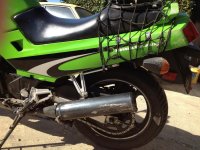
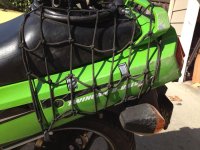
Mark, you're like a frikin crash whisperer! Bike damage is as you predicted. Gear damage (thanks to BARF for pounding ATGATT into my head!) is as you say. Most of the scuffing is actually on the left shin, but I'm feeling a bit sore right on the left hip. There was only minor scuffing on the left forearm. Thankfully, my head never touched the ground (at least no scuffs on my helmet) and the gear is only minimally damaged. And, of course, you can hardly tell the Helimot gloves were in a crash.
 

Attachments

  • photo-8.jpg
    photo-8.jpg
    110.8 KB · Views: 60
  • photo-9.jpg
    photo-9.jpg
    100.3 KB · Views: 62
  • photo-10.jpg
    photo-10.jpg
    97 KB · Views: 65
I biffed it on 84 in Woodside today. I was headed east into Woodside. Here's the corner:

Thanks for looking and any feedback.
After having closely examined the video and more importantly "audio" portion of the provided video, and combining that info with a viewpoint of someone having logged 120K miles on the very same bike, and having long ago identified its attributes, here's what I believe is the two-part recipe of this crash.

PART 1 (the bike part):

1) What was it that actually triggered the bike's final moment in going down?

- Metal-to-pavement contact at one, or more of the following vulnerable points.

* The foot of the left side of the centerstand
* The foot of the sidestand, and the metal baseplate of the sidestand pivot
* The lower side of the left mid-pipe of the exhaust, right before where it heads into the muffler.

If you listen closely in the video, there's a very defined interval (close to a second?) of a recognized type of "kaaaakkkk" scraping sound (signatory of the parts above touching down), that occurs just BEFORE the bike goes though the actual heading to the ground crashing actions.

I can almost guarantee if you check these locations on the left side of the bike, you'll see noticeable "scraping" evidence is present.

2) What was the impact on the bike of the metal-to-pavement contact at that/those points?

- As the greater and greater amounts of the bike/rider weight was transferred to the metal-to-pavement contact points (as the suspension compressed and the bike was leaned over more in the turn), it eventually leveraged enough weight off the rear tire that it virtually was lifting it off the pavement.

- At the point where insufficient weight remained on the rear tire, it instantly lost traction, and the back end of the bike slid out (first), and the bike lowsided off the road

-----------------------------------------------------------------------

PART 2 (the rider's actions part):

Error 1) Initiating the original turn-in event too early for that corner (i.e. "early apexing")

- Result being an early apex, that put the bike on a forced trajectory of heading outward away for the direction of the turn.

Error 2) Being "off-the-throttle" during the first portion of the corner entry, leading up to the point of scraping hard parts

- Result in being off-the-throttle?

* The bike's rear/side ground clearance was reduced (bike squats in rear), because of the absence of needed (on an early-gen Ninja 250) throttle induced "anti-squat" action via the drivechain's action on the swingarm angle

* The front forks were also compressed more than ideal (again reducing the bike's overall ground clearance), due to the extra forward weight bias of being off-the-throttle on corner approach/entry

Error 3) Making a lean angle increase, once already committed into the turn, due to having to tighten up the line to try to fix the improper trajectory (heading wide) of the bike - due to the excessively early apex. This one being a forced action, driven by Error 1 (turning in too early).

Error 4) Not actively working to setup some level of inside body positioning on the bike to reduce the amount of bike lean angle needed for cornering.

Though it's not visible in the video to say with absolute certainty, based on the stated experiece level of the rider, and those aspect that are visible in the footage, I highly believe that some level of this behavior could likely have prevented - or at least reduced the level of - hard parts contact. Perhaps enough to have prevented a full crash.

-------------------------------------------------------------------------

What to do to prevent a similiar event in the future?

- Acquire and read training materials and attend classes to:

1) Develop a better understanding on turn-in points, and target apex locations, for the different types (decreasing apex, increasing, constant - off camber, on-camber, etc) of corners.

2) Develop a better understanding of the dynamic effects that throttle application has on the bike, and learn to develop better throttle control ("roll-on") skills to optimize the safety buffer while riding

3) Learn about the "one steering input/turn" (in most instances) rule, and develop the skills to setup lines for corners that will not create a temptation/need for corrective inputs once into a turn

4) Develop a better understanding on the front/rear weight transfer aspects that occur during downhill riding; and techniques for using rider controls (i.e. throttle input, brake management, etc) to optimize conditions

I firmly believe that all of the above is an accurate post-mortem of the events that transpired before, and during this crash; and list of directly applicable (to this crash) points to focus on learning and improving in the future to minimize the chances of a repeat performance.

Glad you weren't injured Billy and got some great help from the BARF angels (way to go Aaron! :thumbup) in getting things sorted and back home. Hope this information above is of some value to you in learning and moving on in your future riding! :ride
 

Attachments

  • nina 250 scrapes.jpg
    nina 250 scrapes.jpg
    38.5 KB · Views: 561
Last edited:
Help educate a noob (me).

To me, it looks like he loses the front. In the vid it appears the bike falls before it starts rotating, suggesting that the front washes first, the bike falls, then the rear begins to rotate out. I can definitely hear the scraping, which would certainly seem to support the rear getting light and stepping out first, but is there anything to my observation?
 
I do try to stay relaxed on the bars, but I have noticed it's harder going downhill.

Yes it is! *Concentrate*, ie actively *think* about squeezing the tank with your thighs. Play with incorporating leg-initiated leans with your bar control. Make it into a fun exercise, not a "oh boy let's get this right this time" thing.
 
Help educate a noob (me).

To me, it looks like he loses the front. In the vid it appears the bike falls before it starts rotating, suggesting that the front washes first, the bike falls, then the rear begins to rotate out. I can definitely hear the scraping, which would certainly seem to support the rear getting light and stepping out first, but is there anything to my observation?

Read the post above yours...
 
That part of the video was ambiguous to me too, because the bars aren't visible in the video when the bike begins to go down. A few frames later, they are visible and are steered into the slide (the bike has stepped out by then), consistent with the front still tracking while the rear is sliding.
 
Back
Top