
• There has been a recent cluster of spammers accessing BARFer accounts and posting spam. To safeguard your account, please consider changing your password. It would be even better to take the additional step of enabling 2 Factor Authentication (2FA) on your BARF account. Read more here.

Motorcycle Adaptive Headlight

SCLights

New member
Joined
Jun 7, 2010
Location
San Luis Obipo, CA
Moto(s)
1978 Honda CB400
Hi everyone,

I'm trying to do a little market research for a school project that I am currently working on and would like some help. Myself and a few class mates are working on developing an aftermarket auxiliary adaptive headlight for motorcycles (similar to the adaptive headlights on the high end Lexus cars). The short version is that it is being developed to automatically auto-level itself and turn the correct direction that an upcoming curve in the road is going. This will greatly increase visibility during turns while riding at night and hopefully help decrease riding accidents.

Here are some key things I would like help with:
1. opinions on the idea in general
2. Would you buy one if this was actually available to the public?
3. What would riders want this to look like?
- bolt on auxiliary lights
- flush mount to the fairings
- etc...
4. Any functions in particular that would help improve the the idea?
5. What type of bikes would this be best for?
- cruisers
- adventure
- motard
- supersport
- .....
6. ???? anything you would like to add

Please list the bike you ride so that I can get a good idea of the rider trends.

Any Help with this would be greatly appreciated.

*Hopefully I will have some pictures and video available of our current progress in the near future.*

Thanks
 
wow, auto-level itself? and turn to follow the road? sounds great, but...

I've ridden m/c with the headlight mounted fixed to the frame, and with it mounted on the forks. neither is perfect for every situation. but as far as an adaptive bolt-on, I'd be inclined to just buy more lights, to affix in the 'other' way from what my bike has, giving me both "straight ahead" and "turn with forks" lighting. The cost and weight of a motor (to turn the headlight) seems like overkill. If you're suggesting that your adaptive headlight use some other method (e.g., GPS, or sensing the center/edge of the roadway), I can't see that working without a failsafe of some sort, which brings us right back to running two kinds of lights.

as far as the self-levelling aspect, that'd be great, as braking can cause a dramatic shortening of lit roadway. but would it be able to react quickly and predictably?

and then there's the whole interaction between the two. how many sensors would you have to place on a motorcycle to sense everything necessary to correct both left-right and up-down aiming? you'd want to sense steering input, pitch, yaw, speed, and lean angle. That sounds like more than just a quick bolt-on project. But if you could get there, the touring crowd (who ride in the dark more than motard and s/s riders) just might be willing to pay for it.
 
I doubt I'd buy one because I try not to ride at night, and take it really slow when it's really dark.

The idea sounds good. It'd have to be done as a bolt on. You could probably do it with a simple gyro sensor, and 2 DC motors for the 2 axis. I've done a similar project for a camera system for RC helicopters and it is pretty straightforward.
 
Two-axis servo system and accelerometer. Three, if you want to get really fancy and keep the road lit while the rider is doing standup wheelies... :teeth
 
Best for tourers and sport tourers which are more expensive to begin with, less concerned with weight and complexity, and are more likely to be ridden at night.

If executed properly, a light that compensates for the lean and keeps the road illuminated would be cool. Good luck!
 
Great idea. When cornering in the dark, I use my high beam (sometimes in spite of oncoming traffic) to get a better view through the turn. A headlight that figures out how much I'm leaned over and where I'm going would be very cool.

It would also be helpful to have the beam slue away from an oncoming headlight--or at least dip automatically. Riding at night in the rural areas around SLO, I often have to switch between high beam and low beam to get the best illumination I can without blinding an oncoming driver.

For a bike like my ST1100, with twin headlights, I would prefer implementation as a replacement for the stock headlights. I tend to disfavor accessories that require alteration of the bodywork and stringing new wiring.

It seems to me that one receptive market would be the Gold Wing owners. There's a helluva lot of them, and the bikes are designed with the addition of accessory lighting in mind. Another good market might be the adventure tourers, BMW GS, Suzuki V-Stroms, Kawasaki KLR.


edit: There's a fairly obvious problem (which I didn't think of until 4 hours after my original post ;)) of distinguishing between frame mounting and fork mounting. Unless I'm missing something, I would guess that lights on nekkid bikes like my 919, which would require fork mounting, would need to be controlled differently than frame-mounted lights.
 
Last edited:
cool idea and I'd go for it if it worked.

I've got a pair of PIAA auxilary lights on my bike that are mounted to point 10 degrees off center on either side. they do a great job lighting up corners at night but do tend to blind the piss out of oncoming traffic if I don't shut them off in time

for my next bike I'd like a set of 8" Baja lights :laughing
 
If you really get it to work properly and cover yourself patent-wise, you may be able to sell the technology to one or more of the big motorcycle manufacturers. But it's gotta be good and fool proof.

Also, it would be wise to do some extensive patent searches for existing technology. No point wasting your time on something someone else already has a patent on. Unless you're doing it just for the fun of it.
 
We've looked into this quite a while back and abandoned the idea. Maybe you can keep the cost down, but more importantly, perhaps you can now get accurate and reliable sensors. In oder to pull this off, you're going to need a 3 axis system. Because of the headlight beam cutoff pattern, you do need to take tilt into account instead of just vertical/horizontal axis. Otherwise, you're blinding every oncoming car in a right hander. This is not a trivial sensor system due to the forces you encounter during turning of a two-wheeled vehicle. Alternatively, you could try a simple gyro system, but again, you have to take into account the multiple forces during a motorcycle turn. Then, on top of all this, it has to be reliable enough to meet DOT and other european standards.

Personally, I would rather have an auto-leveler that operated at request (push of a button) while stationary. Leveling my lights properly everytime I change loading gets to be a PITA after a while, and I do this because I love night riding.
 
Last edited:
I've ridden m/c with the headlight mounted fixed to the frame, and with it mounted on the forks. neither is perfect for every situation. but as far as an adaptive bolt-on, I'd be inclined to just buy more lights, to affix in the 'other' way from what my bike has, giving me both "straight ahead" and "turn with forks" lighting.

That's what I did. Pretty happy with it.
 
awesome idea. great for super sport bikes


i like to pick up my beezy for the night and smash up to the wall at like midnight and "take in the scenes"


i could see this allowing me more late night speed up the mtn!!!
 
That's what I did. Pretty happy with it.

Problem is, the forks don't fully turn as much as the bike is turning so just mounting them on the forks really doens't get the job done.
 
Thanks for the quick responses.
I have a few things I'd like to say about the project and to respond to some of the statements that a few of you have made.

First, I'd like to say that we have been doing extensive research on the topic to try to identify all of the problem areas of riding at night. By the very nature of street riding at night, a simple bolt on lighting system that bolts to the forks will not give much help to the inside of a turn. With counter steer your lights will actually be pointing in the wrong direction. The other problem is that when the bike leans over, the inside part of the light will get cut off by pointing at the ground.

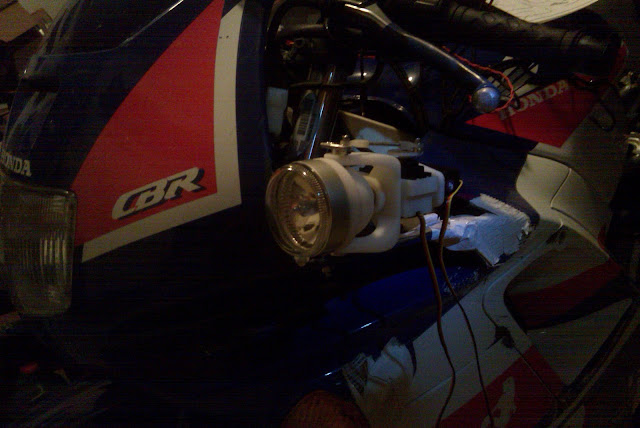
For our sensors, we are using a 3 axis accelerometer along with a rate gyro for our lean angles. For the turning direction we will be using an infrared sensor system. We are using very small DC servo's for the system that don't weigh very much so that is not an issue. The price for our first prototype was not too bad considering we just sized everything and went up one to five sizes just to make sure it would work. When we scale it down to what we just need then the price can get cut in half.

Patent wise, we are looking like we are alright. We already have a provisional patent.

We are on our way to having our first real test. We have tested it on a test stand that simulates the lean angle and left/right turns and it seems to be working great. We are trying to mount it on one of our bikes and hope to have some real data to report in the next week or so.
 
Here is a photo and a short video of the lean angle compensation:

025.jpg


Video here: It isn't great but shows how the light will stay level when the bike leans.

http://www.youtube.com/watch?v=q9pk80WeKVs
 
This sounds awesome. Every time I take an on/off ramp without a car in front of me, I'm forced to turn my high beam on to see down the road.

I'm fairly certain that whichever way you implement it will be too rich for my college student blood. But my post-college self will be very interested.
 
Now can you take the board it's mounted on, hold it at arm's length, and spin around while tilting the board towards you, somewhat simulating the turning forces experienced on a leaning motorcycle?
 
Video here: It isn't great but shows how the light will stay level when the bike leans.

To effectively illuminate the road ahead of a motorcycle in a turn (motorcycle leaning), the headlight should be aimed upwards (in relation to the motorcycle) and not actually level. In aircraft terms: If you are looking to eliminate roll, you will also need to address pitch. In a turn, the headlight should also pitch upwards to better illuminate the road.

Keeping the headlight level along the roll axis is going to present a huge challenge since the motorcycle will probably not have a repeatable lean for a given speed, lean angle, or rider position on the motorcycle. Getting the pitch correct for a given lean, turn radius, and altitude change of the turn will likely be the bigger challenge though.
 
I know it looks kind of non-sporty, but since it's at night it might not matter, but I used to do off-road night rides in the woods and on the dunes and I always wore a friends HID helmet light system.

It was AMAZINGLY bright, and best of all it put the light EXACTLY where you wanted it to be... Where you were looking.

It was interesting because in a lot of ways the night riding with the HID helmet lights was almost easier than riding in daylight. I know that sounds weird, but I think it was because the light and where you looked became your focus and your attention area, and everything else that had nothing to do with where you were going was "blacked out". It's difficult to explain and much easier to observe.

There are so many variables as to where the light goes on a bike, unlike a car that is more a direct link between where the steering wheel is pointed etc, on the bike, the light might not be exactly where you want it to be, and so to compensate you manuever the bike to aim the light, rather than the light being where you want to manuever, as it is with a helmet light...
 
Back
Top