• There has been a recent cluster of spammers accessing BARFer accounts and posting spam. To safeguard your account, please consider changing your password. It would be even better to take the additional step of enabling 2 Factor Authentication (2FA) on your BARF account. Read more here.

Reverse mortgage pros and cons? Anyone have one?

But I won’t be alive that long. And my home will likely be sold after I’m dead. In the meantime, I’m maximizing what I get from my investments. And I live entirely on my SS. No need to touch my investments.

I figure on dividing all my assets among my 11 siblings. For some, that means being able to buy a home.

And my current situation also means I don’t have any money worries.
 
My two kids won't want this house after I leave the planet. My son is already set up in his own house, daughter will be on her own soon. So I ask myself why should I continue to struggle with a monthly house payment? Just to accumulate more equity? Who does that benefit?
Obviously I need to give this a lot of thought but wow...
 
What I think should drive your decision is you and your wife’s comfort in the years you have left. It’s a huge decision to make. Go slowly and cautiously. And explore other options.
 
That is why I like HELOCs -The flexibility

You can pay off the principal and pay zero interest but have the HELOC for a rainy day.

You can draw from the HELOC for 25 years for the CMG HELOC

Not everyone will qualify for the CMG HELOC
 
We can't take it with us when we die, so unless you plan to leave your home to your heirs, then spend away


"2.5% is free money"

And we wonder why the median home price has doubled since 2012 :loco


Yet, 2.6% over 30 years is really 44% interest of the amount you borrowed.


For Example, if you borrow $1,000,000 you pay $441,223 in interest at the end of 30 years at 2.6%
At 7% you'd pay $1,395, 089 in interest over 30 years.
 
At 7% you'd pay $1,395, 089 in interest over 30 years.
Word.

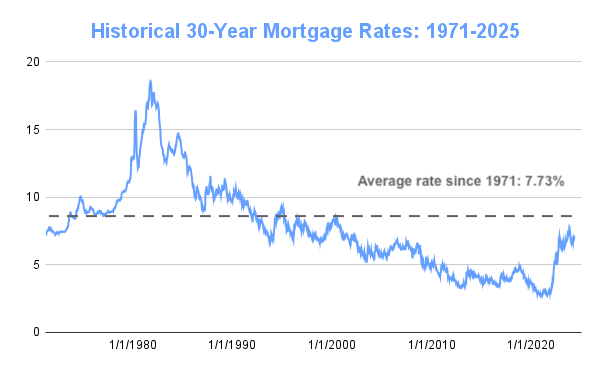
And 7% is below the ~50 year average rate (see figure 1)

I wonder why home prices are so high <sarc!> And the the inflation in the home market is government subsidized.


You pay 100% interest over 30 years if the interest rate is 5.3%


Figure 1
Historical-30-Year-Mortgage-Rates_-1971-2025.png
 
Last edited:
I'm sixty and my health has begun to fail me.

I have a choice, 20 acre parcel in the Santa Cruz Mountains. The house and utilities need some work.

451334286_8068177176537513_5880436562275162294_n.jpg


257599838_4701991286489469_229073930742460078_n.jpg


91634300_2988544581167490_7125914084859445248_n.jpg


465279887_8834690763219480_34450574089178088_n.jpg


464797159_8798747676813789_3705748948406321188_n.jpg


I bought it from my mom so I got a pretty sweet deal. I still owe $600K. My mortgage was $3,600/month last year. This year I got an increase in my fire insurance bill which is impounded into the mortgage. So now my mortgage is $5,400/month.

I used to clear about $10K a month; but since I've been disabled with spinal stenosis, I'm only getting an income stream of about $6K a month now. I'm eligible to receive a pension, but that's only gonna be about $4K a month after taxes and deductions if I were to take it right now. My saving grace is my wife out earns me by about 60% and we split the bills. I just don't like the idea of being dependent upon her. I'm not very disciplined in my spending habits either. I have about six Grand in credit card debt and just sold a car for $4,000.

I used to be able to keep up with maintaining this property, but it's really been kicking my ass these past few years. I'm really looking forward to selling out and moving away. That's not going to be very easy, and I'm having difficulty coming up with a solid strategy. This place looks like Fred Sanford's been around. I've got a lot of stuff that I'm gonna need to get rid of. I figure it's gonna take me three years if I quit working. (That might actually happen soon.) Since my funds are rather limited, I've often wondered if I should take out a loan to fix the place up, or just sell it as is. I think some Bondo and a coat of paint would be warranted at the very least. I think if I'm lucky, we could get two million for this place.

So what to do? I think I should retire, get on my wife's health insurance, open a fab shop, do an estate sale, wait until I'm 65, sell the place, and then buy a small house near San Diego. Airbnb the new place, and then travel on the left-over funds. My wife is not adverse to the idea, but she worries that I'm going to become a lazy bum.(Social Security should also be good for at least another $2,700/month if I take it at 65. So I'd have about $6,700/month incoming at that point.)

But should I get a reverse mortgage in three years? (I think you're eligible for one when you turn 63, and this HECM Saver loan I read about in the article linked above doesn't look too bad.) My sister-on-law's in-laws have a reverse mortgage, but they don't talk about it. I'm afraid to ask about it since she's estranged from her husband.

 
Last edited:
imo reverse mortgages work well only if you stay in your home until you kick the bucket
 
My two kids won't want this house after I leave the planet. My son is already set up in his own house, daughter will be on her own soon. So I ask myself why should I continue to struggle with a monthly house payment? Just to accumulate more equity? Who does that benefit?
Obviously I need to give this a lot of thought but wow...
The reverse mortgage will shut off your house payment, but your equity may dwindle each month after that. And your mortgage will increase. The result will be quantifiable. You are correct in that equity is not spendable. Depending on where your house is, the loss of equity each month could be made up to some extent by appreciation.
 
imo reverse mortgages work well only if you stay in your home until you kick the bucket
This. The only situation where a reverse mortgage makes sense is if you're old and have outlived your money. Getting a reverse mortgage will let you live in the home till it's paid off (so the borrower, The Reverse Mortgage Company now owns it) or you die and (the borrower, The Reverse Mortgage Company) is absolved of the remaining balance and now owns it.

Its a good deal for the lender (borrower, really?) because you stay in your home and are still responsible for insuring it, repairing things that break, paying property taxes, and basically have all the responsibilities of ownership but you receive a payment each month instead of making a payment. Its a safe bet for them because its a fixed amount, the value will go probably up, and you'll probably die before they pay the whole thing off.

You'll be better off if you just sell it or rent it, even if you don't get top dollar or pay a lot to a property management company
 
If it really is all about reducing monthly payment, look into refinancing the remaining balance on your house for 30 years at whatever today's rate is.

If you haven't refinanced or renegotiated your loan in the 19 years you've had it, you're probably paying in the neighborhood of low-mid 6%. Rates aren't a lot higher than that right now.

It's not the best move to build wealth, but it preserves the equity you already have, drops your mortgage payment significantly, and frees up more money every month to do what it is you want to go do.

The best financial advice would be to suck it up and keep paying for 11 more years and deal with the sacrifice in the meantime. But maybe you're sick of doing that.

Sometimes you've got to live a little.
 
Last edited:
I’ve just watched a few videos on reverse mortgages.
Fees are high, interest can be higher than current market rates.
As littlebeast says the advantage goes to the lender.
It’s just so damn attractive to turn off my mortgage payment. That would life changing.

A reverse mortgage is a seller financed installment sale, effectively. The variables that affect value are interest rate and inflation (anticipated). IMO, the only advantage to a RM is the use of the asset while installment payments are made. IME, the largest asset you have in your home is your interest rate (if it's low). I think it smarter to lease your replacement home and lease your existing home out. Sell when you're able to purchase something in the new location with a rate similar to your current rate.
 
My grandmother did it after my grandfather passed away. Everyone in the family regrets letting her do it and not stepping in to help. My dad considered it for a short time recently, because he wanted to buy a motor home. I stepped in and gave my dad the money for the down on a motor home.

IMO, don’t do it. For all intents and purposes, you no longer own your home.
 
As Lights_Guy3 says - sometimes you have to live a little. Leaving the mortgage payment in place means slaving away for the next decade vs turning off the payment now and being able to travel spontaneously or buy something stupid but fun.
My wife runs a daycare out of our home with a dozen kids coming to the house every day. This would mean she cut down the number to maybe 3 or 4, or close altogether and stop stressing over fighting and crying toddlers all day long.

I've read that an RM is for those whose backs are against the wall and really need the money. I'm not in that position, just resentful that I'm sitting on a mound of equity that isn't doing me any good.
 
I had a RM quoted for me. Your payment depends on house worth. They really low balled the value of my home, significantly. Lessens the amount of equity. I was surprised.
 
As Lights_Guy3 says - sometimes you have to live a little. Leaving the mortgage payment in place means slaving away for the next decade vs turning off the payment now and being able to travel spontaneously or buy something stupid but fun.
My wife runs a daycare out of our home with a dozen kids coming to the house every day. This would mean she cut down the number to maybe 3 or 4, or close altogether and stop stressing over fighting and crying toddlers all day long.

I've read that an RM is for those whose backs are against the wall and really need the money. I'm not in that position, just resentful that I'm sitting on a mound of equity that isn't doing me any good.
One perspective is you’re paying a fixed monthly cost for housing (mostly, home insurance is climbing these days) vs worrying how much rent will go up when the lease term is up
 
As Lights_Guy3 says - sometimes you have to live a little. Leaving the mortgage payment in place means slaving away for the next decade vs turning off the payment now and being able to travel spontaneously or buy something stupid but fun.
My wife runs a daycare out of our home with a dozen kids coming to the house every day. This would mean she cut down the number to maybe 3 or 4, or close altogether and stop stressing over fighting and crying toddlers all day long.

I've read that an RM is for those whose backs are against the wall and really need the money. I'm not in that position, just resentful that I'm sitting on a mound of equity that isn't doing me any good.
Refi and drop your monthly payment!

You could probably drop it by 50%, that's a lot of extra cash every month.

And you won't lose a dime of equity.
 
His rate'll pop though, IIRC. And he's in prime principle pay down territory w/ less than 120 months remaining.
 
Back
Top