

-
There has been a recent cluster of spammers accessing BARFer accounts and posting spam. To safeguard your account, please consider changing your password. It would be even better to take the additional step of enabling 2 Factor Authentication (2FA) on your BARF account. Read more here.
You are using an out of date browser. It may not display this or other websites correctly.
You should upgrade or use an alternative browser.
You should upgrade or use an alternative browser.
SV Carbon Tank project for Zoran
- Thread starter tygaboy
- Start date


Hellraizer547
Active member
When you say you can feel the fibers, is it consistent across the entire part or are some areas "ok"? And check to see how much vacuum you're pulling. It sounds like you might have too little epoxy.
The pattern is uniform throughout the product. It does seem to have very little epoxy, but when I apply the epoxy during layup, I use a lot. I do not have a gauge to see how much vacuum I am pulling. I can install one in the next couple days, what should the Hg read?
Sergio

For the last month I have been making ABS brackets, those I convert into a fiberglass mold without using the vacuum bag technique. My issue I am having now is when I vacuum bag fiberglass or the carbon fiber the final product is not smooth. When running my nail over the finished side I can feel all the fibers, and not a glossy finish, but when I do not use a vacuum I get a perfect finish. Any ideas what this can be?
Is there an air bubble in the part that I am vacuum bagging?
Should I let the part gel first before vacuum bagging?
I vacuum bag the parts for about 3 hours till everything cures, is this to long?
Thanks Tyga.
When you say you can feel the fibers, is it consistent across the entire part or are some areas "ok"? And check to see how much vacuum you're pulling. It sounds like you might have too little epoxy.
The pattern is uniform throughout the product. It does seem to have very little epoxy, but when I apply the epoxy during layup, I use a lot. I do not have a gauge to see how much vacuum I am pulling. I can install one in the next couple days, what should the Hg read?
Sergio
Sergio
can you post some pictures of your parts in the bag and under vacuum?
Are there tight radii that the bag has to conform to? if so, the bag can "bridge" over them creating a pocket for resin to pool in and if there are enough bridges or large enough ones it could pull resin out of the part creating a the "not smooth" condition. letting the resin gel a little might alleviate the issue if bridges are the problem. pulling partial vacuum and manually shoving the bag into the tight corners then going to max vacuum might help also.
structurally speaking, being able to feel the fibers in the finished product isn't a big deal unless there are dry fibers with no resin in them at all. the shiny resin look is cosmetic
Hellraizer547
Active member
The piece is extremely strong, very stiff. The front side is smooth(minus feeling the weave very slightly), but it is lacking the gloss look in which I am trying to achieve. I am currently making 6 different brackets at the moment, but by that time I want to get some sort of finished look before I start the carbon layup for the tank.
For the brackets which are going to be mounted around the engine to hold all of the electrical which I have removed from the rear I am using a polyester resins for my molds and brackets, but will use high grade resins for the airbox and tank. Using the polyester resin the pot life is long, so when vacuum bagging the item the resin's viscosity is almost like running water until an hour+. The non polyester resin I have been using from tap plastics will gel within 20-30 minutes. This leads me to believe that while the viscosity is low I am pulling out all of the resin during vacuum bagging.
I am at work, so here are some pictures of my first carbon fiber layup.
For the brackets which are going to be mounted around the engine to hold all of the electrical which I have removed from the rear I am using a polyester resins for my molds and brackets, but will use high grade resins for the airbox and tank. Using the polyester resin the pot life is long, so when vacuum bagging the item the resin's viscosity is almost like running water until an hour+. The non polyester resin I have been using from tap plastics will gel within 20-30 minutes. This leads me to believe that while the viscosity is low I am pulling out all of the resin during vacuum bagging.
I am at work, so here are some pictures of my first carbon fiber layup.
Attachments
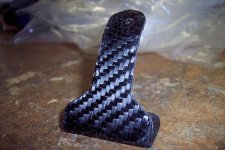

if it's that runny and the vacuum is pulling the resin away you'll see unsupported cured resin "flashing" around the part, it has to go somewhere. if that's what's happening be really careful you don't pull resin into your vacuum pump

The piece is extremely strong, very stiff. The front side is smooth(minus feeling the weave very slightly), but it is lacking the gloss look in which I am trying to achieve. I am currently making 6 different brackets at the moment, but by that time I want to get some sort of finished look before I start the carbon layup for the tank.
[...]
I've used this technique from tygaboy that I read (below). Basically get a coat of epoxy down and tacky first, then proceed with the layup. Maybe that'd help you get a bit more surface coat for the smooth, gloss effect you're after?
Give this a try:
Prep the mold with a good waxing/wiping then apply the PVA and let it get nice and dry.
Mix up your epoxy. I wix mine for about 1 min and that's it. Yes, more may be better but so long as it's mixed, it's mixed.
Apply a coat of epoxy to the mold then let it sit for 10 mins or so.
Take clean brush (I use those cheapy ones from Home Depot), pull on the bristles over and over to be sure you remove any loose ones.
Then, gently and with only the weight of the brush, drag the brush across the surface of the epoxy to remove all the air bubbles. You'll do this for "a while". Drag, let it sit for a few mins so bubbles can work themselves to the surface. You can also poke at the bubbles with a pin.
Now the fun part: wait for the epoxy to start to set up... a little.
What you want is the expoxy to setup enough that you can touch it and leave a finger print but have none stick to your finger. You may want to prep a "test" part so you have a control environment and aren't messing with your production part.
Then, once the epoxy is set up like this, gently but firmly, press your first layer of dry fabric into this "clear gel coat". BE CAREFUL as you do not get to pull it off, move it around, etc. If you do, you pull this initial layer off the mold and you'll get voids, etc.
Once you have the layer pressed into the epoxy. go do something else while it cures a bit.
Come back in a couple hours and wet out the layer in the mold and add your remaning layers, let them cure, etc.
This appoach should give you a perfect, no pin hole result. And you don't even have to bag.
Again, this is just one approach to composite layup. Maybe it'll work for you, too.
Best of luck...
Hellraizer547
Active member
I've used this technique from tygaboy that I read (below). Basically get a coat of epoxy down and tacky first, then proceed with the layup. Maybe that'd help you get a bit more surface coat for the smooth, gloss effect you're after?
It looks like I can use this method in addition to vacuum bagging. Thanks
Hellraizer547
Active member
I am on my 6th carbon fiber piece and have greatly improved. Since the resin takes a while to cure, I leave a coat of resin on the mold for an hour, from there I continue my layup of carbon fiber and a new batch of resin.
Sergio
Sergio
DriftinSideways
New member
Your Tank
Im currently on my 7th tour in Iraq. I was wondering if you still made these tanks Im very interested in I would like one for a tribute bike For my friends that lost thier lifes. If thier is any chance you happen to have one of the mv-sv tanks laying around or can make one would you part with it?
Thanks
SSgt Travis Putnam
USAF
Im currently on my 7th tour in Iraq. I was wondering if you still made these tanks Im very interested in I would like one for a tribute bike For my friends that lost thier lifes. If thier is any chance you happen to have one of the mv-sv tanks laying around or can make one would you part with it?
Thanks
SSgt Travis Putnam
USAF
Last edited:

oktrg500
New member
Wow! I just had to register so I could log in and say thank you for this great thread. I woke up at 01:30 in the night and could not sleep. I decided to surf a little using my phone. I found this thread and could not stop reading before I had read it all. By then it was time to get up. I have saved all 30 pages, so even if the whole net disappears, I have a copy of this thread. Thank you very much.
jesusgatos
New member
Also just registered to say thanks for sharing. Very helpful, and much appreciated.


redline
Greetings from THill...
I noticed someone was looking for tygaboys video on youtube. Here is a playlist of some of his older stuff:
http://www.youtube.com/playlist?list=PL63A0D966BDD78678&feature=plcp
http://www.youtube.com/playlist?list=PL63A0D966BDD78678&feature=plcp
Last edited:
rhubarbray
New member
I realize I may be resurrecting this thread from near death, but I was needing information on how to make carbon fiber parts when I came on to this search result. Freakin` amazing! I logged on and preceeded to read all 30 pages of the forum.
End result being,.........I`ve ordered carbon fiber, kevlar, epoxy, etc and am going to try and make my own for a recently purchased Aprilia Tuono.
I realize of course, my girlfriend may not see much of me this summer as I`ll be in the garage! Damn, spare time, what`s that?
Ray
End result being,.........I`ve ordered carbon fiber, kevlar, epoxy, etc and am going to try and make my own for a recently purchased Aprilia Tuono.
I realize of course, my girlfriend may not see much of me this summer as I`ll be in the garage! Damn, spare time, what`s that?
Ray

Stormdragon
Still Good Lookin'
- Joined
- Feb 12, 2006
- Location
- Cool, (yes, really!) CA
- Moto(s)
- XT600, ZX636, KR250, RS90
- Name
- El Diablo
It does seem to be the definitive thread for do it yourselfers. Good luck on your project! 

Crash Gordon
Pumpkin Pi.
- Joined
- Jan 24, 2011
- Location
- Davis, Ca.
- Moto(s)
- KTM 525smc, CR250, KLX650c, CBR F4i, Ninja 600r streetfighter.
From the dead, indeed.
On the other hand, I've had this thread bookmarked on my computer for years, and I just started actually posting on BARF two months ago.
It really *IS* the best resource out there for what us moto folks are looking to do!!!
On the other hand, I've had this thread bookmarked on my computer for years, and I just started actually posting on BARF two months ago.
It really *IS* the best resource out there for what us moto folks are looking to do!!!
kaighn80
New member
hi dont suppose anyone has used diolen? wondering if its any good really? joined the forum to say thanks to the O.P. for the how to, i was looking for someone to do some fairings for me as i was a bit scared of the black art that is carbon work, having read this i'm a bit more confident that i could do this myself, so i'm looking to make the fairings and a fuel tank, whilst i'm here another question, i know that fuel affects certain resins but does it also affect certain materials, so would a poly based material be affected by the fuel?
I realize I may be resurrecting this thread from near death, but I was needing information on how to make carbon fiber parts when I came on to this search result. Freakin` amazing! I logged on and preceeded to read all 30 pages of the forum.
End result being,.........I`ve ordered carbon fiber, kevlar, epoxy, etc and am going to try and make my own for a recently purchased Aprilia Tuono.
I realize of course, my girlfriend may not see much of me this summer as I`ll be in the garage! Damn, spare time, what`s that?
Ray
From the dead, indeed.
On the other hand, I've had this thread bookmarked on my computer for years, and I just started actually posting on BARF two months ago.
It really *IS* the best resource out there for what us moto folks are looking to do!!!
this thread has been referenced all over the web, all the hell over!
it's why the intarweb was invented: to facilitate sharing information (and porn)
rhubarbray
New member
hi dont suppose anyone has used diolen? wondering if its any good really? joined the forum to say thanks to the O.P. for the how to, i was looking for someone to do some fairings for me as i was a bit scared of the black art that is carbon work, having read this i'm a bit more confident that i could do this myself, so i'm looking to make the fairings and a fuel tank, whilst i'm here another question, i know that fuel affects certain resins but does it also affect certain materials, so would a poly based material be affected by the fuel?
Hi! As for fuel tanks, careful!! I`m still interested in making the tank for my Tuono but in 6 months of looking and talking to resin manufacturers and importers, and looking at all the specs for epoxy, polyester, vinyl ester, novolac, epoxy vinyl ester, isophthalic, terephthalic, and every other kind of phthalic you can think of,........I only came up with 2! Both of them polyester resins. Made by AOC and Reichold but are the only ones I can find that comply with UL1316 specs. That`s the spec used for coating underground fuel tanks. And they`re the only ones I can fine that will resist ethanol fuels. Or in the US known as E10, E15, etc. I know that I`d rather have a stronger resin than a poly for the project but the chemical formulators and researchers have come a long way in the last while. The other major issue I have with the poly and vinyl ester resins is the shrink rate. Some are as little as 4%, while some are as much as 10%! Epoxy doesn`t shrink nearly at all and you must wear a respirator while using poly and vinyl. I`m thinking of using epoxy for the molds and plugs and then switching to poly for the final layup. Should minimize the shrinkage.
Ray