• There has been a recent cluster of spammers accessing BARFer accounts and posting spam. To safeguard your account, please consider changing your password. It would be even better to take the additional step of enabling 2 Factor Authentication (2FA) on your BARF account. Read more here.

Torque Specs. Question

Johnny LaRue

Member
Joined
Feb 9, 2023
Location
San Jose
Moto(s)
2005 ZX10
2024 ZX10
Name
Dave
Hi there, anyone aware of any detailed documentation on torque specifications when using different types of thread locker, anti-seize, or lubricants, as opposed to dry Specs.? I have been using the fabled 25% reduction recommendations. I am hoping to find more detailed information. It is very important because I am working on my Rev II, Two Stroke Shopping Cart.
 
All the manuals I have used have a specific torque setting for using a specific type of compound. As an example, Honda usually has a specific torque setting for spark plugs and says to use anti-seize. Honda also has a specific toques settings for some bolts with a set type of Loctite (comes on those bolts if ordered from Honda).

AST give a general guideline for verifying a torque setting on a specific fastener when using a compound vs. dry.
  • The standard method of verifying torque shall be performed by marking a line on the fastener (head or nut) and mating part (torque it with no compound).
  • Remove faster and apply your compound.
  • Measure the torque required to tighten the fastener until the lines match up.
Good luck!
 
Yes, I have the manuals as well. I am hoping to find something for all applications. The line thing is a great idea; I will give it the smoke test! Thx
 
Torque until yield + 1/4 turn
 
I unsuccessfully spent some time looking for an older video I once watched which thoroughly tested torque and thread tension using various compounds. The results were wildly different and although I can’t remember the specifics, the take away was that oil was the preferred and most consistent.
 

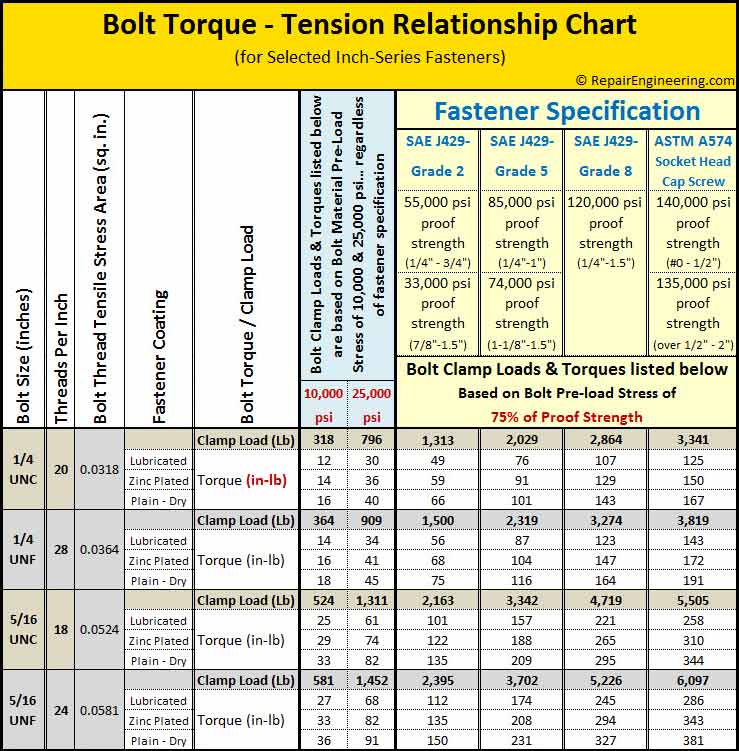
Dry steel nut factor is taken to be 0.20, and torque-as-proxy-for-elongation can be scaled proportionally based on these other factor values.


1756972396453.png
 
Back
Top