• There has been a recent cluster of spammers accessing BARFer accounts and posting spam. To safeguard your account, please consider changing your password. It would be even better to take the additional step of enabling 2 Factor Authentication (2FA) on your BARF account. Read more here.

Why a full face helmet???

budman

General Menace
Staff member
Administrator
Joined
Apr 4, 2002
Location
Menlo Park, Ca.
Moto(s)
Keep me rocking life
Name
Budman
BARF perks
AMA Life Member #203453
We all see the riders out there with brain buckets and open faced helmets.

I think the graphic below from David Hough really gives some insight into why a full face helmet is a better call. Diagram by: David Hought / Courtesy of Proficient Motorcycling.

Sure you can say "I like to feel the wind in my face" or "I don't need no stinking helmet" at all, but a little education on where we hit our heads can go a long way to changing perspective.

Look at the % of impacts a brain bucket actually can help with.. pretty small and most have shit for padding as well. I showed this graphic to a motor officer and he was like :wow I had no idea.. so if a motor officer may not know I figured.. maybe a little refresher to barf was in order.

It is about personal choice of course.. and recently I have noted an increase in full face helmet use by folks on cruisers.. that is cool.

Also here is a little excerp from a document I have written for the 1 Rider program.. in a document call "What a Parent should know"..

Pass the link to this thread to you friends that may choose to ride without a full face helmet.. can't hurt.. unless you crash without one.

Cheers

************

THE RIGHT GEAR

The gear that a rider wears is the first line of defense from injury and several major upgrades have been made in the safety of the current gear. The first thing you need to look at it is the helmet. A good full face helmet will help save a rider’s life very quickly. Many riders will want open face helmets or even the small “brain buckets” that many older cruising types of rider wear. In the diagram below you can see where impacts typically occur and having the jaw area, the side and back of the head protected is of utmost importance.

The technology of a current helmet offers more than just style. Impact zones inside are made to breakdown and slow the transfer of force to the brain. Some have suspension systems besides the crush zones to add even better slowing of the forces transferred. A helmet that is involved in a crash or even dropped can be compromised so spending the money for a new one is a good idea. If there are any visible impact marks or the rider suffers a good blow to the head it is a must do. They also will break down over time all by themselves without even being used. Shelf life for a helmet is about 5 years so buying one that is 5 years old and “never used” is not a deal. Over the years my helmets have saved my life several times and they are always replaced when damaged.

************

:smoking
 

Attachments

  • barf helmet by David Hought (2).jpg
    barf helmet by David Hought (2).jpg
    39.7 KB · Views: 71
My pop used to ride dirtbikes alot in the 60s and 70s. He said he saw some dude in an open face helmet crash face first into a tree once that it broke his jaw...OFF. His jaw, chin, and bottom row of teeth were dangling from what little was left of his cheeks.

The next day my dad went out and bought the new Bell Star...one of the first good full face helmets.

We all know motorcycling can be dangerous, but why make it more dangerous for no good reason?!? Half helmets look stupid anyway. Seeing a rider in one makes me think of those retarded kids that have to wear a helmet all the time cause they fall down alot.

I'm not a huge Harley fan, but I think it looks pretty cool to see a dude in black leathers wearing a black full face helmet with a smoke shield on one. Now THAT's bad ass...
 
I have only worn quality full face helmets,and they have saved me more than once.I have broken the front chin piece on an Arai rx from hitting a concrete drain,I hate to think what the outcome would've been with an open face helmet,not good....Robbie
 
I'm not the best looking guy but I do not want to look worse.
Full face for me.
 
The guys who wear half-helmets are such good riders they don't even need a helmet since they'll never go down.

:rolleyes
 
I started wearing a full face helmets because my 3/4 helmet was stolen off my scooter so I got a full-face dirtbike helmet that I could put a chain through. When I got back into riding last year I did alot of internet reading about safety and bought a full-face Shoei RF-1000. I couldn't imagine going back since I'm sort of clumsy sometimes. . .
 
Um...because I value my face?
 
Why a full face helmet???

Let me think in that one for just a minute........


Ok Because I am pretty sure after the plastic surgery is done, your gonna look like this :ride

double-jointed-face.jpg
 
A bird decided to slam himself into my visor once; I can't imagine what would happen had I an open face.
 
why a full face helmet, cus bugs taste nasty, really they do, bleech :barf
 
As one of the few Harley riders wearing an Arai RX7 I got my share of "what a wuss" looks back in the day. It always amazed me that guys with $50,000.00 bikes rode with $30.00 beanies. I didn't wear the Arai to set a good example, I was just selfish having done too much asphalt surfing. When I go to the River Run and will be on surface streets cruising I will switch into my novelty helmet. It offers the same amount of practical protection cruising as the Arai does if you eat bark on 9, 2Xing or 3Xing the corners.
 
We all see the riders out there with brain buckets and open faced helmets.

I think the graphic below from David Hough really gives some insight into why a full face helmet is a better call. Diagram by: David Hought / Courtesy of Proficient Motorcycling.

Sure you can say "I like to feel the wind in my face" or "I don't need no stinking helmet" at all, but a little education on where we hit our heads can go a long way to changing perspective.

Look at the % of impacts a brain bucket actually can help with.. pretty small and most have shit for padding as well. I showed this graphic to a motor officer and he was like :wow I had no idea.. so if a motor officer may not know I figured.. maybe a little refresher to barf was in order.

It is about personal choice of course.. and recently I have noted an increase in full face helmet use by folks on cruisers.. that is cool.

Also here is a little excerp from a document I have written for the 1 Rider program.. in a document call "What a Parent should know"..

Pass the link to this thread to you friends that may choose to ride without a full face helmet.. can't hurt.. unless you crash without one.

Cheers

************

THE RIGHT GEAR

The gear that a rider wears is the first line of defense from injury and several major upgrades have been made in the safety of the current gear. The first thing you need to look at it is the helmet. A good full face helmet will help save a rider’s life very quickly. Many riders will want open face helmets or even the small “brain buckets” that many older cruising types of rider wear. In the diagram below you can see where impacts typically occur and having the jaw area, the side and back of the head protected is of utmost importance.

The technology of a current helmet offers more than just style. Impact zones inside are made to breakdown and slow the transfer of force to the brain. Some have suspension systems besides the crush zones to add even better slowing of the forces transferred. A helmet that is involved in a crash or even dropped can be compromised so spending the money for a new one is a good idea. If there are any visible impact marks or the rider suffers a good blow to the head it is a must do. They also will break down over time all by themselves without even being used. Shelf life for a helmet is about 5 years so buying one that is 5 years old and “never used” is not a deal. Over the years my helmets have saved my life several times and they are always replaced when damaged.

************

:smoking

why a full face helmet?

because I like a full face
 
Given the apparent frequency of the visor on a full face striking the pavement and the extremely low percentage shown for that area on the chart, I have to question the validity of the data on that diagram.
 
You are crazy man, man

"When I go to the River Run and will be on surface streets cruising I will switch into my novelty helmet. It offers the same amount of practical protection cruising as the Arai does if you eat bark on 9, 2Xing or 3Xing the corners."

You don't know that...how you believe you can forsee all possible crashes, impacts and outcomes enough to make such a statement is beyond me.

I've gone down at 2X or 3X the legal limit and walked away with a damaged helmet...what would have happened with a stupid novelty beanie? Maybe nothing, maybe something worse, but who knows? Not me, not you, not anybody. Sure, your RX-7 won't protect you from everything, won't even protect you from most things, but a 1/2 helmet or plastic yarmulke will protect you from...nothing.
 
Given the apparent frequency of the visor on a full face striking the pavement and the extremely low percentage shown for that area on the chart, I have to question the validity of the data on that diagram.
My semi-educated guess is that in order to gather data, they (Hough and Co.) visually examined enough helmets to provide a data point environment that weeded out some off-the-charts variables. As a visor is the most flexible, often scratch-resistant and movable object on a full face helmet, perhaps some of them were out of the way or no longer attached to the helmet post-crash.

-jim
 
Given the apparent frequency of the visor on a full face striking the pavement and the extremely low percentage shown for that area on the chart, I have to question the validity of the data on that diagram.

I'm guessing that the data represent the initial strike in a collision, not where damage was incurred thereafter. The 10% to the faceshield shown seems about right to me, if even a little higher than I might have guessed.

Thanks for posting this reminder, budman.

Trevor
 
That data and diagram is from a Euro study performed by Otte in Germany, completed around 2002, and presented as part of the COST327 study, iirc.

Here's more as posted in another recent thread and previous threads from a couple years ago:

I asked Ed Becker of Snell about a number of issues, including chinbars and the tests surrounding their use a few years ago:

"Thanks for your message. Our stance on full face helmets is really a reflection of how uncertain we are about them. The best crash injury data I've seen does not point up any convincing relationship between helmet use and neck injury. Particularly, I haven't seen anything implicating chin bars. Crash injury data confirms that full face helmets protect against facial injuries but, so far as I know, no one's certain about the mechanisms by which they prevent injuries. Since even well-fitted helmets can be shifted dramatically fore and aft on a wearer's head, it could be that the chin bar merely provides a friendlier surface for the wearer's chin to strike than, say, pavement. The Foundation's deflection test looks for a rigid structure, something that might keep what ever the wearer strikes from jumping into his helmet with him. BSI has a much more involved test that supports the helmet on a headform back facing up and puts a surface behind the helmet shell and then drops a weight onto the chin bar and measures the shock delivered to the weight. The implication is that some sort of equal and opposite force is also applied to the chin and this should not exceed 300 G. ECE 22-05 specifies a regular impact on point "S", the chin bar. They use a full headform and specify the orientation of the helmet as it is dropped. The shock is measured by a triax accelerometer at the c.g. of the headform and must not exceed 275 G. Since the impact severity is 5.5 m/s and since a whole lot of the shock is dissipated in rotation there's rarely a problem (the orientation of the helmet puts the headform c.g. well away from point "S" in the horizontal plane). To be sure, our impact is only 3.5 m/s but our helmet is locked into a test rig so that the entire shock must be born by the chin bar itself.

On the whole, a peak G criteria doesn't sound like a bad idea but there's not much information at all about the G sensitivity of the chin, facial structures or teeth in this context and no chance at all that testing with a full headform would give any insight into what might happen with the highly mobile human jaw. The virtue of the Snell test is that it establishes that a chin bar structure of at least a given strength is indeed present and that our technicians have not been hoodwinked by holograms or paper cut-outs.

As for the Foundation certifying full and open face helmets, I don't think there's a contradiction. We're concerned about brain injuries much more than cosmetic injuries. Further, there's not much chance for confusion between full face and open face helmet configurations. If we were in a position to dictate what people might wear there might be a moral dilemma but all we can do is advise. Just as well, I was never one to want to help anyone against his will. I've been on the receiving end of that sort of thing and still resent it. If I'm going to try to help, the first thing I'll look for is consent, otherwise, I'm much more likely to help myself to a bloody nose than to do anyone any real service. At any rate, my advice is to look for a well fitting Snell certified full face helmet that you can stand to wear and stand to be seen wearing. If you can't find any that will do, look for a Snell certified open face helmet, if only because an open face helmet that you're willing to wear will be lots better protection than the full face helmet you leave in the garage.

Regards

Ed Becker"

In another reply regarding chinbar shape:

"We have not been able to associate any differences in injury hazard with chin bar configurations either. The most I believe anyone can demonstrate right now is that full face helmets, street and motocross types, provide a measure of facial protection in addition to the head and brain protection we demand of all helmets. Until we know a whole lot more, I lack the temerity to tell any rider what chin bar shape is best.

Regards

Ed Becker"
 
Given the apparent frequency of the visor on a full face striking the pavement and the extremely low percentage shown for that area on the chart, I have to question the validity of the data on that diagram.

Thirty-six percent chance to hit the chin area is good enough reason for me to wear one.
 
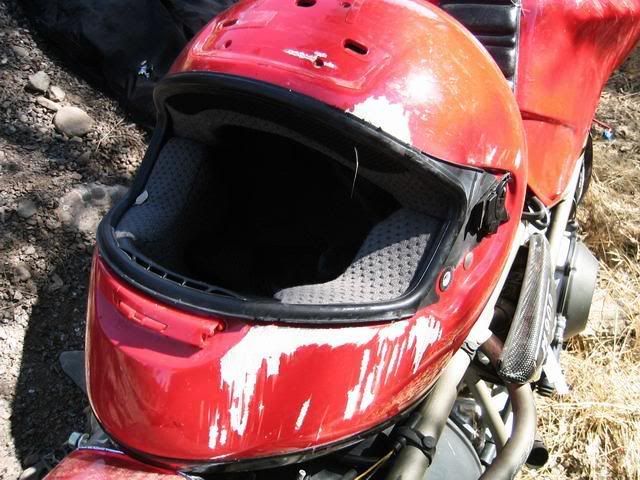
I was wearing this helmet when it contacted the road at about 60 mph. This is why I only wear full face helmets when riding a motorcycle.
helmet.jpg
 
Back
Top