
-
There has been a recent cluster of spammers accessing BARFer accounts and posting spam. To safeguard your account, please consider changing your password. It would be even better to take the additional step of enabling 2 Factor Authentication (2FA) on your BARF account. Read more here.
You are using an out of date browser. It may not display this or other websites correctly.
You should upgrade or use an alternative browser.
You should upgrade or use an alternative browser.
Are open face helmets stupid?
- Thread starter rodr
- Start date


Gixxergirl1000
AFM #731
- Joined
- Oct 30, 2006
- Location
- Stockton
- Moto(s)
- GSXR-1000; GSX-R 450 Triple race bike "Timmay"; GS 500 race bike "The Murderbike"
- Name
- Connie
Don't racers typically walk new tracks before races? My first fall on pavement was in a parking lot where I noticed a suspicious material and didn't check it. I turned over it practicing and went down instantly. It turned out to be a cup of silica beads dumped by a road painting truck during a lunch break. Most of my falls have been traction issues on things I couldn't see or overlooked.
I've yet to walk any of the tracks I've ridden, nor the track I've raced. In fact, I'm not able to. I've still managed to wend my way around the various tracks without binning my shit... and my one get-off at T-Hill was not traction related.
May I suggest you stop running over shit in the road, particularly if you don't know what it is?

No, when in doubt you get off the bikie, inspect the pavement, and then do 3,786 figure 8s. Get it straight.
Bahahahahahaha!!!


Stormdragon
Still Good Lookin'
- Joined
- Feb 12, 2006
- Location
- Cool, (yes, really!) CA
- Moto(s)
- XT600, ZX636, KR250, RS90
- Name
- El Diablo
In asphalt macrotexture is the size of the aggregate, usually gravel, and how far it sticks out of the asphalt. Microtexture is whether the gravel is polished or sharp edged. A good surface to slide on has a prominent macrotexture but the gravel is polished, smooth. The drawback of a polished microtexture is it's liable to be more slippery when wet. Getting off the bike once in a while to hand check pavement has its place. I notice, as my skill improves, I can feel subtler changes in traction which tells me it's time to ease off or get on the throttle.

I'd post a bigger one, but then I'd have to link it, and really... I can't spare the time from my busy schedule of non-road inspection.
Don't racers typically walk new tracks before races?
They walk the track to determine their lines. Not the quality of the road surface.
I've yet to walk any of the tracks I've ridden, nor the track I've raced.
You really should. It's quite enlightening. You get to see all the subtle parts of the track you don't notice at 40~120MPH. Plus the amount and type of detritus is pretty fascinating.


MotoDonkey
New member
I never hear these refereed to as open face helmets but more as "half face helmets" since if you wreck, that's what you are left with... half a face.
What amazes me is that motorcycle cops always wear half face helmets and they are actually officially issued to them. They are so dangerous for the rider yet it's the required gear.
What amazes me is that motorcycle cops always wear half face helmets and they are actually officially issued to them. They are so dangerous for the rider yet it's the required gear.

Motech
_-_-_-_-_-_
- Joined
- Mar 1, 2008
- Location
- Santa Cruz, CA
- Moto(s)
- aprilia RSV Mille: BMW R1200RT: F650-GS: GPZ-Ninja 1000R: Bandit 600: Seca 650:
- Name
- Nancy
I never hear these refereed to as open face helmets but more as "half face helmets" since if you wreck, that's what you are left with... half a face.
What amazes me is that motorcycle cops always wear half face helmets and they are actually officially issued to them. They are so dangerous for the rider yet it's the required gear.
Try defending yourself from multiple threats in a full face helmet sometime. The reduced vision is an extreme disadvantage.
Or, to make it safer, take a joyride one day with an open-face helmet and marvel at the convenience and the significant difference it allows for visual input.
It's a trade-off. Open-face is safer for the enhanced vision, easier to put on and off and more liberating on a warm day. Full-face is safer to crash in, warmer on cold days and compatible with a need to be anonymous.

Sane_Man
Totally Tubular
Try defending yourself from multiple threats in a full face helmet sometime. The reduced vision is an extreme disadvantage.
Or, to make it safer, take a joyride one day with an open-face helmet and marvel at the convenience and the significant difference it allows for visual input.
It's a trade-off. Open-face is safer for the enhanced vision, easier to put on and off and more liberating on a warm day. Full-face is safer to crash in, warmer on cold days and compatible with a need to be anonymous.
I believe cops mitigate the risk of crashing with advanced training. If there is a less risk of crashing, there is less of a need to wear a full-face helmet.

Marcoose
50-50
- Joined
- Jun 24, 2009
- Location
- South Beach, SF
- Moto(s)
- '07 BMW F800s
- Name
- Marc
- BARF perks
- AMA #: 2818042
ATGATT
Don't know 'bout that. I don't crash very often, yet the risk of crashing is in every inch of road. ATGATT.If there is a less risk of crashing, there is less of a need to wear a full-face helmet.
I believe cops mitigate the risk of crashing with advanced training. If there is a less risk of crashing, there is less of a need to wear a full-face helmet.
While it's true that they have infinitely more training than the average joe rider, I think that factor is cancelled by the amount they ride each day, and the situations they have to ride in normally. I can't remember the last time I had to engage in a high speed pursuit in heavy traffic, or split lanes at speed to get to a traffic accident, or have a fleeing felon try to ram me with their car (on purpose), or had to coax a clueless driver to pull to the shoulder on the freeway, by acting as their "blocker" amongst other distracted drivers (hell! Its dangerous enough on the freeway going straight only in the fast lane
 )
)I think the number of incidents you hear about involving motor officers isn't telling the whole story until the results are weighted by numbers. Because they are so often in harm's way, I wouldn't be surprised if the accident rate compared to all other motorcyclists isn't comparable per capita, as in when you go and ride, and they go to work, you both have about a .157% chance of being involved in a serious mishap, something like that. And only their advanced training keeps the numbers from being REALLY dismal for them.
Last edited:

High-Side
New member
My father rode for our local PD back in the fifties before they used helmets. He had a lot of chases and never went down. I think riders were more fearless back then.
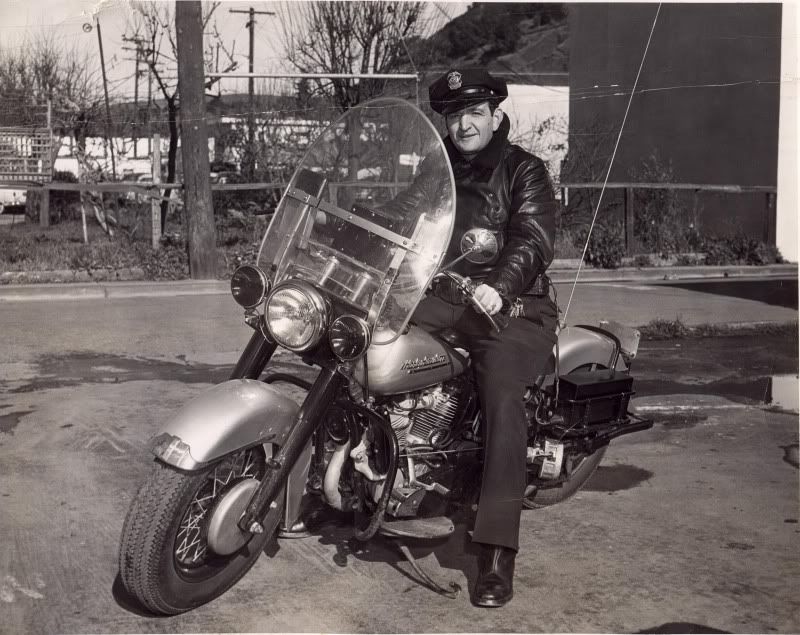
My father rode for our local PD back in the fifties before they used helmets. He had a lot of chases and never went down. I think riders were more fearless back then.
Cool Dad!
I would argue that there is more "fearlessness" now in the riding communities, and back then as it is now with just the moto cops, its akways been competence and confidence.
Sane_Man
Totally Tubular
My father rode for our local PD back in the fifties before they used helmets. He had a lot of chases and never went down. I think riders were more fearless back then.
Was he in black & white in real life?

High-Side
New member


Motech
_-_-_-_-_-_
- Joined
- Mar 1, 2008
- Location
- Santa Cruz, CA
- Moto(s)
- aprilia RSV Mille: BMW R1200RT: F650-GS: GPZ-Ninja 1000R: Bandit 600: Seca 650:
- Name
- Nancy
Interesting graphic posted up by Joe/4theriders on Facebook, thought it was timely to this discussion:
Joe's quote:
Joe's quote:
interesting little graphic i just found. thoughts on 3/4 helmets and saladbowls now? haha!
Attachments

Marcoose
50-50
- Joined
- Jun 24, 2009
- Location
- South Beach, SF
- Moto(s)
- '07 BMW F800s
- Name
- Marc
- BARF perks
- AMA #: 2818042
Interesting distribution between left and right side. Nevertheless, the chin is between 15-20% of impacts. Full face!
Motech
_-_-_-_-_-_
- Joined
- Mar 1, 2008
- Location
- Santa Cruz, CA
- Moto(s)
- aprilia RSV Mille: BMW R1200RT: F650-GS: GPZ-Ninja 1000R: Bandit 600: Seca 650:
- Name
- Nancy
Interesting distribution between left and right side. Nevertheless, the chin is between 15-20% of impacts. Full face!
No, the chinbar takes nearly 35% of the impacts according to that chart. Add both sides together.
Marcoose
50-50
- Joined
- Jun 24, 2009
- Location
- South Beach, SF
- Moto(s)
- '07 BMW F800s
- Name
- Marc
- BARF perks
- AMA #: 2818042
Right-o!
No, the chinbar takes nearly 35% of the impacts according to that chart. Add both sides together.
I need to head to Vegas with my ability to beat the odds because in my accident the first and most serious impact was dead center right at the top of my damned head!

Mr Pepsi
Mr Pepsi (Brent)
- Joined
- Jul 16, 2009
- Location
- San Francisco, CA
- Moto(s)
- "Razzi" 2009 Kawi Concours GTR1400
- Name
- Brent
The benefits of a FF/helmet far out weigh the minuscule disadvantages. You just need to get used to it. (Or get a modular helmet)
Agreed, but studies show, modulars are not much better than open face.
(Sorry, to lame to have references.)

There is at least one modular helmet that meets full face helmet standards. Most don't and some offer very little protection at the chin bar.
Most of them are heavy, and at least the one I tried felt heavier when opened, so I wouldn't want to ride that way. I realize tourers like them, but I don't think they make much sense for most of us. If you're sitting bolt upright maybe the weight won't bother you. But if I'm not getting the protection of a FF helmet, I'd probably rather have the openness of a 3/4 helmet. The riding experience is different, and sometimes I miss it.
Most of them are heavy, and at least the one I tried felt heavier when opened, so I wouldn't want to ride that way. I realize tourers like them, but I don't think they make much sense for most of us. If you're sitting bolt upright maybe the weight won't bother you. But if I'm not getting the protection of a FF helmet, I'd probably rather have the openness of a 3/4 helmet. The riding experience is different, and sometimes I miss it.