• There has been a recent cluster of spammers accessing BARFer accounts and posting spam. To safeguard your account, please consider changing your password. It would be even better to take the additional step of enabling 2 Factor Authentication (2FA) on your BARF account. Read more here.

Chain wear

N4teTheGreat

FknN8
Joined
Dec 5, 2009
Location
San Francisco
Moto(s)
2012 DRZ 400s, 2018 Ducati Hypermotard SP, 2008 KTM 950 SM
Name
Nathan
Though this was interesting. Replaced the chain on my Hypermotard, it has just shy of 18,000 miles or so. Half a link of stretch and it was started to lose adjustment every hundred miles or so.

Old and new...

PXL_20251014_220314551.jpg

Noticeable wear on the drive side of the pin.

PXL_20251015_010513268.MP.jpg

Non drive side (I'm sure there is a more technical term) has markedly less wear which I suppose makes sense as the engine braking forces are less constant than driving forces.

PXL_20251015_010520563.MP.jpg
 
Very interesting. So it's not so much the links stretching as it is the rollers/pins wearing down?
 
So it seems, and looking at that wear it is pretty easy to see how a worn chain can fail as that shoulder worn into the pin would definitely be a stress riser. I didn't try to look at the inside of a roller but I would be it's oblong as opposed to round.
 
… which I suppose makes sense as the engine braking forces are less constant than driving forces.

While it is true one side of the pin should see more wear than the other, the reason is unrelated to whether the engine is driving or braking. Both cases, put the chain in tension. The side of the pin grinding against the bushing while under tension sees more wear than the opposite side of that pin.

Engine driving → top segment of chain is taut (chain under tension)
Engine braking → bottom segment of chain is taut (chain under tension)
 
Oh, ha, I hadn't thought that through, so really only one side of the bushing really gets worn.
 
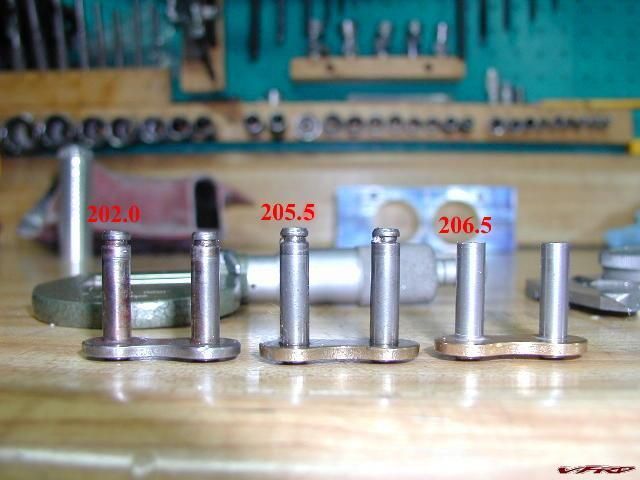
This is what we don't see behind the X rings... metal to metal wear
every time we adjust the chain that eats into our engine's available
HP... a new pin measures 206.5 and wears down to 205.5 at the 8K mile
mark... looks good to the naked eye but multiply that 1 thousand of an
inch times 108 links and you have 108 thousands of an inch wear or
about the range of the green marks provided by Honda's wear gauge...
202.8 show the very visible wear at the 12K mile mark... the pins are
turning red from extreme heat of grinding dry metal... a chain in this
condition may consume up to 6 to 8% of our RWHP... not to mention it
may snap into and cause case damage...

gallery_3131_51_50064.jpg


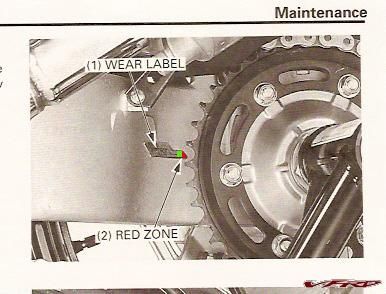
Some manufactures provided a handy guide to monitor chain wear... stay with
in the green and you'll be looking for a new chain and sprockets at the 8 to
10K mile mark...

gallery_3131_51_39609.jpg


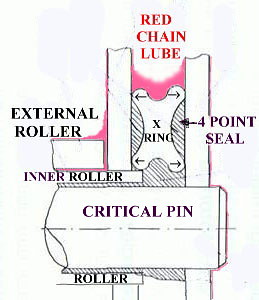
What we are lubing are external roller and between the roller and the
sprockets (red area in my drawing)... we are not lubing the X rings
nor behind the X rings so any oil applied in that effort is a waste
and will only fling off...

14746956046_fb75bdf189.jpg
 
Last edited:
Very interesting. So it's not so much the links stretching as it is the rollers/pins wearing down?
Ya, "chain stretch" has always been a misnomer that confuses people. Pin wear is by far the largest culprit here. I wouldn't be surprised if link stretch is not measurable.
 
favorite chain is the Regina x-ring. It is the only chain I’ve used that didn’t require Slack adjustment within the first 200 miles. A very good chain.
 
WD40 is a lousy lubricant.

I would find a way to get molybdenum disulfide powder on the pins and inside the rollers. That would greatly help to dramatically increase the life of a chain. Unfortunately the seals work to prevent that. And manufacturers won’t use it because they’d sell fewer chains.
 
For those who don’t know about the properties of molybdenum disulfide, it’s a microfine powder, often mixed with oils and grease, that has a coefficient of friction lower than pure Teflon and capable of handling extreme pressures and extreme temperatures. And it works its way into the microscopic pores of the material it’s applied to. And stays there.
 
So WD-40?

WD-40's formula is a trade secret. The product is not patented to
avoid completely disclosing its ingredients. WD-40's main
ingredients, according to U.S. Material Safety Data Sheet information,
are:

* 50%: Stoddard solvent (i.e., mineral spirits primarily hexane, somewhat similar to kerosene)
* 25%: Liquefied petroleum gas (presumably as a propellant; carbon dioxide is now used instead to reduce WD-40's considerable flammability)
* 15+%: Mineral oil (light lubricating oil)
* 10-%: Inert ingredients

If you want your chain to smell nice then use WD-40 but it's about good as spit as a chain lubricator...
 
Running DID ERV520 chain with aluminum AFAM rear sprocket on my RC. I have only used Tri-Flow lube on my chains for last 35+ years. Usually apply after ride when chain is hot and really spray heavily on the inside run of the chain. Wipe off excess at rear sprocket with rag or paper towel folded over the sprocket and chain while slowly rotating the wheel. I get good life out of them. I ran a Sprocket Specialist 530 0n the RC for first 16k miles before switching to 520. That was also aluminum sprocket and is still good.
 
In steel-to steel contacts of this kind you may find a reddish discoloration or even red powder the iron oxide that results
from "frettage," the slight vibratory weld-and-break action between surfaces.


ChainWear.JPG
 
Last edited:
The observation I found compelling about WD40 was... "It's edible".

"Approved for food handling equipment"... that means edible, right?
 
Back
Top