An easier analog for a 50mm
on an SLR body is this:
Get a piece of paper. Cut a rectangle in it.
Looking through the hole in the paper, the view is neither expanded nor compressed.
A smaller sensor is simply like having a smaller rectangle cut in the paper.
That's it.
It is based on a pinhole being 50mm from a 35mm frame size.
When the frame size is 20mm, you just get less of the picture.
But on a point and shoot, for example, the sensor is smaller - and so is the focal length. Which is why you get silly things like 9mm focal lengths on a tiny camera, but it's still only the equivalent of a 35mm lens on an SLR.
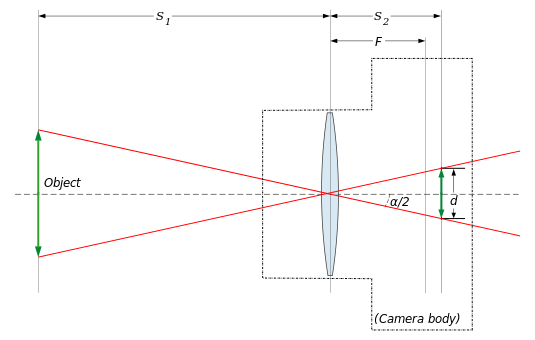
If you move the pinhole closer to the sensor - as in a P&S, then the focal length will be shorter for a given field-of-view. I.e. to see the same amount of world in a smaller camera, the focal length HAS to be shorter because the 'pinhole' is closer to the plane of the sensor.
In this diagram, S2 is the focal length. Clearly, for a large camera, like an SLR, this distance can be larger. At 50mm it is 'neutral' - it's like there is a pinhole at 50mm away from the sensor, that neither condenses nor expands light.
Now, imagine that you shrink that distance to 35mm, but all else stays the same. To fill the sensor, the lens must 'see' more the the world and be a wider angle.
But if you have a P&S with a 10mm sensor, now a 35 mm focal length is actually a zoom lens!
It's confusing because when they launched DSLR's, they did not make the lenses 'fit' onto the smaller sensor size - they just crop unwanted light. Hence, crop-sensor, not simply, 'small sensor'.