• There has been a recent cluster of spammers accessing BARFer accounts and posting spam. To safeguard your account, please consider changing your password. It would be even better to take the additional step of enabling 2 Factor Authentication (2FA) on your BARF account. Read more here.

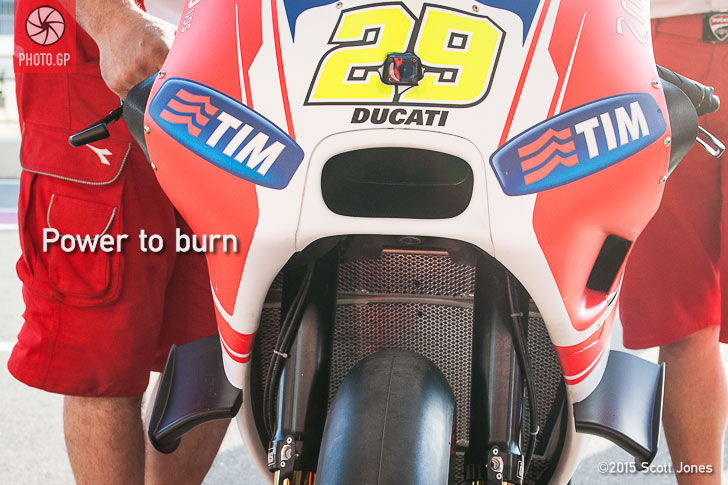
Jorge Lorenzo's fancy new winglets

the bodywork rules fit on 1 page. thats not "a LOT" :laughing. funny u brought up F1. i wouldnt be surprised if they have 1000 rules governing the location, shape, and implementation of just aerodynamic surfaces. GP literally has 9 rules. the consequences of those 9 rules are, of course, endless. i was never talking about that.
 
Sort of like saying, "We're BARELY going to limit your ability to run, because we only have hardly any rules, way fewer than everybody else. But our one rule is this: Your feet have to be cemented into the ground." :laughing Yeah that sounds legit.


My point in my OP was that, wings might work, but maybe they don't under the regulations that limit the aerodynamics of the whole bike. Kind of like putting a giant wing on a civic. If the rest of the bodywork is creating lift and all sorts of other airflow issues, it doesn't really matter how big the wing is. And even then motoGP regulates how big the wing is, so it REALLY might not work.
 
Last edited:
uve got a great imagination for how the current rules limit the winglets. but u havent yet applied that imagination to how any of the factories could implement larger winglets well within the rules. they could line the leading edge of the fairings with countless winglets and make them as deep as they wanted and still be legal. Duc made their upper fairing wider at the handlebars with extra pieces to allow for wider winglets, adding only a tiny bit more frontal area. then, they added tiers to the winglets which likely increased their effect. then, they made the rest of the fairings narrower and the winglets larger still. so where is the problem? that Duc cant put winglets on the tail or the swingarm. hell, even Lou knows that winglets on the tail would be completely useless because of the huge wake created by the rest of the moto. thats not a regulation, thats just flow dynamics :laughing

there is no way u can say that the winglets do not or will not work under the current regulations or because of the regulations. Duc has been using that all season and their implementation actually gave Yamaha the idea to use them. Iannone and Dovi think they have an effect. it might not be much, but its something over a single lap. thats greater justification for their success than anything u can guess at.

oh, one little thing. Duc's winglets are actually limited in length by the curb height at some tracks and 63deg of lean angle :D. of course they could move them up, but u know.
 
Last edited:
there is no way u can say that the winglets do not or will not work under the current regulations or because of the regulations.
Motogp has a slew of rules limiting the effectiveness of wings, their length, the size and shape of bodywork, etc. it might be something where wings WOULD very clearly give an advantage if they were 4x bigger. Maybe not.


You love arguing so much you don't even care when you're agreeing with someone. :twofinger goddamn you're an annoying condescending DB sometimes.
 
Last edited:
u typed it, but its def not correct. ya i was enjoying the convo w/ u. i wasnt try to be condescending, just giving justification for y u are wrong. thnx for calling me a douchebag though.
 
Last edited:
Ducati-GP15-front-view.jpg

Here's the other part of that, the point of these wings is to create downforce on the front wheel. The way F1 does this is by creating a wing down and in front of the wheel. IN MotoGP the bodywork, including the winglets, can be in front of the front wheel. There can't be anything blocking the sideview of the front wheel either except forks, brakes, and the mudguard (which has a bunch of size and shape limits too). That means it has to be above or behind the front wheel. Those are sort of awkward places to work from when trying to leverage the wind against the front wheel. The problem with a wing too high is that, if the bike wheelies, it's going to create even more lift, and that upper fairing above the radiator already has lift problems. And the rules say you can't have a wing that tilts, so you can't fix that problem with a little motor, tilting the wing.

The other rule says that the bodywork, incl the wings can only be about 23 inches wide (600mm) I'm going to guess that the wings are at the maximum width. The curb's not limiting the length, but it is limiting how low they can be placed.
 
Last edited:
notice that u never said that generating downforce was impossible, just "awkward". race engineers deal w/ "awkward" shit all the time within regulations. designing a GP bike is hard, we know that. Duc found a solution that works for them.

the height of the winglet wont have a large affect on the possibility of generating lift. Yamaha's winglets are further from the rear tire and would generate more torque due to any lift. maybe thats why Duc's arent on the nose. but ya, the winglet's angle of attack is a bigger deal. obviously Duc and Yam has their wings set w/ an angle of attack below horizontal to help w/ that. one cool part of that is when braking... the angle of attack will decrease as the bike pitches forward and may create more downforce and more drag, which could be a good thing.

theres a guy on here named BusyLittleShop. he was allowed to take a tape measure to some GP bikes a few years ago. if we can find his posts about it, itll give us a better idea if the bodywork and winglets are at max width.
 
Last edited:
Yep, notice I never said it was impossible.... I said the rules could be limiting the functionality. I don't know how else to tell you this, but you're arguing with me and agreeing with me at the same dumb time.

Look at the bars. Those bars are probably 24 or 25 inches wide. Honda and Yamaha are 25/26 inches. The winglets aren't too far behind and we know they can't be more than 23.4 inches wide so... eyeball it.
 
Last edited:
i understand what u are trying to say. im not agreeing with u. sry i havent been clear on that. u keep bring up ideas that mostly boil down to "designing a GP bike is hard" as justification for "MAYBE they dont" AND "the rules are limiting them". im providing justification that the current winglets DO provide an advantage under the current regulations AND the factories could easily increase the effect if they wanted under the regulations. i posted info on how Duc has already increased the effect and provided suggestions for how they could continue to increase it within the regulations. telling me "but they cant do it like F1" isnt justification of anything.

this is an engineering problem and i do like them. here are some quick ideas for increasing the effect of a single set winglets within the regs:
- increase the camber / change the profile of the winglet
- decrease the angle of attack further
- use the shape of front fender, maybe like Moto2, to direct more laminar flow to the base of the winglets
of course, all those will have side-effects. more drag is prob the most likely one. but if the goal is keeping the wheel down so u can wind on more power, maybe there would be a net positive.
 
Last edited:
u keep bring up ideas that mostly boil down to "designing a GP bike is hard" as justification for "MAYBE they dont" AND "the rules are limiting them".

never said that. thx. You don't need to boil it down because its simple as is: You may never be able to create enough of a wing for it to do anything under the current regulations. And right now the consensus is "we don't know if it does anything."

factories could easily increase the effect if they wanted under the regulations.

Go for it. Create an example of how you'd increase front wheel downforce under the regulations. You have no effing idea whether or not your "just make it deeper" idea would improve downforce over the front wheel. Making it deeper moves the wing further and further away from the front wheel so there's less leverage. It may not do anything at all except create more drag. And it moves it further into, as you so poignantly pointed out a couple pages ago, more turbulent air.

Here's Lorenzo weighing in:

“The idea have more than 15 years because Yamaha used it in ‘99 with Checa and Biaggi, but they didn't keep using it in the next years and after some years we put it on again,” Lorenzo explained. “Ducati started to use it this year again, so they started it and we make more or less the same to see what happens.”

The ones on Lorenzo’s Yamaha are farther forward, located on the front fairing rather than the lower ones on the Ducatis' side fairings. Yamaha tested them at Aragon and Lorenzo wanted to try them at first opportunity to see if they work (teammate Valentino Rossi opted not to). So did it make a difference?
“We’re not sure,” he said. “We have to still see the telemetry… It’s not a big difference because if it was we would notice so much from the first lap. But if it can give you a very small advantage, it’s better.”
 
Last edited:
theres no substance to your rebuttal and u just continue to claim that u know more. more of the same bullshit story from u.

no one said "over the rider". there is a significant difference between the flow of the air at the FRONT of the bike and at the BACK. the winglet are not anywhere close to the rider or the tail of the motorcycle.

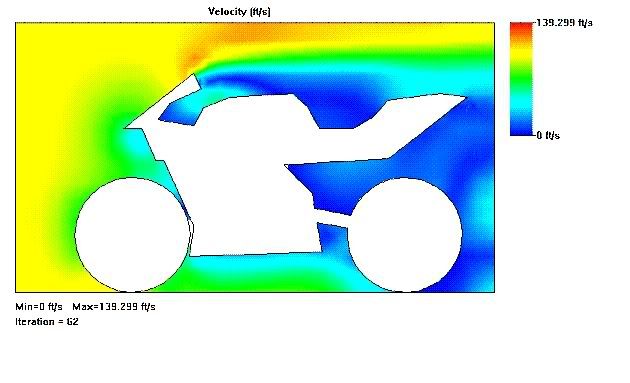
heres a little over-simplified CFD i did years back during my aerospace engineering degree. i eventually did add the rider and refined the model slightly, but i cant find those images. funny enough, even these drag coefficients were within 10% with such a terrible model.
roughbikevelsmall.jpg

Nice image. My old SV race bike had a flimsy fairing stay and the windscreen would visually bend the entire front fairing down a couple inches at speed 100+.
 
I think they direct the flow to a location to channel the air better and allow the bike to slip through the air easier..not add downforce. Because the reason you add downforce is to keep the car on the track, and most importantly add in cornering grip. And since these winglets will be facing a more vertical angle, they won't do anything when the bike is leaned over in a corner. Hence the airflow in a straight line idea.
 
tl:dr all the posts.

But the winglets for both Ducati and Yamaha were in an attempt to get better front end feel via downforce, in a corner. Their issue is to not create so much downforce that it hinders their top end speed.
 
These winglet replicas will sell on ebay with A++ fast shipping from china with annodized billet rearset for $50. Good for bling points for your next bux run.
 
These winglet replicas will sell on ebay with A++ fast shipping from china with annodized billet rearset for $50. Good for bling points for your next bux run.

So want for my SV!:)
 
But the winglets for both Ducati and Yamaha were in an attempt to get better front end feel via downforce, in a corner. Their issue is to not create so much downforce that it hinders their top end speed.
by the look of them I had to wonder what happens when you accidently get a big wheelie at speed? (over a rise, etc.) Added downforce likely makes it harder to do this as an added benefit, but you can be sure that's been thought of?
 
never said that. thx. You don't need to boil it down because its simple as is: You may never be able to create enough of a wing for it to do anything under the current regulations. And right now the consensus is "we don't know if it does anything."

continuing to type this will not make it true. this is your opinion and its just wrong.

Duc continuing to use and develop their winglets is great justification for the existence of an effect. hell, Duc now has 2 version of their winglets that they switch between at each track, depending on which one works better. theyve got a two-tiered version (similar to an airplane with its flaps down) that likely produces more downforce and more drag and a single-tiered version that prob has less drag but less downforce. choosing between the two per track shows unequivocally that they there is an effect that they like.

Go for it. Create an example of how you'd increase front wheel downforce under the regulations. You have no effing idea whether or not your "just make it deeper" idea would improve downforce over the front wheel. Making it deeper moves the wing further and further away from the front wheel so there's less leverage. It may not do anything at all except create more drag. And it moves it further into, as you so poignantly pointed out a couple pages ago, more turbulent air.

i already gave u 2 ways that Duc already did increase downforce over prev designs and i gave u 5 plausible ways to continue to increase downforce. "make it deeper" might be the least effective way to increase the downforce, depending on the airflow, but that doesnt mean it wont increase the effect. it seems u are failing to understand the ideas that ive proposed. do u know anything about the aerodynamics of airfoils?

u are mixing up downforce with torque about the rear wheel. downforce is always just a vector that points straight down. if the airflow is the same, downforce wont change with the location of the winglet. but of course the torque will based on the distance from the rear axle. if making the winglet deeper increase the downforce by 50% and only moves the center of pressure (the point location of the downforce) closer to the rear axle by 5%, u still get a net positive for torque.
 
Last edited:
Nice image. My old SV race bike had a flimsy fairing stay and the windscreen would visually bend the entire front fairing down a couple inches at speed 100+.

your fairing stay was F1-level tech. F1 teams have purposefully tried to make their wings as flimsy as allowed by the rules so that theyll bend out of the wind at high speeds to reduce drag.

rough dimensions of the model were based on my CBR F2. the CFD program was able to produce a drag result. i was really surprised when it told me that it would take about 75HP to do 130MPH (IIRC), since those numbers are not that far off of the real world.

what incited me to do that little pet project was a guy on an old CBR forum talking about his salt-flat runs. he told stories about how turning the handlebars in to get them out of the wind gained them >5mph. i never made it to modeling that change, but it was fun none the less.
 
continuing to type this will not make it true. this is your opinion and its just wrong.

You're getting way too far ahead of yourself. You see one team out of fourteen play with winglet designs and you assume they absolutely work. That's to say you know something at least thirteen teams don't.
Leave a little room for skepticism and, at the very least, you won't come off so pointlessly argumentative and condescending.

And no I'm not mixing downforce with torque. You're mixing your ability to model aerodynamics on your computer with an ability to know what's going on in a conversation. If you're limited to a certain size wing, where you put that wing matters, and if the rules state you can't put that wing in the most ideal location, then the rules are limiting the effectiveness of that wing. It's that simple.
 
Last edited:
You must know something Yamaha, Honda, Suzuki, Aprilia etc. doesn't then. Where's your proof? Continued development from Ducati means they're playing with an idea, not that it works.

race teams dont play with ideas that produce no effect for more than half a season. Duc found an effect. some tracks they want more effect, others they want less. IIRC Duc ran the tiered winglets at Sachsensing, Silverstone and Misano, but ran non-tiered ones at Indy and Brno.

why are u including Yamaha in the list? Rossi raced with them so he must have liked the effect they produced.

You're getting way too far ahead of yourself. You see one team out of fourteen play with winglet designs and you assume they absolutely work. That's to say you know something at least thirteen teams don't. Leave a little room for skepticism and, at the very least, you won't come off so pointlessly argumentative and condescending.

:laughing, this point is stupid

14 teams? u mean 3, right? Sat/Open teams dont do development. its true that Honda, Suzuki, and Ape havent developed winglets. but Yamaha now has in response to Ducati's continued use of them.

i am very skeptical of new ideas. but i know how airfoils work and i can make a lot of educated guesses as to how that applies to motorcycle dynamics. no one is ever going to tell us that Duc is getting 15lb-f out of their winglets and can dial back 3% of their wheelie control. but if they continue to use them for the entire fucking year, still have them on next years bike, and other teams put in development effort, thats great justification for a positive result.

perhaps u should actually attempt to learn something in any thread so u dont come off so pointlessly ignorant

And no I'm not mixing downforce with torque. You're mixing your ability to model aerodynamics on your computer with an ability to know what's going on in a conversation. If you're limited to a certain size wing, where you put that wing matters, and if the rules state you can't put that wing in the most ideal location, then the rules are limiting the effectiveness of that wing. It's that simple.

your logic is full of bad assumptions. just stop.
 
Last edited:
Back
Top