• There has been a recent cluster of spammers accessing BARFer accounts and posting spam. To safeguard your account, please consider changing your password. It would be even better to take the additional step of enabling 2 Factor Authentication (2FA) on your BARF account. Read more here.

Sinking San Francisco building

All together there was 17 Bents/Footing that were on the project (for the bridge). There were 8 piles per footing, IIRC. The piles were always part of the contract. Kiewit was the GC and they initially began to drill the piles using their reverse oscillation method. Basically, it's an open hole method that works good in competent material (they actually did a few Bents with this method). But when they got to the deeper shafts, and the claystone/siltstone turned to weathered crap, they couldn't keep the hole open and had caving conditions. So they had to backfill the shafts and come up with a new game plan.

So after wasting alot of time and money. Caltrans pretty much said that the shafts had to be cased down to tip. Being that Malcolm was the only driller with the equipment capable to do such a job, they made a lot of money. It was all T&M...I think it was around a $40M dollar job. It was a pretty impressive job.

The 3 Bents you may be thinking of might have been the land footings, which Malcolm did on the south side, I believe in early 2002...prior to me coming on board.

Yes pile were always part of the design but rotating them into place was not. Kiewit had a pile hammer that happened to be the biggest one on the west coast until they bought a bigger one for the Bay Bridge pile.

Initially the Benicia pile driving was killing fish from the high decibel level travelling through the water, measured at near 200 decibels in the water. So a bubble curtain was configured around the pile during pile driving by placing large compressors on barges and blowing compressed air through perforated pipes around the pile. This was allowed only twice a day at slack tide instead of driving pile for full shift as was initially planned. This added over a year to the project.

There were 8 pile per footing except for piers 7 and 8 which were on either side of the navigation span. Those two had 9 pile. At pier 7 the sub soil was harder than expected from the soil samples. If you remember some of the pile at pier 7 were already driven by the time Malcolm showed up and were sticking well above their design elevation. They had to be water jet cut and a platform built over those pile for Malcolm to place their rotator.
At pier 8 it was the opposite, the soil was softer than expected and the cave in issues. Malcolm also drilled the pile on the north shore at pier 16.

Pier 9 was the first pier to have its pile driven and was finished before Malcolm came onto the project. The cost to the project in delayed schedule, Malcolm, supporting Malcolm with platforms, pile cutting… was over $100M.

The initial contract was won by Kiewit with a bid of around $278M. The total paid to Kiewit in the end was over $800M.
 
Last edited:
I've heard a of wind turbine tower with a cracked foundation that ended up leaning a bit. This was allegedly because the foundation designer use an assumed constant rather than using values from the geotech report.
 
Yes pile were always part of the design but rotating them into place was not. Kiewit had a pile hammer that happened to be the biggest one on the west coast until they bought a bigger one for the Bay Bridge pile.

Initially the Benicia pile driving was killing fish from the high decibel level travelling through the water, measured at near 200 decibels in the water. So a bubble curtain was configured around the pile during pile driving by placing large compressors on barges and blowing compressed air through perforated pipes around the pile. This was allowed only twice a day at slack tide instead of driving pile for full shift as was initially planned. This added over a year to the project.

There were 8 pile per footing except for piers 7 and 8 which were on either side of the navigation span. Those two had 9 pile. At pier 7 the sub soil was harder than expected from the soil samples. If you remember some of the pile at pier 7 were already driven by the time Malcolm showed up and were sticking well above their design elevation. They had to be water jet cut and a platform built over those pile for Malcolm to place their rotator.
At pier 8 it was the opposite, the soil was softer than expected and the cave in issues. Malcolm also drilled the pile on the north shore at pier 16.

Pier 9 was the first pier to have its pile driven and was finished before Malcolm came onto the project. The cost to the project in delayed schedule, Malcolm, supporting Malcolm with platforms, pile cutting… was over $100M.

The initial contract was won by Kiewit with a bid of around $278M. The total paid to Kiewit in the end was over $800M.

I remember watching Kiewit drive the permanent casings down to rock, as all the platforms we drilled off were built on the 8 to 9 casings driven into place, and there was a couple guys out in a dingy monitoring the fish kills. Pier 8 was a joy because Kiewit backfilled the casings with fiber reinforced concrete. So we had to rotate/drill through that. Yes, we (MDCI) drilled Pier 16 and 17...Condon-Johnson did the one just north of Pier 17.

Pier 10 was the most sketchy as it was in the middle of the Carquinez Strait. Those went to as much as 300ft below platform level.
 
I heart shop talk (even when I don't understand it.) Thanks for that guys.
 
Yes pile were always part of the design but rotating them into place was not. Kiewit had a pile hammer that happened to be the biggest one on the west coast until they bought a bigger one for the Bay Bridge pile.

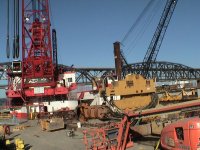
The APE Super Kong.
 

Attachments

  • DSC00598.jpg
    DSC00598.jpg
    123.7 KB · Views: 48
Thats just a vibrator to get it through the soft mud enough for the hammer to take over.

This is the Bay Bridge hammer.

7898d097_1200.jpg
 
Oh cool. Awesome pic.
 
^^ That's a BFH. Those poor fish...LOL
 
So, now the pertinate questions.

How much vertical clearance does one of those pile driving machines need to have in order to drive piles that need to go down 300 feet?

From what I read, the parking garage is under the 11 (12?) story portion of the Millennium Tower, so how would they go about driving piles down to bedrock while the building is still standing? I'm guessing that they'll need to reinforce places when they have to create access for the machine to be moved about the foundation.
 
So, now the pertinate questions.

How much vertical clearance does one of those pile driving machines need to have in order to drive piles that need to go down 300 feet?

From what I read, the parking garage is under the 11 (12?) story portion of the Millennium Tower, so how would they go about driving piles down to bedrock while the building is still standing? I'm guessing that they'll need to reinforce places when they have to create access for the machine to be moved about the foundation.

Those smaller ones look like the height of a couple of floors might do. Nowhere would they try to drive a 300' pile. it would be installed in shorter sections and welded together as it went down if driving with a hammer. With rotating they bolt sleeve sections together as they go. Those sleeves may or may not be removed as they fill with concrete, depending on how fat your budget is.

In a confined space like Millennium Tower it's going to be super expensive at this stage and slow. But they put a man on the moon 50 yrs ago so its not impossible to fix that tower.

;
 
Last edited:
Those smaller ones look like the height of a couple of floors might do. Nowhere would they try to drive a 300' pile. it would be installed in shorter sections and welded together as it went down if driving with a hammer. With rotating they bolt sleeve sections together as they go. Those sleeves may or may not be removed as they fill with concrete, depending on how fat your budget is.

In a confined space like Millennium Tower it's going to be super expensive at this stage and slow. But they put a man on the moon 50 yrs ago so its not impossible to fix that tower.

;
Do you have a general idea of the rough range that it would cost to get it done and also to get it done right (i.e. no problems for more than 50 years)?

If it's over $100 Million, I'll bet the developers will pocket their profits and hide behind declaring bankruptcy with the corp to wash their hands of all of this.
 
Thats just a vibrator to get it through the soft mud enough for the hammer to take over. [/img]

Hmmmmmm...That's a big vibrator.
 
Do you have a general idea of the rough range that it would cost to get it done and also to get it done right (i.e. no problems for more than 50 years)?

If it's over $100 Million, I'll bet the developers will pocket their profits and hide behind declaring bankruptcy with the corp to wash their hands of all of this.

Its specialized work and just dealing with the confined space in an occupied building in a city like SF, union worker rates, getting material in and dirt out...
Pulling a number out my ass yeah I'd guess near $100M. This isn't my field but I have been around these operations and their planning so have an idea of the complexity and time frame, and costs when things not going to plan.


;
 
Last edited:
Its specialized work and just dealing with the confined space in an occupied building in a city like SF, union worker rates, getting material in and dirt out...
Pulling a number out my ass yeah I'd guess near $100M. This isn't my field but I have been around these operations and their planning so have an idea of the complexity and time frame, and costs when things not going to plan.


;

Do tenants get relocated during projects like this? Imagine if someone fucked up and there was a collapse with people living there. Yikes.
 
Do tenants get relocated during projects like this? Imagine if someone fucked up and there was a collapse with people living there. Yikes.

No ides. I'm not an expert, I just play one on barf :laughing


If I were to guess I would assume tenants could stay. Any proposed solution would have to show minimal risk to the city or adjacent buildings or to the Millennium Tower itself.
 
Back
Top