• There has been a recent cluster of spammers accessing BARFer accounts and posting spam. To safeguard your account, please consider changing your password. It would be even better to take the additional step of enabling 2 Factor Authentication (2FA) on your BARF account. Read more here.

pge liable for camp fire?

Stockholders of PG&E don't make money on rising stock values, they make money on dividends. So the price going down doesn't really effect them like you might think.

Once upon a time I was a military acquisition officer. The crap that private military contractors were allowed to get away with because of the whole too big to fail mentality and the fact that the major military contractors had consolidated so much that for certain capital equipment needs there were only 2 companies left that could produce the product was sickening. Massive massive massive fuck ups and unnecessary cost overruns eaten by the tax payer because making the contractor comply with the contract would bankrupt them. Hard to learn a lesson when Uncle Sam says it's ok, we got this, do better next time.

Incorrect. The dividend was stopped after the last fire and the bonds that were issued to help PG&E keep doing business do not guarantee their future existence. They are in deep deep trouble. They were in deep trouble after the last fire. The stock is down 20% today. Edit, fifteen minutes later it is down almost 30% today, and from a high of 70 plus a year ago to the low 20s, now 23. PG&E is probably toast.

It may be many years before they pay a dividend again, if ever.


https://seekingalpha.com/article/4203700-pg-and-e-bailout-will-dividends-resume
 
Last edited:
PG&E and SoCal Edison would be smart to acquire (or contract) and maintain their own fleet of DC10 Fire bombers. Serious comment.

Why on earth would they invest that much money? Let the public pay for it all like we do now.
 
Trading just halted on PG&E as it slid almost 30% today.
 
Down to 1980's prices. Healthcare and electricity will be services for the elite in California. :laughing
 
Down to 1980's prices. Healthcare and electricity will be services for the elite in California. :laughing

What I expect to happen is reorganization with shareholders taking a huge bath, along with bondholders, and a new company inheriting the infrastructure.
 
What I expect to happen is reorganization with shareholders taking a huge bath, along with bondholders, and a new company inheriting the infrastructure.
Of course, the Execs will give themselves fat bonuses for all of their effort...
 
What I expect to happen is reorganization with shareholders taking a huge bath, along with bondholders, and a new company inheriting the infrastructure.

Yup. Just like they did in the 2000's. They will split into two companies. One will focus on generation, the other distribution.
 
Yup. Just like they did in the 2000's. They will split into two companies. One will focus on generation, the other distribution.
As I recall, their split in the 2000's was a move to preserve their profits in the parent corp by separating out the other part. It was done purely for tactical purposes in the event of lawsuits, with all of the profits moving up to the parent corp and out of reach of any lawsuits.

Anybody have more specific information on this?
 
As I recall, their split in the 2000's was a move to preserve their profits in the parent corp by separating out the other part. It was done purely for tactical purposes in the event of lawsuits, with all of the profits moving up to the parent corp and out of reach of any lawsuits.

Anybody have more specific information on this?

It was due to bankruptcy:

from wikipedia (https://en.wikipedia.org/wiki/Pacific_Gas_and_Electric_Company#Bankruptcy)

In 1998, a change in the regulation of California's public utilities, including PG&E, began. The California Public Utility Commission (CPUC) set the rates that PG&E could charge customers and required them to provide as much power as the customers wanted at rates set by the CPUC.

In the summer of 2001 a drought in the northwest states and in California reduced the amount of hydroelectric power available. Usually PG&E could buy "cheap" hydroelectric power under long term contracts with the Bonneville Dam, etc. Drought and delays in approval of new power plants and market manipulation decreased available electric power generation capacity that could be generated in state or bought under long term contracts out of state. Hot weather brought on higher usage, rolling blackouts. etc.

With little excess generating capacity of its own PG&E was forced to buy electricity out of state from suppliers without long term contracts. Because PG&E had to buy additional electricity to meet demand some suppliers took advantage of this requirement and manipulated the market by creating artificial shortages and charged very high electrical rates. The CPUC refused to adjust the allowable electric rates. Unable to change rates and sell electricity to consumers for what it cost them on the open market PG&E started hemorrhaging cash.

PG&E Company (the utility, not the holding company) entered bankruptcy under Chapter 11 on April 6, 2001. The state of California tried to bail out the utility and provide power to PG&E's 5.1 million customers under the same rules that required the state to buy electricity at market rate high cost to meet demand and sell it at lower fixed price, and as a result, the state also lost significant amounts of money.

The crisis cost PG&E and the state somewhere between $40 and $45 billion.[56] There is some evidence that this crisis played an important part in the eventual recall of California Governor Gray Davis.

PG&E Company, the utility, emerged from bankruptcy in April 2004, after paying $10.2 billion to its hundreds of creditors. As part of the reorganization, PG&E's 5.1 million electricity customers will have to pay above-market prices for several years to cancel the debt.
 
Another note- we talk about undergounding which is hugely expensive, but what about retrofitting with insulated wires vs the naked wires we have now? That way the only spark is the end where a line breaks, not the whole length of it. Colorado has had massive success with insulated wires if I remember correctly.
 
Another note- we talk about undergounding which is hugely expensive, but what about retrofitting with insulated wires vs the naked wires we have now? That way the only spark is the end where a line breaks, not the whole length of it. Colorado has had massive success with insulated wires if I remember correctly.

I'd love to see some studies on this. The issue with high voltage is that the insulation has to be thick, and that's quite thick. Typically the line breaks fall to the ground and arc at one or two points, not the entire length. Potential looks for the lowest resistance always.
 
I'd love to see some studies on this. The issue with high voltage is that the insulation has to be thick, and that's quite thick. Typically the line breaks fall to the ground and arc at one or two points, not the entire length. Potential looks for the lowest resistance always.

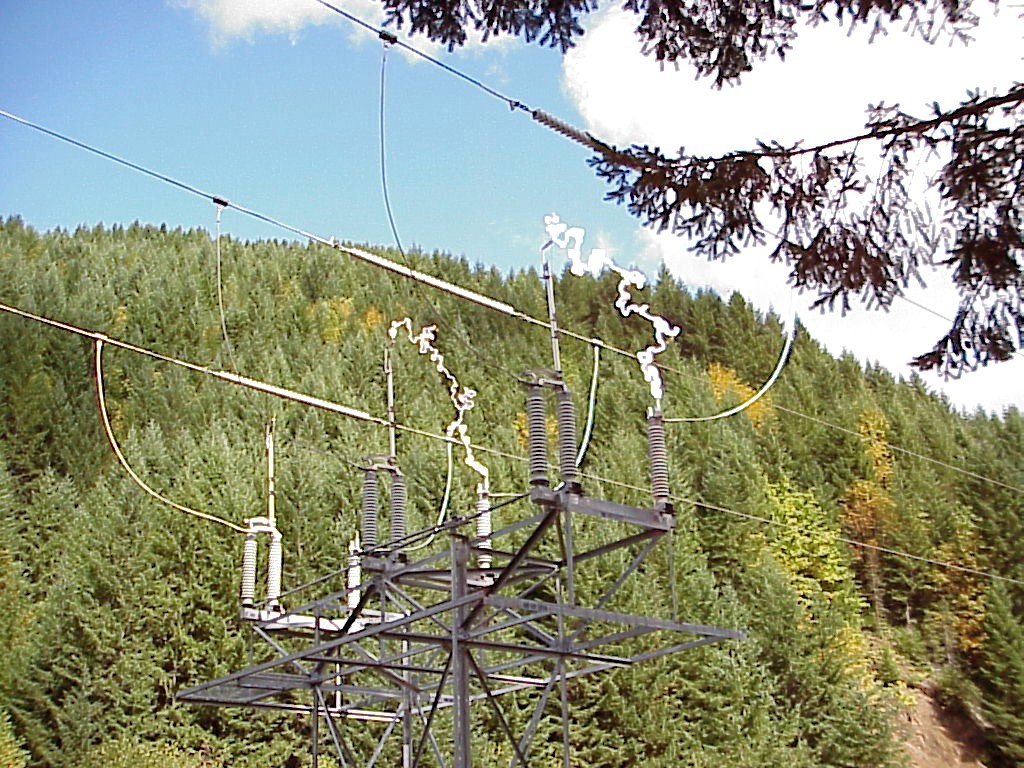
Quite thick yes. If the issue is phase-phase arcing (as opposed to line downing) because of vegetation blowing into the lines and connecting phases (then dropping the now flaming vegetation which had caused the phase-phase arc into the fuel below), it may help.

(this is not a photo of what I've described, but a similar arc caused by a switching failure)
B-1196%20switching%20failure.JPG
 
Last edited:
Incorrect. The dividend was stopped after the last fire and the bonds that were issued to help PG&E keep doing business do not guarantee their future existence. They are in deep deep trouble. They were in deep trouble after the last fire. The stock is down 20% today. Edit, fifteen minutes later it is down almost 30% today, and from a high of 70 plus a year ago to the low 20s, now 23. PG&E is probably toast.

It may be many years before they pay a dividend again, if ever.


https://seekingalpha.com/article/4203700-pg-and-e-bailout-will-dividends-resume

I guess I wasn't clear enough. Since San Bruno I assumed nobody owning PG&E was making money. I should have said in general, when buying a PUC, buyers tend to get in for the dividend not the appreciation of the stock value. Obviously in PG&Es case much has changed in the last few years.
 
I guess I wasn't clear enough. Since San Bruno I assumed nobody owning PG&E was making money. I should have said in general, when buying a PUC, buyers tend to get in for the dividend not the appreciation of the stock value. Obviously in PG&Es case much has changed in the last few years.

There are also BIG tax benefits for investing in PUCs
 
An article written about PG&E's (guaranteed) profits and their failure to do their job of keeping trees off their lines despite funding built in to do so with their rates.

Editorial: PG&E records show utility cannot be trusted
The Bay Area News Group’s George Avalos reported Thursday on the state audit by the PUC showing that PG&E violated electricity-grid safety regulations at least 11 times in the North Bay in the years prior to this fall’s ferocious fires. The PUC said that the utility had also failed in thousands of instances over a five-year period to conduct timely inspections and work orders required by the state regulator.

That’s since the 2010 San Bruno gas line explosion that killed eight people and destroyed 38 homes.

During the same five-year period, PG&E pocketed about $1 billion in profits every year.

The PUC should immediately reduce PG&E’s guaranteed profit level. When the utility went bankrupt in 2001, the PUC guaranteed shareholders an 11.3 percent return on equity, about a percentage point above the industry standard. If cutting their profit doesn’t get PG&E’s attention, it may be time to begin the complex process of breaking up PG&E and to seek another, safer system to provide gas and electrical service to its 16 million customers.
 
I thought about insulating the wires too but wouldn't it make the wires too heavy?
 
Not sure why all of this discussion is coming up to spend $6 Million per mile when PG&E has been given a ton of money to do maintenance on their lines but instead pockets the money instead to provide bonuses for the Execs and higher profits.

It's like plenty of other discussions on laws that aren't enforced, if PG&E actually did the maintenance, spending the rate-payer assessed charges that they were given by the CPUC to do it, we wouldn't be seeing these problems and explosions like in San Bruno.

But, since there were no real consequences (certainly not for killing people for profit), why would they bother to do that?

Each time they are proven to not be doing what they're supposed to with the money, they are just given more.
 
Back
Top