rothmans
Lowering my expectations
Another bummer about the OZ crash as this 777 was a Quadra Smartium bird !!

Half the ones I know refuse to fly
Then they get drunk and start telling you about how much is actually holding your wings on etc etc etc.
I won't get on a plane sober
arty
SOUTH SAN FRANCISCO, Calif. (AP) — The pilots of Asiana Flight 214 that crashed at San Francisco airport have told investigators they were relying on automated cockpit equipment to control their speed, turning a focus of the accident investigation toward whether a mistake was made setting the autothrottle or if it malfunctioned.
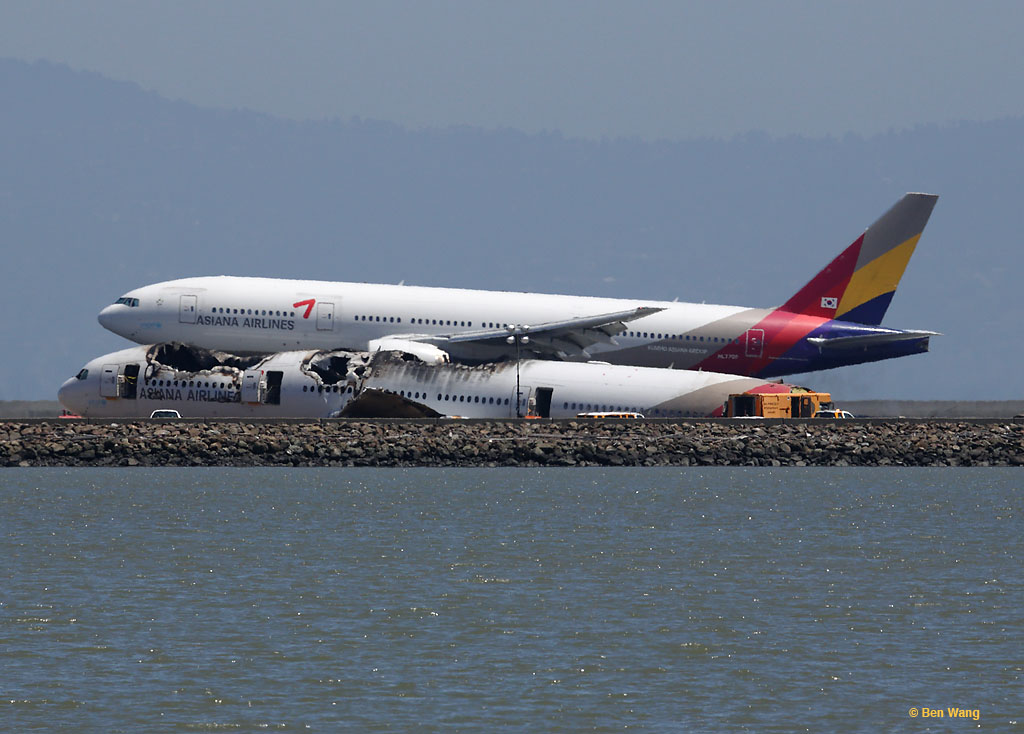
One of the most puzzling aspects of the crash Saturday has been why the wide-body jet came in far too low and slow, clipping its landing gear and then its tail on a rocky seawall just short the runway. The plane then careened before slamming to the ground, killing two of the 307 people aboard the Boeing 777 and injuring scores of others.
Among those injured were two flight attendants in the back of the plane, who survived despite being thrown onto the runway when the plane slammed into the seawall.
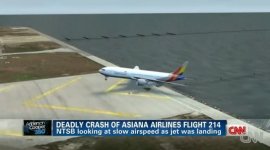
National Transportation Safety Board chairman Deborah Hersman said Tuesday the training captain who was instructing the pilot flying the Boeing 777 has told investigators he thought the autothrottle was programed for a speed of 137 knots — the target speed the pilots had selected for how fast they wanted the plane to be flying when it crossed the runway threshold. Instead, investigators said the plane reached speeds as low as 103 knots and was in danger of stalling because it was losing lift fore it hit the seawall.
The pilot told investigators he realized the autothrottle, similar to a cruise control, was not engaged just seconds before they hit. Their last second efforts to rev the plane back up and abort the landing failed, although numerous survivors report hearing the engines roar just before impact.
Asked if the autothrottle was malfunctioning, Hersman said that is something investigators are looking into as they examine hundreds of parameters of data downloaded from the plane's flight data recorders.
An overreliance on automated cockpit systems has figured in dozens of air crashes and incidents in recent years.
Tuesday's Asiana Flight 214 comes in for a landing over the wreckage of Saturday's Asiana Flight 214 …
"Some people, if they believe the autothrottles are engaged and if they are used to flying with the autothrottle engaged, will not realize that the autothrottles are not engaged and will let the plane get pretty slow. That has come up before," said John Cox, an aviation safety consult and former Air Line Pilots Association accident investigator.
Hersman said the pilots told investigators they were relying on automated cockpit equipment to control their speed during final approach, but NTSB officials say it is still unknown whether a mistake was made in programming the "autothrottle" or if the equipment malfunctioned.
Hersman said the pilot at the controls was only about halfway through his training on the Boeing 777 and was landing that type of aircraft at the San Francisco airport for the first time ever. And the co-pilot was on his first trip as a flight instructor.
A final determination on the cause of the crash is months away and Hersman cautioned against drawing any conclusions based on the information revealed so far.
Here is what is known: Seven seconds before impact, someone in the cockpit asked for more speed after apparently noticing that the jet was flying far slower than its recommended landing speed. A few seconds later, the yoke began to vibrate violently, an automatic warning telling the pilot the plane is losing lift and in imminent danger of an aerodynamic stall. One and a half seconds before impact came a command to abort the landing.
The plane's airspeed has emerged as a key question mark in the investigation. All aircraft have minimum safe flying speeds that must be maintained or pilots risk a stall, which robs a plane of the lift it needs to stay airborne. Below those speeds, planes become unmaneuverable.
Because pilots, not the control tower, are responsible for the approach and landing, former NTSB Chairman James Hall said, the cockpit communications will be key to figuring out what went wrong.
The wreckage of Asiana Flight 214, which crashed on Saturday, July 6, 2013, is seen on a tarmac at S …
"Good communication with the flight crew as well as the flight attendants is something I'm sure they're going to look at closely with this event," he said Tuesday. "Who was making decisions?"
Hall was on the transportation board when a Korean Airlines Boeing 747 crashed in Guam in 1997, an accident investigators blamed in part on an authoritarian cockpit culture that made newer pilots reluctant to challenge captains.
Since then, the industry has adopted broad training and requirements for crew resource management, a communications system or philosophy airline pilots are taught in part so that pilots who not at the controls feel free to voice any safety concerns or correct any unsafe behavior, even if it means challenging a more senior pilot or saying something that might give offense.
If any of the Asiana pilots "saw something out of parameters for a safe landing," they were obligated to speak up, said Cass Howell, an associate dean at the Embry-Riddle Aeronautical University in Daytona Beach, Fla.
"There are dozens and dozens of accidents that were preventable had someone been able to speak up when they should have, but they were reluctant to do so for any number of reasons, including looking stupid or offending the captain," said Howell, a former Marine Corps pilot.
There's been no indication, from verbal calls or mechanical issues, that an emergency was ever declared by pilots. Most airlines would require all four pilots to be present for the landing, the time when something is most likely to go wrong, experienced pilots said.
"If there are four pilots there, even if you are sitting on a jump seat, that's something you watch, the airspeed and the descent profile," said John Cox, a former US Airways pilot and former Air Line Pilots Association accident investigator.
Asiana Airlines President and CEO Yoon Young-doo, left, answers reporters' questions before heading …
Investigators want to nail down exactly what all four Asiana pilots were doing at all times.
"We're looking at what they were doing, and we want to understand why they were doing it,." Hersman said Monday. "We want to understand what they knew and what they understood."
It's unlikely there was a lot of chatter as the plane came in. The Federal Aviation Administration's "sterile cockpit" rules require pilots to refrain from any unnecessary conversation while the plane is below 10,000 feet so that their attention is focused on taking off or landing. What little conversation takes places is supposed to be necessary to safely completing the task at hand.
Choi Jeong-ho, a senior official for South Korea's Ministry of Land, Infrastructure and Transport, told reporters in a briefing Tuesday in South Korea that investigators from both countries questioned two of the four Asiana pilots, Lee Gang-guk and Lee Jeong-min, on Monday. They planned to question the other two pilots and air controllers Tuesday.
Choi said recorded conversation between the pilots and air controllers at the San Francisco airport would be investigated, too.
In addition, authorities were reviewing the initial rescue efforts after fire officials acknowledged that one of their trucks might have run over one of the two Chinese teenagers killed in the crash. The students, Wang Linjia and Ye Mengyuan, were part of a larger group headed for a Christian summer camp with dozens of classmates.
Asiana President Yoon Young-doo arrived in San Francisco from South Korea on Tuesday morning, fighting his way through a pack of journalists outside customs.
In this Saturday, July 6, 2013 aerial photo, emergency crews respond at the scene of the wreckage of …
He said he will look at the efforts of airline employees to help injured passengers and their family members, visit with the NTSB and other organizations to apologize for the crash and try to meet injured passengers.
Yoon said he can't meet with the Asiana pilots because no outside contact with them is allowed until the investigation is completed.
More than 180 people aboard the plane went to hospitals with injuries. But remarkably, more than a third didn't even require hospitalization.
The passengers included 141 Chinese, 77 South Koreans, 64 Americans, three Canadians, three Indians, one Japanese, one Vietnamese and one person from France.
South Korea officials said 39 people remained hospitalized in seven different hospitals in San Francisco.
The flight originated in Shanghai, China, and stopped over in Seoul, South Korea, before making the nearly 11-hour trip to San Francisco.

I am also curious to know this. Marlowe has done his homework, but I don't think he knows a much as he leads on.

No shit there is. How many times have you landed there? I've done it more than a few. Want to compare log books(and I do mean plural)? I've landed everything from a PA-31 to a Lear 55 there, on that runway. And being off from the centerline just a little, with how high the tail is on a 77, it's a total possibility. And the amount of thrust it makes at idle isn't enough to make that much spray. Like I said, your half knowledge is muddying the waters here.
What level of certificate do you hold? How many type ratings do you have? Because it'd real easy to see. The FAA doesn't hide that kind of info. I make my money flying people around. If my memory serves me correct, you make your money by following people around.
Honestly, it's mostly because the airplane isn't legal to dispatch with whatever it might be causing the issue. It could be something as simple as the ACARS isn't communicating with dispatch, and you can't get your performance numbers/fuel numbers/etc. from dispatch. It's not that it won't fly, or is even unsafe. It's just not legal. In a transport category airplanes (airplanes certified under part 25 standards), if the coffee pot is broken, a piece of interior trim is missing, or the left elevator is missing, the plane isn't legal to dispatch unless certian criteria are met and the item is defer'ed. In what I fly now, the oddest thing that can be inop and the plane still dispatched is the fuel cross flow valve. Not that big a deal if both engines are operating. But should one fail, you have no way to get the fuel from one side of the airplane to the other to balance the fuel loads (max 800lbs imbalance), but now you have one engine burning roughly 1600-1800 lbs an hour. Descending from the mid 30,000 foot range, you have a very limited time to get it on the ground before the airplane is no longer within limits, and you basically become a test pilot. It takes a while to get down from 30k feet. You can't just push the nose over and go for it, you'll overspeed the the airframe and it will come apart on you. Thankfully, modern turbine engines are so reliable, it's never been an issue. "But one day Alice... One day!"
And Marlow gets the offical "I have no fucking clue what I'm talking about but I'm going to pretebd like I do award". Not only did he get shown he doesn't know what he's talki g about in the 1st six pages then gets told later on lol. Cant believe some of you are still even quoting the know it all.


I agree with what you write, but newer computerized aircraft commonly have boot up glitches. Some are well known, and documented. Often you will boot up an aircraft and have an EICAS message that won't clear, but it is gone when you reboot, and the system is functioning normally. If that is the case, then a deferral is not necessary.
You are flying the wrong airlines or in economy.
Just to add, Asiana was one of my best flight experiences in F, truly worldclass airline in that respect.
ACARS is one of those "boot up" things. If it isn't initialized properly, you'll have to "reboot" it. But, 99% of the time, all that crap (booting up)is done well before a passenger even enters the jet bridge. What I typically see is something like a SOV (shut off valve) not matching the switch position. Once we have pushed back from the gate, we can deal with it when we either get to the outstation or back to base, but anything prior to that, we are at the gate until we either resolve the issue, or maintenance comes and resolves the issue.
Edit to add: I fly a modern "computized" airliner. I wouldn't exactly call it common. Hell, I have never seen the computer shit the bed. But I do hear about some of my friends who fly Embraer and Airbus products having to reset circut breaks every once in a while before they leave the gate.

I found the link with the charts I was looking for... http://flyingprofessors.net/what-happened-to-asiana-airlines-flight-214-2/
I thought it was from a pilot, but I guess its a couple of aerospace engineers. Interesting to read though.
The 777 can catch you out with with what is known as the "FLCH trap."
When you are above the glide slope and need to get down in a hurry Flight Level Change (FLCH) is a useful mode to use. Normally you transfer to another mode like glideslope or vertical speed, or you switch off the flight directors.
However in this situation the glideslope was off the air so the ILS would not have ben selected or armed. If the flight directors were left on and the plane was descending at a high rate in FLCH the autothrottle would have been inhibited and would not have put on power so the thrust levers would have stayed at idle.
If the Asiana was a bit high (quite normal for SFO) then regained the visual glideslope, the rate of descent would have decreased and the speed would have started slowly reducing but with the thrust levers staying at idle the 777 would now be in the same situation as the Turkish 737 at AMS, ie speed decreasing below Vref and not being noticed.
The 777 has autothrottle wake up, ie when the aircraft approaches a stall the power comes on automatically to almost full power. This gives pilots great confidence however autothrottle wake up is inhibited in FLCH.
So 777 pilots will be looking at this scenario and wondering if Asiana were in FLCH with flight directors on, too high, stabilised late and did not notice they were still in FLCH and that the autothrottle was not keeping the speed to Vref plus 5 untl too late.
Just a theory but I think it far more likely than engine failure, radalt failure or autothrottle failure and I suspect when the events are unravelled this will be what has happend.
one of the links in the comments is interesting...zero clue if this is accurate or not:
msethhunter, yes/no?

A trainee captain with a first time check captain.
Too much technology? Not enough common sense?
It's an absolute miracle that this didn't kill 307 people.
MY dad was an engineer and he said Korean airplanes were tail heavy because of the lack of passenger weight, due to Asians being smaller than real Americans. It's obvious what happened.
Couldn't give you an honest answer on that one. Everything I've flown so far doesn't have FLCH. But it sounds like a system that if you're not careful will catch you with your pants down at the wrong time. It's early here even in Atlanta right now, so my brain isn't awake yet. But I'll see what I can find out.

Funny thing is, there is some truth to that.