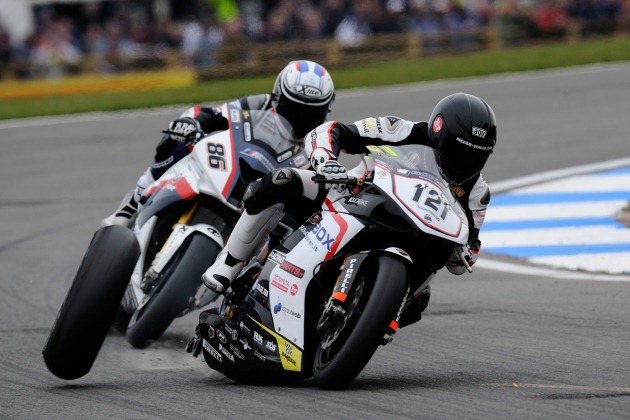
Yes, really. Is using both hands that unusual? I've read many times that others do that too. It's very natural on dirt/SM/ADV bikes with wide bars, but I did that on sport bikes too.
Do you have a mental image when you counter-steer?
Like Tom and Robert said: counter steering isn't something I'm focused on at all. Like, almost never. I'm absolutely using bar pressure when at (lower) street pace, but I also realize my perspective on CS is different from around-town riding. 90% (or more) of my annual riding is @ a track environmentn running at pace. My corners, I'm focused on brake pressure, turn-in point, and when I can pick up the throttle. I'm not even focused on body shifting, which happens automatically. Now...all that tends to go to shit when I get in a chase battle.
Around town, yeah, my hands are moving with the bars, but I'm not using both at the same time unless it's to balance the bike at slow speeds. Initiating lean at low speeds is a lot easier with weight too, but there's still the resistance at the inside bar to keep the bike from too much steering/ turning.
And you can do both. push on one bar and pull on the other bar.
Truth. However, once there's even a slight degree of lean angle, there will be a large discrepancy in the force on both bars. Yes: pushing on the outside bar will help stand a bike up, but it's far easier to pull the inside bar IME. The outside bar is awkward to use effectively as the inside bar is, for me.
I have had a few races where bars have come loose and I've only has one bar to work with. @ that point, anyone who thinks you can ride without bar pressure learns reality. But, I can get around a track fine with one bar, but when it's the outside bar, it's just super weird cause of where my body's at, etc.
In the classic, left hand on hip-headed for Starbuck's pose, doesn't that rider alternate between pushing and pulling the right grip to wend his way through traffic?

Brakes and weight will make do too. Once again, this conversation has me realizing that riders may not be aware when they're "pushing" and when they're "resisting". There's a difference, IMO. Pushing to me, implies the initiation of lean. Resisting means added lean, but it also equates to holding a certain arc (so long as we're not accelerating).
I also use inside and outside bars at the same time to counter-steer. Not all the time, but frequently.
As we all know there are two categories of street rider crashes, single-vehicle and multi-vehicle. For single-vehicle crashes, the most common reason is running wide in a turn (failure to counter-steer). For multi-vehicle it is the failure to avoid the vehicle that violates the motorcycles path (failure to counter-steer). Both of these instances the rider is generally in panic mode. When in panic mode they revert to attempting to change direction by leaning their body, attempting to push the motorcycle sideways, or turning the front wheel in the direction of the turn(direct steering). Obviously none of these work. Its in these panic situations, when lizard brain takes over, the rider needs to have counter-steering embedded in their brain. For most people that means learning and actively practicing it until it is subconscious and muscle-memory. It is uncommon for a rider to counter-steer subconsciously in an emergency / panic situation without prior training (formal or self).
Counter-steering is the quickest way to adjust motorcycle lean / adjust path of travel.
These must all be fairly new or low time (annually) riders. I question that failure to counter steer is the primary reason for lane violations given many new and inexperienced riders fear actual lean angle. I believe those riders are purposely NOT counter steering. I'd pick elevated speed, poor eye placement and fear of lean angle. Also, i've always felt that by not explaining what happens after counter steering, riders continue to fight the subsequent steering phase. If riders understood (and experienced) that by stopping countersteering, they then stop increasing lean angle. Above all: eyes first. Experienced riders tend to not have emergency situations because they're experienced in spotting problems before they fully form. Application of brakes is the most common manner in which to avoid accidents (aside from getting ass-packed). Hmmmm...now I'm thinking of a survey thread.
Good discussion anyway and always, thanks T.
Since when has running wide in a turn become equated with failure to counter-steer??
How about target fixation? Failure to look all the way through the turn? Or not trusting your tires to maintain traction at high lean angle?
Enchanter is pretty much correct. The most common reason for running wide in a turn is insufficient counter steering. Motorcycles are capable of much greater lean angles than what the average rider ever attains. One must get over the fear of really leaning the bike.
Of course, there are other factors that result in running wide but in the vast majority of cases, running wide can be avoided by simply counter steering more which will tighten up the bikes turning radius which results in an increased lean angle.
I think Tom hit the nail on the head. New and low time riders fear lean angle. They fear "grip issues" and don't trust what happens at increased lean angles. We all know, the secret to having less lean angle and still have steering is body placement.
Since the focus of this thread is on counter-steering.
You can do all the other stuff right - vision, anticipation, brake, etc., but what happens when you cannot steer effectively?
Vision, brakes, body position are all parts of the system that steer a motorcycle. Bar pressure too.