• There has been a recent cluster of spammers accessing BARFer accounts and posting spam. To safeguard your account, please consider changing your password. It would be even better to take the additional step of enabling 2 Factor Authentication (2FA) on your BARF account. Read more here.

California becomes first US state to set efficiency rules for replacement tires

OE tires matter because they are the standard tire set for the CAFE test, yet consumers don't replace their tires with the CAFE test in mind. Consumers are price sensitive. OE tires have lower production runs which drives their cost basis higher. CA spec tires (with the proposal) will have lower production runs than current replacement tires, given the market size for CA vs. national. Production of "special" tires is a less efficient process than "standard" tires, etc. Ergo: higher production costs. I don't see limited runs as anything but inefficient, WRT to "cheaper product". The consumer will take on the cost for special tires, or costs will be spread across all NA tires, which I don't see happening...but I could be wrong. CA may be just that valuable of a market....discounting CA's disdain for ICE, etc. I suspect CA may think they can wag to the dog and push manufactures to offer CA tires solely in NA. Perhaps.
 
OE tires matter because they are the standard tire set for the CAFE test, yet consumers don't replace their tires with the CAFE test in mind. Consumers are price sensitive. OE tires have lower production runs which drives their cost basis higher. CA spec tires (with the proposal) will have lower production runs than current replacement tires, given the market size for CA vs. national. Production of "special" tires is a less efficient process than "standard" tires, etc. Ergo: higher production costs. I don't see limited runs as anything but inefficient, WRT to "cheaper product". The consumer will take on the cost for special tires, or costs will be spread across all NA tires, which I don't see happening...but I could be wrong. CA may be just that valuable of a market....discounting CA's disdain for ICE, etc. I suspect CA may think they can wag to the dog and push manufactures to offer CA tires solely in NA. Perhaps.
The CAFE standard is bordering on off-topic. It doesn’t even measure the same thing as the CEC reg (mpg vs force of rolling resistance). It’s prob not a good indicator of passing CEC, esp given that it’s an avg across vehicles of a given brand.

Why are you assuming special CA tires will exist? Do you know which current segments fail the regs? Do you know how many segments will fail, creating that need?

I wonder if it’s safe to assume Arizonian and Sentury tires will need to produce CA specials. Ehh, maybe those subsidiary brands will just leave CA entirely. Does Cooper-Goodyear care enough about Arizonian sales to improve the product? Or maybe they aren’t THAT shit and they’ll actually pass the Phase1 limit 🤷‍♂️.

If I had to guess, I bet some brands will produce a CA special. Some brands will leave CA. And the majority of brands won’t do either.
 
Agree with your last line. I see that being the reality too.
 
The CAFE standard is bordering on off-topic. It doesn’t even measure the same thing as the CEC reg (mpg vs force of rolling resistance). It’s prob not a good indicator of passing CEC, esp given that it’s an avg across vehicles of a given brand.

Why are you assuming special CA tires will exist? Do you know which current segments fail the regs? Do you know how many segments will fail, creating that need?

I wonder if it’s safe to assume Arizonian and Sentury tires will need to produce CA specials. Ehh, maybe those subsidiary brands will just leave CA entirely. Does Cooper-Goodyear care enough about Arizonian sales to improve the product? Or maybe they aren’t THAT shit and they’ll actually pass the Phase1 limit 🤷‍♂️.

If I had to guess, I bet some brands will produce a CA special. Some brands will leave CA. And the majority of brands won’t do either.
Just pointing out that your gas issues probably started out this exact same way and the tires will probably wind up doing something similar.
 
The State's batting average on how things meant to "help" us often end up costing us financially is pretty darned high.

Cutting the legs from under "at home solar" while simultaneously pushing "electrification" is just one of them.
 
To clarify, again; OE tires may be different in composition (and most are) than the same model number tire sold through non OEM distribution.
Case in point: Goodyear makes a tire called a "Wrangler". Ford signed a contract with Goodyear to provide said Wrangler tires as OEM tires on their Broncos. Ford then told Goodyear to produce those tires WITHOUT the Wrangler name molded into the sidewall - so now Goodyear produces labelled and non-labelled versions of the Wrangler tire.
 
the ~$2+ discrepancy between what you pay per gallon versus the rest of the USA. I can see the tire situation going the same route pretty easily especially as the requirements for efficiency go up
When CA passed the new gas requirements, did that gas already exist? Was it already produced by refineries across the country? I’d bet the answer is ‘no’. This source says that only a few refineries across the country can even make the CA blend.

I don’t think the situations are comparable. Some unknown quantity of tires that you can already buy today will pass the new regs and people out of CA will continue to buy them.

I agree that things will change more for Phase2. I won’t be surprised if Phase1 was designed to be non-disruptive and Phase2 is the disrupting one.
 
Truth is consumers will not save $$ on this. The tires will cost more and negate any fraction of a percentage in longevity. High wear tires like 500AA will likely be considered too environmentally unfriendly. I bet the CA approved tires will have a lower wear rating but be considered more environmentally friendly in the after use.

That's the thing many aren't thinking about. How CA spins this. They could be trying to backdoor the idea that the new tires are better for the environment POST life meaning they break down better in landfills or something like that or they put off less pollution during use. So nothing that improves the economical use of the tires which would save consumers $$. Therefore, consumers will be buying and paying a premium for environmental and eco reasons that should be a choice not a mandate. Also it's not quantifiable.
 
Still no mention about the greening of "rubber dust".
This has to be the REAL reason for Ca. tires, not so much tire life, but how fast they wear, & pollute.
Just how sticky, a tire could be, as fertilizer, , ,
Semi's to e-bikes, fertilizing tires !
 
Tire dust is actually the #1 biggest source of microplastic release into the environment. Along with a tire additive called 6PPD-quinone which has been linked to Parkinson's. My best advice is, avoid running/jogging along a busy street. :ROFLMAO:
 
Tire dust is actually the #1 biggest source of microplastic release into the environment. Along with a tire additive called 6PPD-quinone which has been linked to Parkinson's. My best advice is, avoid running/jogging along a busy street. :ROFLMAO:
It's crazy how imbedded car culture is in this country. A true marketing masterstroke.
 
Truth is consumers will not save $$ on this. The tires will cost more and negate any fraction of a percentage in longevity. High wear tires like 500AA will likely be considered too environmentally unfriendly. I bet the CA approved tires will have a lower wear rating but be considered more environmentally friendly in the after use.

That's the thing many aren't thinking about. How CA spins this. They could be trying to backdoor the idea that the new tires are better for the environment POST life meaning they break down better in landfills or something like that or they put off less pollution during use. So nothing that improves the economical use of the tires which would save consumers $$. Therefore, consumers will be buying and paying a premium for environmental and eco reasons that should be a choice not a mandate. Also it's not quantifiable.
You should read the report. The cost savings estimate is attributed only to gas saved.

Tread Wear rating is not part of these new regs in a meaningful way - it’s not something that will be regulated or mandated or whatever. It is an explicit requirement of the regs to “not adversely affect avg tire life”.

Long life (1000-1399 tread rating) and ultra long life (1400+) are allowed to roll slightly slower than normal car tires. But it’s not like those tires are common.
 
I missed the part where the state pays us if we run tires more efficient that required? Oh wait- I see it now, it goes to Newsom's campaign war chest.
 
As I recall from my dealership days (prior to 2014), the OE LRR tires on hybrids were only lasting about 25k miles. Most people were pissed and replaced them with non-LRR tires at the first change. But perhaps they've improved since then.
 
Last edited:
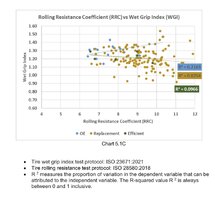
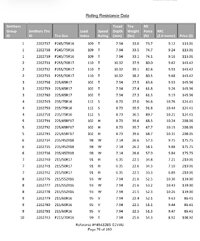
Oooo I found the test data.


Look like the CEC had the whole tire market evaluated. Here’s 3 of the like 50 charts in the report. Remember, the limit for car tires for Phase1 is 9.

IMG_6482.jpegIMG_6481.jpeg
IMG_6480.jpeg
 
Back
Top