• There has been a recent cluster of spammers accessing BARFer accounts and posting spam. To safeguard your account, please consider changing your password. It would be even better to take the additional step of enabling 2 Factor Authentication (2FA) on your BARF account. Read more here.

Five valve heads for dummies ...

Joined
Nov 30, 2010
Location
San Francisco, 94102
Moto(s)
KLR, K75s, TR7V, FXSB
Name
John A.
BARF perks
AMA #2917550
54578


... like to lurk in Garage threads because I usually
learn something and recently augustiron taught me
that WR450s have a five valve head ...

... was wondering how the intake cam opens
three valves and what the geometry is ...
hard to picture 90 deg angles between
the camshaft and valve stem like on
OHC four valve singles with shim-over-bucket
designs ...

... I was a little surprised by the WR’s
head because I thought the world had moved
on from five valve heads ... :dunno

Kevin Cameron has this to say
about five valve heads (he’s talking about
ignition timing in relation to the crank, not valve geometry):
https://www.cycleworld.com/what-is-truth-about-yamahas-genesis-motorcycle-engine

Saying a cylinder head “has potential” is what you say
for public consumption when it doesn’t. Otherwise, why did
Yamaha’s chief problem-solver, Masao Furusawa, offer Valentino Rossi
four different testbikes before the 2004 season? Two had five-valve heads,
two had four-valvers, and both 180-degree-firing and 90-degree-firing cranks
were offered. Rossi liked best and went quickest on the four-valve 90-degree
engine, and it was on an M1 of that type that he won the championship
that year.

To my knowledge, no one has used a five-valve in MotoGP since.
Yamaha's R1 1,000cc production sportbike was itself converted from
five valves to four valves, which it now features.

... just interested in the engineering problem
regarding opening and closing the valves
in a five valve head that Yamaha solved
with the Genesis and similar designs ... :dunno

Mr. Cameron goes on to say some
interesting things about the
trade-offs regarding power and compression ratios
when trying to build a five valve engines ... :ride
 
Last edited:

Junkie posted this pic of the top of his WR head
to show that the WR does not use some sort of follower
to deal with camshaft/valvestem geometry ... I thought
a follower might be used to reach from the cam to
the middle intake valve ...

... the two pics here sort of demonstrates what I’m
trying to imagine, which is how the three intake valve stems
radiate up from the combustion chamber and
meet back to the single intake camshaft ... ?
 
Last edited:
not my pic or head, just one I found looking for heads on ebay

Yamaha 4 strokes were 5 valve for quite a while: YZ250F 01-13, YZ400F/YZ426F/YZ450F 98-09, WR400F/WR426F/WR450F 98-15

The R1 was 5 valve (per cylinder) 00-06 too, and plenty of other bikes.

There's a shim and bucket missing from that picture, here's one that shows them - the cams have no followers, they just press on the buckets

s-l1600.jpg
 
  • Wow
Reactions: mjj
Three lobes on the intake cam, two on the exhaust. The guide of the middle intake valve sits at a different angle than the two flanking it. Sounds complicated but once you see a diagram it all makes sense. :eboy

Yamaha experimented with 6 and even 7 valves, but concluded that the benefits of increasing numbers of valves actually decrease after five-valves-per-cylinder.

fRimKDr.jpg
 
... wow, those six and seven valve pics are fun! :party

... the only angle I can imagine for the
middle valve has the valve seat angling
away from the center of the combustion chamber ...
unless the middle lobe on the intake cam
is ground very different from the outside
lobes?

... fun to try to imagine how
they figured out grinding the
intake cam profiles if they
solved the intake valve train geometry
by using different cam lobes ...

Edit: I guess I can see in the bottom pic
that the intake seats have different
angles (or planes), with the middle seat being flatter
in relation to to piston ... and see it
in Junkie’s pic, too ...

... kind of gets to Mr Cameron’s
points about issues with the shape
of the combustion chamber regarding
how the intake charge burns and
what compression ratios are ultimately available
with a five valve design ... :dunno

also fun to think about how a single for
the dirt may work better within those
combustion chamber limitations than
a multi-cylinder street bike engine ...

I like Yamaha as an engineering company
and don’t imagine they’d have used a five valve
design for as long as Junkie points out
unless it was successful ...
 
Last edited:
The only angle I can imagine for the
middle valve has the valve seat angling
away from the center of the combustion chamber ...
unless the middle lobe on the intake cam
is ground very different from the outside
lobes?

Looks like the middle lobe on the aftermarket version of the intake cam for a Yamaha YZ450F has slightly different timing (judging from the reflection), compared to #1 & #3 lobes.

XH9Hc3s.jpg


A typical Genesis 4-cylinder Yammy appears to have identical lobe shapes across all three (top cam in this pic below).

SElcGax.jpg
 
One American builder who had a lot of experience
with the FZ, Steve Johnson, told me with the five-valve the builder
had a difficult choice.

If he wanted strong acceleration, he could raise the compression,
but because that slowed combustion on top-end, peak power was poor.

If he built the engine for peak power, with a combustion chamber
open enough for combustion-accelerating turbulence to persist
all the way through combustion at peak revs, its lower compression
ratio reduced acceleration.

In his experience, the advantages of the
two could not be combined.

... always fun to think about
the trade offs an engine builder
has to make ... :party

... I seem to recall that Ferrari
licensed a Yamaha five valve design
for one of their engines ...? That
would certainly be a top end application ... :laughing
 
Last edited:
Looks like the middle lobe on the aftermarket version of the intake cam for a Yamaha YZ450F has slightly different timing (judging from the reflection), compared to #1 & #3 lobes.

XH9Hc3s.jpg


A typical Genesis 4-cylinder Yammy appears to have identical lobe shapes across all three (top cam in this pic below).

SElcGax.jpg

... ha, that is cool! :ride

... guess an engine builder
could not “degree the cams” and
move the power around with the WR, the
way they are able to do
with more traditional engines ...?

... may be why there seem to be so many
WR aftermarket cam choices for the WR ... :dunno
 
Last edited:
and if you ever pull those intake valves out, don't get them mixed up. The center is longer than the other two
don't ask how I know :laughing
 
and if you ever pull those intake valves out, don't get them mixed up. The center is longer than the other two
don't ask how I know :laughing

:laughing:thumbup

5vlvhd.jpg


... found an interesting patent application that--I think--
deals with the concept I'm trying to get my head around,
which is the different planes the valve seats are on if
the three intake valve stems wind up being in a line
under the intake camshaft (and where the stems have to be different
lengths, as in 89fj's example ... in order to compensate for
the intake valves radiating down from the centerline of the intake cam) ...

I think in this patent application the rocker arm set-up
allows the three intake valves to be similar ... :dunno
... looks like the rocker arms allow the tops of the valve stems
to be offset from the center line of the camshaft, the two
outside valves on one side of the cam and the middle valve on
the other side of the cam ...?

... notice that on the intake cam the middle intake
rocker set up is reversed from the outside two intake valves ...


... here the patent application
is talking about Yamaha's solution (I think):

... the axis of the third inlet valve is inclined
to the plane containing the axes of the other
two inlet valves so that the three upper ends
of the stems of the three inlet valves are aligned
with each other and can be operated by the camshaft.

This conventional solution has the disadvantage
that it requires more complex working. Moreover,
the configuration of the inclined surface portion,
which constitutes part of the top of the
combustion chamber, is quite complex and irregular
since the surface must be perpendicular to the
valve axis in correspondence with each of the
three inlet valves
(whose axes are not all parallel).

... I think the "working" the patent app is talking
about is the machining of the head to deal with the
different intake valve seat planes (the two outside being
on a different plane from the middle valve seat) ...?

... the patent app goes on to talk about
the planes of the top of the combustion chamber,
noted in the diagram as "1C" ...

... I'm guessing that the top of the
combustion chamber of a Yamaha five valve head
would have a third plane ... one for the exhaust valves, one for
the two outside intake valves and a third for the middle valve seat ...?

Here is the patent application from Fiat, 1989-91:
http://www.google.co.ug/patents/EP0412064A1?cl=en
 
Last edited:
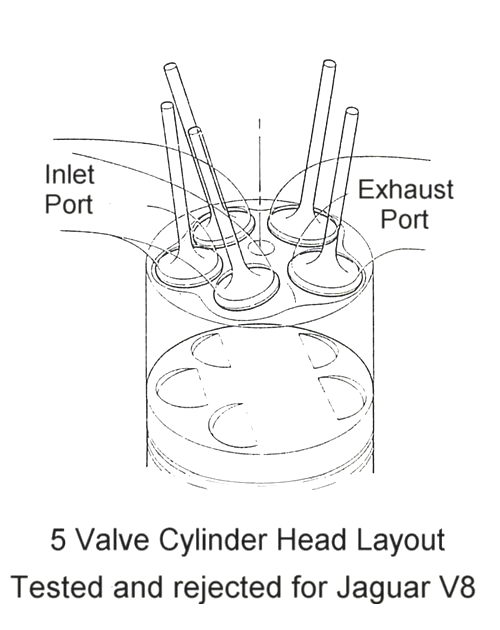
5_valve_head.jpg


Most modern engines use the four valve
layout but as befits a project aiming for
the best solution, Jaguar's engineers also
considered alternative arrangements
like the five valve configuration used so
successfully by Yamaha on their
high performance motor cycle engines.

No real advantage could be found
that way so progress continued with
a more conventional four valve layout.

... here's another simple diagram
that sort of shows how I think
Yamaha solved the three intake
valve engineering problem ...
with the three intake valve seats
being on two different planes and with the valve
stems reaching up to form a line under the
camshaft ...? ... shows how the three intake valve
stems are not parallel with each other ...

http://www.jagweb.com/aj6eng/v8_performance.php
 
Last edited:
5vlvhd2.jpg


... here's another diagram from
the patent app that shows
the intake valve stems parallel
with each other, and
the tops of the valve stems
offset from the center line of the cams,
thanks to the rocker arms ... :ride

... also shows the two planes
that form the top of the combustion chamber ...
the patent app refers to the planes as "1B" and "1C" ...

... I think Peugeot solved the five valve
engineering problem in 1921 using three camshafts ...
trying to find a diagram of that set up ... :laughing
 
Last edited:
Yamaha used 5 valves head starting on what, the 1985 FZ750? And ending with the 2015 WR450F? (Really ended when the YZ450F went to 4 valves but the WR gets hand-me-down tech for a couple years.)

They had a good run but it's extra complexity that is not needed.
 
Yamaha used 5 valves head starting on what, the 1985 FZ750? And ending with the 2015 WR450F? (Really ended when the YZ450F went to 4 valves but the WR gets hand-me-down tech for a couple years.)

They had a good run but it's extra complexity that is not needed.

Yes, always loved Yamaha ... tuning forks! :laughing

jonah1.jpg


... here's a WR450 with a JVO kit that Jonah Street raced at
Dakar in 2011 ... guess the JVO kit was $12k back in the day ...

... always liked the WR because you could plate some of
them in California ... surprised I didn't remember the
five valve head ... must have known that at some point ... :rolleyes

... more Jonah WR pics from a Dakar send-off party in Dec., 2010:
https://caryandjohn.wordpress.com/2010/12/20/jonah-street-sendoff-party/

[YOUTUBE]LsjFoOif7yQ[/YOUTUBE]

:party
 
Last edited:
Re-shimming my brother's FZ750 on almost all 20 valves was crazy back then.
It pulled a huge wheelie on the test ride :laughing
My FZ1 never needed adjustment even after 100K miles, weird
 
7c9c79c2f709835d35687c802e0eb830--endurance-daytona.jpg


Lawson08_l.jpg


Eddie Lawson won the 1986 Daytona 500 on a FZ750 ...:ride

77d556_d8176812b77d4be687bd424f33adc7a3.jpg


Audi A4 head ... read Audi made a five cylinder 25 valve experamental
engine ... :ride

[YOUTUBE]ZJn2g8Nt6Vs[/YOUTUBE]

Audi TT (8N)

For some, the Audi TT is the true home of the 1.8 20V turbo. Every state of tune of the venerable 20V turbo was available in the TT, but it was the only car in Volkswagen Group to get the most powerful version of the engine.

The 240PS (yes, that's 133PS per litre!) TT quattro Sport (also known as the TT Club Sport) was a limited edition monster that could hit 0-62 in under six seconds and was the final hurrah for a car that helped propel Audi to the stratosphere.

16 cars that use the VAG 1.8 20v turbo engine
 
Last edited:
old yamaha ad slogan,
"when you know how they're built"
:afm199
 
AFAIK none of the 5 valve WRs were street emissions compliant. Yes, some have plates, but mine would be a red sticker bike if it wasn't plated.
 
old yamaha ad slogan,
"when you know how they're built"
:afm199

:thumbup:laughing

here's a couple more interesting
Yamaha patent diagrams ...

5vlvd3.jpg


... thought this diagram was fun
because you can see that in this
Yamaha design that the two outside
intake valves are set a more acute
angle than 90 degrees to the camshaft ...
it also shows the two planes of the intake
valve seats ...

... this one also speaks to simplifying
the manufacturing process ... design
does away with the moving parts of rocker arms
and utilizes tappets set in the head casting ...

http://www.google.com.pg/patents/US5685265


5vlvd4.jpg


Here's a Yamaha patent diagram for a single overhead cam
for a five-valve cylinder ...

https://www.google.com.pg/patents/US5163390
 
Last edited:
Back
Top