• There has been a recent cluster of spammers accessing BARFer accounts and posting spam. To safeguard your account, please consider changing your password. It would be even better to take the additional step of enabling 2 Factor Authentication (2FA) on your BARF account. Read more here.

pge liable for camp fire?

Are metal roofs effective at all in slowing down wild fires near populated areas? I

 
There's no water shortage for fire fighting that I am aware of. WUI fires aren't typically fought with water, it's used to control spread and hot spots. You can't put out forest fires with water, there's no way to deliver that much. You surround them with lines the fire can't cross and they burn out. That's my experience anyway.

Yes, but in cities.....And I was responding to Berto's insane comment.
 
Are metal roofs effective at all in slowing down wild fires near populated areas? I

It's the eaves. Metal roof and cement siding is great, but fires will always sneak in through the eaves.
 
I have a great story on that one. Back in the early seventies I did some water development in Big Sur, including a water tank that fed two homes, and pump for it. It was sized for daily needs. Not for wildfire protection, which would have been twenty times the size.

One of the owners put on rooftop sprinklers, turned them on, and left her home. Of course the tank drained dry, and the other home burned to the ground as it had no water at all.

Funny story. Our house in PA has a 30,000 gallon railroad buried in the front yard (it's a large parcel by CA standards). In the summer(s) in drought years, the fire dept "borrows" water and puts it back in the fall/ spring. Maybe we've got a new business!

WTF Berto? Did you think this through before you hit submit reply? Have you had your coffee yet?


Sprinklers were not mandated for forest fires. They are for when someone falls asleep while smoking and their house catches. However, these sprinklers could definitely stop the single house fire from spreading to nearby homes.

Regarding landscaping. Most new landscaping is drought tolerant. This means stuff like rock gardens and succulents, not dry trees and dead tall grass. Less water for landscaping means more water for firefighters. And drought tolerant landscaping is less likely to burn than your yard full of lovely trees and shrubs.


I can't tell if you are joking or high.

Not a big druggie, Mike...but, I'm not joking (and I know the reasons for the sprinkers...but don't agree with the effectiveness); how many house fires (smokers) have we had that led to massive (or even moderate) destruction in CA and how many wildfires have we had? Instead of the $10K for a fire system in a residential unit, how about adding that into a wildfire/ mass fire fund...just tax new homes already. If they're gonna do it, at least be effective.

As Ernie said...I've not heard water is a problem. The fuel of a dry state seems to overwhelm a land based fire force. Do you have different info?

Are metal roofs effective at all in slowing down wild fires near populated areas? I

Intersting question...
 
Wildfires can reach 1400 degrees. If they encroach on a home ( again, WUI fires are by definition fires that do encroach) they will dump thousand of kilowatts per meter, which basically mean that if there's something flammable under the metal roof, it will burn. The plastic window frames will burn, the wood siding will burn, and anything else flammable will burn. Even a concrete building will lose windows due to thermal expansion and the heat will get inside.

I don't think city fires reach anywhere near the level of heat that WUI fires do. WUI fires generate intense heat for long enough periods of time to set anything flammable on fire pretty quickly.
 
If your estate is surrounded by a giant green lawn then I’d agree it is buffered from wildfire. But yeah, the purpose of the sprinklers mandated by code is to prevent internal fires, not external ones. The idea of affordable scalable exterior suppression systems is something best considered with a slice of cake. The consensus is that we’ve got the wildfire damage because of increasingly dry conditions and sprawl into high risk areas. I would be fine letting localities have control of their fire codes, but I don’t see how it has much to do with wildfires.

As for all the blamestorming on PG&E, it just doesn’t matter. Bailout or bankruptcy, we pay either way. This is the perfect example of why corporate (unlimited) liability is a poor control over public safety. If we have any free market levers to turn it should be assigning the true costs on property owners for the expense of living in high risk areas.
 
Last edited:
While a metal roof and siding that won't burn certainly doesn't absolutely protect the house from fires, I suspect there's some advantage in that it's less likely to catch from fires that don't get right to it
 
If your estate is surrounded by a giant green lawn then I’d agree it is buffered from wildfire. But yeah, the purpose of the sprinklers mandated by code is to prevent internal fires, not external ones. The idea of affordable scalable exterior suppression systems is something best considered with a slice of cake. The consensus is that we’ve got the wildfire damage because of increasingly dry conditions and sprawl into high risk areas. I would be fine letting localities have control of their fire codes, but I don’t see how it has much to do with wildfires.

As for all the blamestorming on PG&E, it just doesn’t matter. Bailout or bankruptcy, we pay either way. This is the perfect example of why corporate (unlimited) liability is a poor control over public safety. If we have any free market levers to turn it should be assigning the true costs on property owners for the expense of living in high risk areas.

Indeed. Oakland is ripe for another fire similar to the one thirty years ago. The new homes are surrounded by trees and shrubbery, most property owners are not keeping a fire barrier, and it will happen again.
 
PGE should burn to the ground like the communities it served (or neglected to serve). Utilities should be public not corporate. This state can and should produce its own power. Ratepayers have been hostage to many a corporate schemes for decades. Fuck PGE, period.
 
PGE should burn to the ground like the communities it served (or neglected to serve). Utilities should be public not corporate. This state can and should produce its own power. Ratepayers have been hostage to many a corporate schemes for decades. Fuck PGE, period.

y u hate capitalism?
 
I had the best electric and water prices and service when I was in the IE. Both were run by the city.
 
Wildfires can reach 1400 degrees. If they encroach on a home ( again, WUI fires are by definition fires that do encroach) they will dump thousand of kilowatts per meter, which basically mean that if there's something flammable under the metal roof, it will burn. The plastic window frames will burn, the wood siding will burn, and anything else flammable will burn. Even a concrete building will lose windows due to thermal expansion and the heat will get inside.

I don't think city fires reach anywhere near the level of heat that WUI fires do. WUI fires generate intense heat for long enough periods of time to set anything flammable on fire pretty quickly.

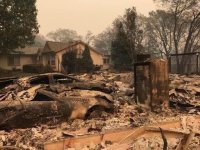
Hey Ernie, No argument that heat alone can cause a flashover and ignite a structure. What I don't understand, and I don't think anyone does really, is how this happens. This is what remains of my father in laws home. Be sure to note the house next door. How come it is intact? My wild ass guess is embers, not heat, ignited my father in laws house. I think a metal roof or siding may help, not eliminate, slowing fire propagation in a developed area. Wish there was a cheap way to test that.
 

Attachments

  • paradise house.jpg
    paradise house.jpg
    53.2 KB · Views: 60
Hey Ernie, No argument that heat alone can cause a flashover and ignite a structure. What I don't understand, and I don't think anyone does really, is how this happens. This is what remains of my father in laws home. Be sure to note the house next door. How come it is intact? My wild ass guess is embers, not heat, ignited my father in laws house. I think a metal roof or siding may help, not eliminate, slowing fire propagation in a developed area. Wish there was a cheap way to test that.

Yup. There are currently some very fire resistant roofing materials, such as CeDur composite shingles, that withstand 1400 degrees.

Did you father in law have shake shingles? They are notorious for spreading fires.
 
Yup. There are currently some very fire resistant roofing materials, such as CeDur composite shingles, that withstand 1400 degrees.

Did you father in law have shake shingles? They are notorious for spreading fires.

I think they were asphalt. The development they lived in had a very restrictive HOA and all the houses had to be essentially the same externally. Paint, windows, doors etc had to all be approved by the board and they liked uniformity. It is hard to make out but the surviving neighbors hose looks like an asphalt shingle to me.
 
Hey Ernie, No argument that heat alone can cause a flashover and ignite a structure. What I don't understand, and I don't think anyone does really, is how this happens. This is what remains of my father in laws home. Be sure to note the house next door. How come it is intact? My wild ass guess is embers, not heat, ignited my father in laws house. I think a metal roof or siding may help, not eliminate, slowing fire propagation in a developed area. Wish there was a cheap way to test that.

1 cheap improvement you can make is to put very fine metal mesh screens over your attic/basement vents. The standard hardware cloth is meant to keep out rodents, not embers. You can replace with fine cloth that keeps out embers, and may be the reason why the other house still stands.
 
Last edited:
Hey Ernie, No argument that heat alone can cause a flashover and ignite a structure. What I don't understand, and I don't think anyone does really, is how this happens. This is what remains of my father in laws home. Be sure to note the house next door. How come it is intact? My wild ass guess is embers, not heat, ignited my father in laws house. I think a metal roof or siding may help, not eliminate, slowing fire propagation in a developed area. Wish there was a cheap way to test that.
Have you ever cooked things like bread sticks or marshmallows on a camp fire? Did you notice the wide variation of temperatures depending on where you put them?

It would be a complex system of burnable materials, direction and intensity of wind and a variety of other factors that could make temperatures and duration vary wildly between two houses near each other.
 
we already found the formula for fire proofing eggs
[youtube]RxqFyDugqs4[/youtube]

why not paint it on all the homes?
 
Back
Top