• There has been a recent cluster of spammers accessing BARFer accounts and posting spam. To safeguard your account, please consider changing your password. It would be even better to take the additional step of enabling 2 Factor Authentication (2FA) on your BARF account. Read more here.

Slow speed practice, no experts please

Status
Not open for further replies.
You know--I just recieved notice that one of my High School students took thier own life.

And I'm reading your infantile bullshit and...you're..really...not...as...important...as you want to be.

I tired of making you important, and making you more important than you are. You're a gadfly. And a poor one at that.

I have more important things to do.
 
Last edited:
I could have said slow ride practice seems to help at all my speeds and all my maneuvers. The bike is always changing lean angles, it's aways grabing or giving up a little traction.
Practicing correctly helps. You draw conclusions that more skilled riders disagree with and sthen stand firm that you are correct.

I'm noticing my ability to control the bike has everything to do with what I can feel. If I can't feel it I can't do it.
Bummer that you limit yourself to what you can feel. Your focus seems to misdirected.

Slow riding seems to be a useful core exercise that you never out grow. I envy the balancing abilities of the trials riders.
It can be useful at low speeds, but once above 15-20mph, the balance skill of the rider are a miniscule part of the skill required to ride. That is a big problem with your practice.
Which begs the question of what particular skill deficiencies.
Judgment. Not looking far enough ahead. Relying on body position to control lean. Fear/panic.

In practice I've been exploring rear wheel traction, how to increase and decrease it and I'm impressed by how little effort it takes to unhook the rear by subtle changes in power, weight distribution, roll rate, etc.
This is a skill, but not one that is useful outside of a controlled environment (parking lot, racetrack, dirt riding area).

Driving a car is valid experience for situation awareness but it is zero preparation for the skills needed to maneuver a motorcycle anywhere near it's potential.
You couldn't be more wrong. The input to the controls may be different in a couple of areas, but everything else is the same. Look well ahead, complete your braking before turning, accelerate through the turn. Path of travel is the same, where to look when turning is the same, smooth control input is the same.

When you invoke your "dangerous" argument you step over the line. Riding a motorcycle is not a religion and you are not a priest. I could be right, I could be wrong. Understanding is crucial to proficiency on a bike. Blind following undermines that. If you want to disagree do it on the merits, not with logical fallicies, ie.
The irony of you asking someone to give up logical fallacies is sad. These fallacies are a large part of what you teach yourself and share here.

Practicing it isn't a panacea, just a very useful lesson.
Only if doing it correctly and properly interpreting the results.

 
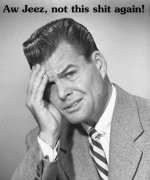
notagain.jpg

Can't we just let this die already. Every angle has been explored to death by everyone. The bottom line is he is going to do what he is going to do right or wrong and he doesn't want to hear anything that doesn't fit into his little world.

Just say NO to posting in this thread.

LET IT DIE DIE DIE DIE DIE DIE DIE DIE!!!!!!!
 
^ thank you

for fux sake people, if you just stop responding to him, he will stop posting, it's really that simple

/thread
 
How about the Mods just lock the fucking thing? :dunno

258troll_spray.jpg
 
Tim (Enchanter) please do teh needful. :|

I don't see how this can be discussed constructively at any length anymore.
 
Tim (Enchanter) please do teh needful. :|

I don't see how this can be discussed constructively at any length anymore.

Upon locking of this thread, $20 says beginner starts another "practice" thread.:rolleyes
 
I finally looked at this thread. 8s worn into asphalt by DS tire rubber... 5mph rear-tire slides... this is classic. :rofl

Successful Troll is successful!
 
Today's first practice was interesting for a couple reasons. It occured to me the police rodeo style riding is mostly about maneuvering to the inside of cones. The gymkhana riders mostly maneuver around the outside of cones. When police riders do figure 8s they practice in a box, try to stay in a confined area. When gymkhana riders do figure 8s they drive around two cones as quickly as possible with no outside boundaries. If I was a motor policeman my biggest dread would be hitting a pedestrian. That would keep me practicing.

Here's the only example of a motor policeman doing a figure 8 I've been able to find. The figure 8 starts at 1:25 in the video http://www.youtube.com/watch?v=N0zF6SBAjGM&feature=channel_page Notice the rider is sitting up, his outside arm is mostly extended and he's counter balancing effectively. When I sit up and keep the outside arm extended my slow turns are better.

Last summer I tried the gymkhana style figure 8 and decided I wasn't ready. I tried it again today and decided it's time to work it in to the routine. I think the change is I'm more comfortable with the traction issues. Here is the gymkhana-outside-the-cones version. http://www.youtube.com/watch?v=c3a1wLiaO0s Notice how the rider leans forward during the acceleration then sits up for the turn. You can also see the outside arm extended, same as with the motor policeman in the other video.

Crash, sorry to hear about the human tragedies you're dealing with lately.
 
Gymkhana sounds like some kind of dirty-ass Japanese sex video.
 
"place it on it's side and it's a symbol meaning infinity" <-- pretty much sums up this thread. :laughing


[youtube]Jeq5a8bBh8c[/youtube]


Oh, and to be on topic, I do offset cone weaves, eliminator and 40mph decel patterns in the parking lot.
 
Last edited:
If I was a motor policeman my biggest dread would be hitting a pedestrian.
Yes, because hitting pedestrians is the most persistent danger of being a motor policeman :rolleyes

Here's the only example of a motor policeman doing a figure 8 I've been able to find. The figure 8 starts at 1:25 in the video http://www.youtube.com/watch?v=N0zF6SBAjGM&feature=channel_page Notice the rider is sitting up, his outside arm is mostly extended and he's counter balancing effectively. When I sit up and keep the outside arm extended my slow turns are better.
Why was it important to find an officer doing figure 8s? The technique is the same no matter how many times you're going around. The officer's bike looks a lot different than yours, have you considered that the officer's outside arm might be extended because he has really wide handlebars? If you continue to focus heavily on body position, I think you'll end up missing the key skills for proper (real-world) slow speed maneuvering, which mainly consist of visual skills, and coordinating throttle, clutch, and rear brake use.

Last summer I tried the gymkhana style figure 8 and decided I wasn't ready. I tried it again today and decided it's time to work it in to the routine. I think the change is I'm more comfortable with the traction issues. Here is the gymkhana-outside-the-cones version.
As with any motor skill, it is best to start slowly and gradually work up to speed. My guess is you tried to go faster than your comfort level allowed at the time.
http://www.youtube.com/watch?v=c3a1wLiaO0s Notice how the rider leans forward during the acceleration then sits up for the turn. You can also see the outside arm extended, same as with the motor policeman in the other video.
Again, it seems your focus is on body position. Unless you've got it drastically wrong, spending more time on it probably won't benefit you. You may perceive a benefit, but I doubt it's significant.
 
Last edited:
So is this what you aspire to do in the future?
I'm riding the bike similar to how I rode horses, for the mobility around the farm and the general area and enjoying skills for their own sake. The bike is not as maneverable, versitile, or safe as the horse but it has more endurance and costs less to operate. Most of the enjoyment of riding horses was doing it with skill. The same is true with the bike. Horse training is ring riding (a core exercise is figure 8s). Training on the bike is PLP. I'll borrow intereting techniques from where ever I find them, gymkhana, motor police, trials, dirt. Most of the off road areas I ride are only available from June through the first heavy snows in December. The rest of the year I'll work on skills in the parking lot which was available for 9 months in the past year.
 
Why was it important to find an officer doing figure 8s? The technique is the same no matter how many times you're going around.
The policeman's way of doing figure 8s is distinct and shows a LOT of time spent on that pattern. I learned a lot from it. One of the interesting things about figure 8s on motorcycles is how many distinctive styles you can find. Here are a few I've collected http://www.youtube.com/view_play_list?p=3B2BA3891FCC3769 And an example of what I was doing about a month ago. http://www.youtube.com/watch?v=tLzlZ1DJ6vo
The officer's bike looks a lot different than yours, have you considered that the officer's outside arm might be extended because he has really wide handlebars?
The officiers bike is heavier so it would take more precision and practice to manage lean angle. The longer wheel base might make things harder but that's just a guess. Watch the gymkhana riders, they do the same with the outside arm in turns.
If you continue to focus heavily on body position, I think you'll end up missing the key skills for proper (real-world) slow speed maneuvering, which mainly consist of visual skills, and coordinating throttle, clutch, and rear brake use.
It's a process of constant movement and weight shifting on the bike and there are similarities across various styles of riding. Track racers are another example of constant weight shifting on the bike. Using body weight effectively is so important it should be taught as another one of the controls.
As with any motor skill, it is best to start slowly and gradually work up to speed. My guess is you tried to go faster than your comfort level allowed at the time.
There are things my motor/balance system is ready for and things it's not. Sometimes I test skills to see if I'm ready, if not I stick with more basic stuff. I'm patient.
Again, it seems your focus is on body position. Unless you've got it drastically wrong, spending more time on it probably won't benefit you. You may perceive a benefit, but I doubt it's significant.
Everything counts. Everything that helps control the bike deserves attention. Using body weght effectively is huge and the appears to be true for every style of riding. Shifting body weight effectively seems to be the hardest thing to get consistently right. Throttle might run a close second for the things I do.
 
I'm riding the bike similar to how I rode horses, for the mobility around the farm and the general area and enjoying skills for their own sake. The bike is not as maneverable, versitile, or safe as the horse but it has more endurance and costs less to operate. Most of the enjoyment of riding horses was doing it with skill. The same is true with the bike. Horse training is ring riding (a core exercise is figure 8s). Training on the bike is PLP. I'll borrow intereting techniques from where ever I find them, gymkhana, motor police, trials, dirt. Most of the off road areas I ride are only available from June through the first heavy snows in December. The rest of the year I'll work on skills in the parking lot which was available for 9 months in the past year.

Honestly it was a simple yes or no answer. I did not realize you would go to such lengths to avoid it.
 
The policeman's way of doing figure 8s is distinct and shows a LOT of time spent on that pattern.
It seems like you have a lot of respect for these guys. Have you talked to any motor cops about the technique?

The officiers bike is heavier so it would take more precision and practice to manage lean angle.
How do you think the weight of a bike effects the rider's ability to manage lean angle?

Watch the gymkhana riders, they do the same with the outside arm in turns.It's a process of constant movement and weight shifting on the bike and there are similarities across various styles of riding. Track racers are another example of constant weight shifting on the bike. Using body weight effectively is so important it should be taught as another one of the controls.
As best as you can, would you explain how you think body position effects a motorcycle's handling in a turn?

There are things my motor/balance system is ready for and things it's not. Sometimes I test skills to see if I'm ready, if not I stick with more basic stuff.
How do you determine if you are NOT ready to begin learning a new skill?

I'm patient.Everything counts. Everything that helps control the bike deserves attention.
This is a great attitude! I wish everybody who rode motorcycles was so dedicated. If the over all goal is to be a safe street rider, what skills do you think would be the most important?

Using body weght effectively is huge and the appears to be true for every style of riding. Shifting body weight effectively seems to be the hardest thing to get consistently right. Throttle might run a close second for the things I do.
It seems like you've realized that the throttle is an important control on the motorcycle... do you think there are any controls that are more important than the throttle? If so, please say why.
 
Status
Not open for further replies.
Back
Top